SCOTCAT.COM
your internet guide to all things catfish
FACTSHEETS: March 1997 - no. 004
Corydoras arcuatus Elwin 1939 |
Corydoras
arcuatus Water conditions are of paramount importance on this species as the barbels are very susceptible and can very quickly wear away if the water changes are not adhered to and the bacteria builds up in the substrate, why this species of Corydoras is effected more than any other is a mystery to me. In the following picture you can see the worn down barbels on this species. Sand would probably be a good bet for the bottom of their tank, just a light scattering should suffice.
Corydoras arcuatus
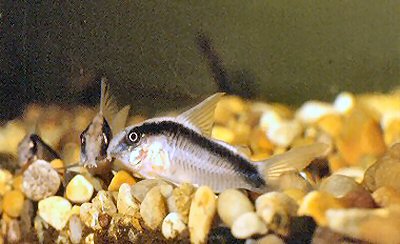
This species is sometimes confused with its longer nosed ‘cousin’ Corydoras narcissus, but the length of the snout is the main difference, and also the stripe in narcissus tends to be longer, running into the lower lobe of the caudal fin. This species was given the CW-number (Corydoras World) of 36 as it had not previously been given a C-number. It is now thought (Grant, S. 2014) that this species, CW036, is the true Corydoras arcuatus instead of the shorter nosed C020.
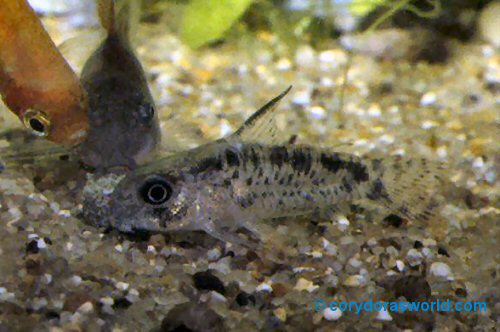
Above is a young speciman, (C020) and as it grows the black spots will join up to show the adult black line. Placed in Lineage 8 sub clade 4 which comprises the "intermediate long-snouts" with deeper bodies. It also includes Brochis in sub-clade 1 which was synonymised with Corydoras by Britto in 2003 but in time there will be a revision which will resurrect Brochis (Cope, 1871) to full genera again. UPDATE: It is now been proven (Grant, S. 2014) that CW036 is the true Corydoras arcuatus instead of C020.
|
 his
member of the Callichthyidae family is a well known
favourite amongst Corydoras lovers. The 'Skunk'
or 'Arched Cory' is sometimes difficult to pick up
in the shops and seems to come and go in periods so
you have to snap them up when seen and of course the
recently unfolding story of the true C. arcuatus
is told below.
his
member of the Callichthyidae family is a well known
favourite amongst Corydoras lovers. The 'Skunk'
or 'Arched Cory' is sometimes difficult to pick up
in the shops and seems to come and go in periods so
you have to snap them up when seen and of course the
recently unfolding story of the true C. arcuatus
is told below.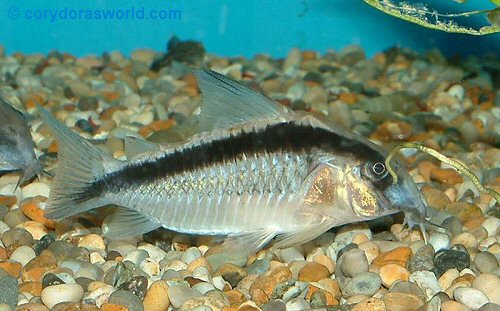
Common Name: |
Skunk Cory, Arched Cory. |
Synonyms: |
None |
Family: |
Callichthyidae |
Subfamily: |
Corydoradinae |
Distribution: |
South America: Brazil, Rio Madeira, Humaita-region. |
Size: |
Male: 7.5 cm (3ins) Female: 8.0cm (3¼ins) |
Temp: |
22-26°C (71-79°F) |
p.H. |
6.5-7.2. |
Characteristics |
Dorsal 1/7; Anal 1/6; 22-24 bony scutes in the upper lateral series, 20-22 in the lower. |
Colouration |
Grey-yellowish to delicate grey-green; underside pure white. A broad, dark longitudinal band commences at the corner of the mouth and passes across the eye into an arched course following the profile of the back to the root of the tail where it turns abruptly downwards and, becoming narrower, continues along the lower edge of the caudal fin. No other markings. Fins colourless; caudal with fine dark spots and a blackish upper edge. |
Aquarium Care & Compatibility |
| Will do well in a community setup with smaller tankmates such as Rasboras and Tetra's. Do not house with aggressive species or large Cichlids. |
Reproduction |
Not one of the easiest cory's to breed, but in one reported spawning a cold water change down to 60f (17c) induces spawning, with the eggs being laid in Java Moss. Eggs will hatch in 3 to 4 days. U.K. Corydoras breeder Ian Fuller of the Corydoras World web site has bred this species in 1980 and reported the usual Cory T-mating clinch fashion. 110 eggs were laid with about 65 of them in the Java moss the remainder were stuck on the sides of the tank mainly in the corners. Temperature was 68f (20c) and the eggs hatched in 3 to 4 days. There was a 95% hatch rate. 30 years later in 2010 In Scotland, aquarist Graham Ramsay has also bred this species. See breeding article on breeding the afore mentioned species C020 here |
Diet |
| After the fry are 3 days old, feed microworm, fry flake then progress on to brineshrimp, keeping up the water changes. Adults can be fed on the usual good quality aquarium flake with tablet food and frozen bloodworm being a good diet. |
Etymology |
| Corydoras:
Cory = helmeted;
doras = leathery skin,(helmeted
Doras) cuirass. |
References |
Lambourne,
Derek,
Corydoras Catfish, An Aquarists Handbook 1995. |
Photo Credits |
© Ian Fuller @ |

|

If you would like to contribute to the monthly factsheets with an
article, information or photos, please e-mail
me. You will of course be credited for your work.
If you would like to donate any denomination of money to the site just click the above link button. All proceeds will go to running the site and hopefully to keep it going for a few years yet.
ScotCat Sources
 Etymology-genera
Etymology-specific
name
Online Sources
 Search
 Fishbase
 Catalog of Fishes
 GBIF
GBIF
 Fishnet2
 iNaturalist

