SCOTCAT.COM
your internet guide to all things catfish
FACTSHEETS: February 2000 - no. 044
Bagrichthys macracanthus Bleeker 1854 |
Bagrichthys
macracanthus I had mistakenly
believed that the black lancer (the common name for
this fish) was indeed Bagrichthys
hypselopterus and indeed
most of the information on this species in the publications
past had stated thus. Although aquarists believed
that the fish imported as the 'black lancer' was,
Bagrichthys hypselopterus
we now know that the 'black lancer' is actually B.
macracanthus. Sadly, the even more beautiful B.
hypselopterus has never been imported (unless
you know of a time when it was imported, my research
has not turned up any).
Bagrichthys macracanthus
How do we keep the black lancer?, well I can only speak from experience as I have been fortunate enough to posses one of these majestic cats (female) for the last 3 to 4 years and is now around an impressive 6ins. It is housed in a 4ft x 15" x 18" tank with one Synodontis species and two smaller bagrids so it is certainly not cramped for space. I find that it is the first out for food at feeding time and this lets me have a look at the condition and its well being as they have naked skin and can easily get scratched, which can sometimes leave a scar to spoil the overall black sooty effect of its colouration and could possibly lead to infection. ( Synodontis are prone to defending themselves with their pectoral fins which can cause scratch marks when kept with other naked skin 'cats'), but so far there has been no quarrels of any kind between it and the 'black lancer', possibly because they have their own territory staked out with plenty of pipework. As stated, provide territories, be it pipework or slatework, as you will be able to view them at feeding time as they will feel more secure in their surroundings. Substrate can be a matter of choice, I have rounded pea gravel but sand would also make a good substitute with plants such as java fern, java moss and possibly tall amazon swords or giant vallis for the corners of the aquarium. Sexing of this species is relatively easy as the males barbels are twice as long as the females and the males possess a genital papilla, also the females tend to be heavier in body shape. Acknowledgement: Asian catfish specialist Shane Linder for his help in preparing this months factsheet.
|
 his
I believe is the crème de la crème of
catfishes and little did I know of the mysteries to
unfold before I had started out on this months factsheet.
his
I believe is the crème de la crème of
catfishes and little did I know of the mysteries to
unfold before I had started out on this months factsheet.
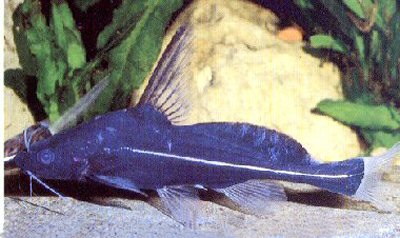
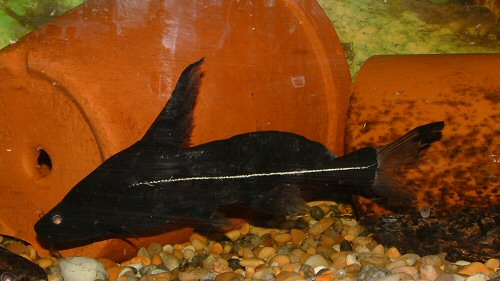
Common Name: |
Black Lancer |
Synonyms: |
Bagroides macracanthus, Pseudobagrichthys macracanthus, Leiocassis macropterus, Bagroides vaillanti |
Family: |
Bagridae |
Subfamily: |
Bagrinae |
Distribution: |
Asia: Sumatra. Type locality: Moara kompeh, in fluviis, Sumatra. |
Size: |
18.0cm (7¼ins) |
Temp: |
24-27°C (75-81°F) |
p.H. |
6.5-7.0. |
Characteristics |
Long dorsal fin spine with 18-19 serrae in adults. Gill rakers 10-14. Pectoral fin rays 9. |
Colouration |
Body dark brown to black with pale stripe along lateral line, sometimes, with 2-3 irregular yellowish brown vertical bands. |
Aquarium Care & Compatibility |
| The male 'black lancers' can be very territorial and as such can be only be kept, one male to a tank with the rest females. Although they posses a small mouth it is wide, but they don't tend to be a threat to other fishes as such, although if you keep very small fish with them they could be picked of at night as the lancer enjoys its night-time forays. |
Reproduction |
Not recorded. |
Diet |
| Frozen foods (bloodworm), whiteworm, garden worms,catfish tablets, trout pellets, algae tablets and wafers. |
Etymology |
| Bagrichthys:
From 'bagre', a South American name for a catfish,
but is only used for African and Asian species. |
References |
Kottelat,
Maurice; Fishes of Laos.
WHT Publications (Pte) Ltd.,
p122 |
Photo Credits |
Top: © Dr David Sands. From Catfishes of the World, Vol 5. used with permision. Bottom:
© Allan James @
|

|

If you would like to contribute to the monthly factsheets with an
article, information or photos, please e-mail
me. You will of course be credited for your work.
If you would like to donate any denomination of money to the site just click the above link button. All proceeds will go to running the site and hopefully to keep it going for a few years yet.
ScotCat Sources
 Etymology-genera
Etymology-specific name
Online Sources
 Search
 Fishbase
 Wikipedia
 Catalog of Fishes
 GBIF
GBIF
 Fishnet2
 iNaturalist

