SCOTCAT.COM
your internet guide to all things catfish
FACTSHEETS: September 2000 - no. 051
Corydoras tukano Britto & Lima, 2003 |
Corydoras
tukano From information given to me by one of the top U.K. Cory breeders, Ian Fuller, according to Hans-Georg Evers, the German aquarist, breeder and author, Corydoras sp.cf.reynoldsi or Corydoras sp. reynoldsi 'Asher' is indeed the real C. reynoldsi and he has had his thoughts confirmed by Stanley Weitzman who described the original species in 1960. Asher Benzaken is the name of the exporter of this fish from the port of Manaus, Brazil and who has a fish farm in this area. Well you might just say that that is the mystery solved then, but hold on there is another twist to the story. another of the top U.K. Corydoras breeders, Jim Makin, has verified that he bred Corydoras reynoldsi in the early 80's and the males did not have the longer dorsal that these 'asher' have and they also bred not unlike Corydoras paleatus with lots of small eggs in a mass. The difference with sp 'asher' is that they lay small amounts of eggs here and there and the eggs are the largest I have ever seen from a Cory, a whopping 2.2mm in size. Jim has bred and raised this larger egged species and I have also had eggs and raised the fry from my collection, and the sizes do match up. The females I found to grow that little bit larger than the males.
Corydoras tukano
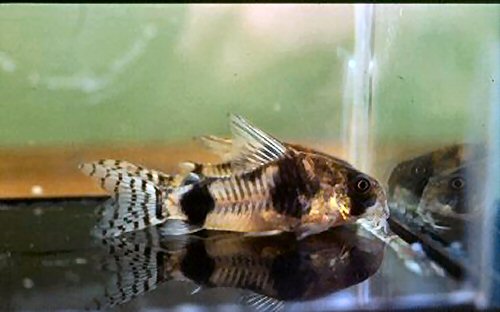
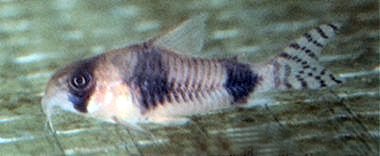
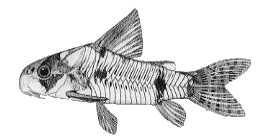
Another bone of contention is the body pattern. As you can see in the above picture there are two large blotches on the body, one at the posterior of the dorsal running down to the ventral fins and the other bridging the area akin to the adipose and anal fins. There is also a small dark patch running down the back and a black band running through both eyes. In the original line drawing below of Corydoras reynoldsi there is also two blotches in the same area but they don't spread down through the body, are only small with the dorsal/ventral spot being broken in two. The body shape of these two illustrations are very much alike so one wonders if it is only a pattern variation which occur in the wild from different locations and they are indeed one and the same fish.
To add even more confusion to this scenario is that there is a long-nose version of this species which is identical in every aspect apart of course in the longer snout. This species hails from the tributaries in the upper Rio Negro, Brazil, so could our sp "asher" also come from this same area and live alongside its larger cousin, as the port of Manaus the export station, is of course down the Rio Negro with its confluent with the Amazon River. So you can make your own mind up until we are told by the ichthyologists, when they get round to working with this species, if indeed they are one and the same species. Now that we move away from the scientific bit, how do we keep this Corydoras. From my experiences they are very easy and adapt to most water conditions as long as they are not too diverse. They do nicely in a small group and you can tell the girls from the boys by the longer dorsal in the smaller male and the fuller and larger body of the female. Acknowledgments: Jim Makin and Ian Fuller of the Catfish Study Group for their input and also to Jim for providing the original papers and article on Corydoras reynoldsi.
Update; December 2003. The new name of Corydoras tukano has now been given to this species by Marcelo R. Britto of Departamento de Vertebrados, Museu Nacional da Universidade Federal do Rio de Janeiro Brazil, and Flávio C.T. Lima. The ichthyologists have finely finished work on this Cory and you can read a short abstract on their published work on ScotCat. Update: Placed in Lineage 6 which has always been classified as Corydoras (Lacépède, 1803) so a new genus would need to be described and a new type species when a new revision is carried out.
|
 his
Corydoras is like one of those intriguing conspiracy
stories where you don't know fact from fiction. What
has that got to do with a Corydoras I hear
you ask!. Well when this Cory was first photographed
in 1997 in the Japanese magazine "Aquamagazine"
and then imported to the U.K. about the same time,
Corydoras sp. reynoldsi "Asher"
was the name that they were imported with, and the
vote was split down the middle amongst the top Cory
breeders in the U.K. whether this was indeed the true
his
Corydoras is like one of those intriguing conspiracy
stories where you don't know fact from fiction. What
has that got to do with a Corydoras I hear
you ask!. Well when this Cory was first photographed
in 1997 in the Japanese magazine "Aquamagazine"
and then imported to the U.K. about the same time,
Corydoras sp. reynoldsi "Asher"
was the name that they were imported with, and the
vote was split down the middle amongst the top Cory
breeders in the U.K. whether this was indeed the true
Common Name: |
Bumblebee Cory, Asher Cory, C064 |
Synonyms: |
None |
Family: |
Callichthyidae |
Subfamily: |
Corydoradinae |
Distribution: |
South America: Brazil; Rio Tiquié, upper Rio Negro basin. |
Size: |
Male: 4.0cm. (1½ins). Female: 4.5cm. (1¾ins) |
Temp: |
22-25°C (71-77°F) |
p.H. |
6.0-7.2. |
Characteristics |
Small round head. Male dorsal fin longer than female. |
Colouration |
Two large blotches on the body, one at the posterior of the dorsal running down to the ventral fins and the other bridging the area akin to the adipose and anal fins. A small dark patch running down the back and a black band running through both eyes. |
Aquarium Care & Compatibility |
| This is akin to most of this genus, very peaceful, and would be best housed with small to medium tankmates such as Tetras, Rasboras and Danios or in a species tank for breeding purposes. |
Reproduction |
I set up 2 males and a female in a 18" x 12" x 12" tank with sand, Java moss, Java fern and a sponge filter. They laid 11 eggs scattered throughout the aquarium, high on the glass and also low on a flower pot. The water parameters were a P.h.of 6.5 and water temperature of 76F, K.H., 3., G.H.,1. The eggs are large measuring 2.2mm and the largest of any Corydoras that I have bred. Unfortunately the eggs did not hatch and were not viable. They also laid eggs about a week later but they were not fertilised either. I have since then purchased more of this species and I hope to record some success with this most beautiful of Corydoras at a later date. Update: I have now bred and raised the fry and and you can now find this article on Ian Fullers, Corydoras World website. |
Diet |
| The usual fare for adult Corydoras, a good quality flake food, tablet food, frozen bloodworm and whiteworm used sparingly. |
Etymology |
| Corydoras:
Cory = helmeted;
doras = leathery skin,(helmeted
Doras) cuirass. |
References |
Alexandrou,
Markos & Taylor, Martin. (2011). Evolution,
ecology and taxonomy of the Corydoradinae revisited. |
Photo Credits |
Top image:
@ Allan James @ |

|

If you would like to contribute to the monthly factsheets with an
article, information or photos, please e-mail
me. You will of course be credited for your work.
If you would like to donate any denomination of money to the site just click the above link button. All proceeds will go to running the site and hopefully to keep it going for a few years yet.
ScotCat Sources
 Article
 Etymology-genera
Etymology-specific name
Online Sources
 Search
 Fishbase
 Catalog of Fishes
 GBIF
GBIF
 Fishnet2
 iNaturalist

