SCOTCAT.COM
your internet guide to all things catfish
FACTSHEETS: November 2001 - no. 065
Synodontis batensoda Rüppell, 1832 |
|
Synodontis
batensoda The original description was Synodontis batensoda, named by the German Ichthyologist W.P.E.S Rüppell in 1832 in his paper "Continuation of the description and figure of several new fish, in the Nile. p1-14 ." It was known as this name until Bleeker in 1862 erected a new genus, Brachysynodontis for it. This was because of the differences between the numbers of gill rakers and the absence of a gap between the dorsal and adipose fin. This is still an ongoing debate after it was moved back into the Synodontis genera again.
Synodontis
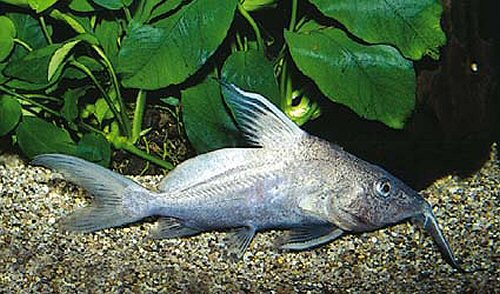
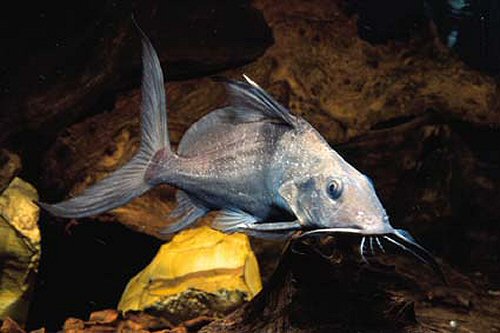
batensoda As its colour pattern suggests, it spends most of its time in an inverted position. In the wild they congregate in large shoals, feeding on phytoplankton, zooplankton and detritus. It is speculated that one of the reasons for the inverted swimming position is that when caught in dry season pools it gives this species the opportunity to exploit the low oxygen content to the full. They are found in some of the largest rivers in Africa, but migrate to areas where the pools and marshes occur. I can only surmise that this is a pre-empt to spawning for Synodontis batensoda. The
common name of "Upsidedown catfish" may
confuse readers as the other Syno also with this name
is the smaller Synodontis
nigriventris which
unlike S. batensoda spends most of its time
inverted under branches or logs whereas the latter
when dormant sits on the bottom of the aquarium. This is an other 'Synodontis' which has appeared as hieroglyphics on the walls of ancient Egyptian tombs along with S. schall, S. membranaceus, S. serratus, S. frontosus and S. sorex.
|
 his
member of the Mochokidae family has been quite a popular
if not too attractive addition to the catfish fraternity
since 1973 when it had then been made the emblem of
the now deceased Catfish Association of Great Britain.
his
member of the Mochokidae family has been quite a popular
if not too attractive addition to the catfish fraternity
since 1973 when it had then been made the emblem of
the now deceased Catfish Association of Great Britain.
Common Name |
Giant upside-down catfish |
Synonyms |
Synodontis membranaceus, Synodontis melanogaster, Hemisynodontis membranaceus, Brachysynodontis batensoda |
Family |
Mochokidae |
Subfamily |
Mochocinae |
Distribution |
Africa: Nile, Chad, Niger (including the Bénoué), Senegal and Gambia basins. |
Size |
17.5cm. (7ins) |
Temp. |
23-27°C (73-81°F) |
p.H. |
6.0-7.2. |
Characteristics |
Dorsal:1/7, Anal:5/7-9. Maxillary barbels with a broad posterior membrane throughout their length; mandibular barbels without membrane and possessing slender ramifications. Shoulder-process rectangular. Adipose fin very large. Dorsal fin spine smooth anteriorly, occasionally with 3-4 serration's at the tip, feebly serrated posteriorly ending in a filament. Pectoral fin spine feebly serrated on outer border strongly serrated on inner border. Caudal fin forked, each lobe ending in a point. Head shield pitted and granulated. |
Colouration |
Adults are silver-green to blue-grey, occasionally delicate redish-brown. Underside blackish. Fins grey, partly with dark spots. Barbels black.The young have large dark blotches on the flanks, separated by an intervening pale network. |
Aquarium Care and Compatibility |
| Keeping S. batensoda in the aquarium poses no problem as they are in my experience an easy going Synodontis and can be quite entertaining in their forages around the tank swimming upside-down along the top of the tank and then reverting to their bottom posture as they glide along the bottom. I have found that they sometimes can get bullied by the more aggressive members of this family so as with all Syno's you will have to experiment to find the best solution for its tankmates. |
Reproduction |
Not recorded. |
Diet |
| Omnivore, in its natural habitat it feeds on plankton, algae and detritus. May also feed on surface insects, chironomid larvae, benthic crustaceans and mollusks. In the aquarium they will take a wide range of foods. They will feed during the day and accept live food, frozen food (bloodworm) tablet and pellet foods and a good quality flake. I have also witnessed my specimen gnawing away at a piece of courgette (zucchini) which was left out for my Ancistrus, so a little bit of greenery now and again would also supplement their diet. |
Etymology |
| Synodontis:
Ancient name for an undetermined fish from the Nile
(Cuvier 1816). |
References |
Catfish
Association of Great Britain Volume 1 1983. |
Photo Credits |
© |

|

If you would like to contribute to the monthly factsheets with an article, information or photos, please e-mail me. You will of course be credited for your work.
If you would like to donate any denomination of money to the site just click the above link button. All proceeds will go to running the site and hopefully to keep it going for a few years yet.
ScotCat Sources
 Etymology-genera
Etymology-specific name
Online Sources
 Search
 Fishbase
 Wikipedia
 Catalog of Fishes
 GBIF
GBIF
 Fishnet2
 iNaturalist

