SCOTCAT.COM
your internet guide to all things catfish
FACTSHEETS: May 1997- no. 009
Corydoras steindachneri Isbrûcker & Nijssen, 1973 |
|
Corydoras
steindachneri
- male
Only wild caught specimens are usually available so care must be taken with them regarding water quality and so they should be acclimatised in a quarantine tank. In saying that once they are over this period they usually settle down well to aquarium life. Probably better of in a species tank as you can then tend to them more easily, being the sole occupant, to the business of good water quality in changing the water regularly. If your finances stretch to it, as they will not be a cheap purchase, buy at least 4 as they tend to settle down better in their own company, you can then be more certain of having a pair of "Steindachners Cory".
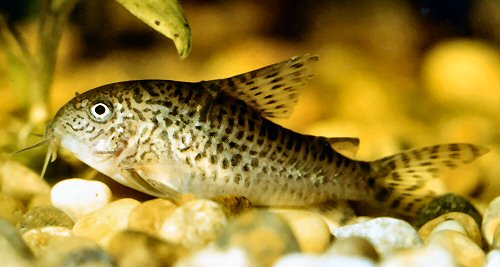
Corydoras steindachneri - female
|
 he
main differences between this species and Corydoras
paleatus is the size, as the latter grows to around
the 7cm mark while steindachneri only atains
5cm. The males of steindachneri possess a more
elongated dorsal fin and are not as heavy looking
as the females.
he
main differences between this species and Corydoras
paleatus is the size, as the latter grows to around
the 7cm mark while steindachneri only atains
5cm. The males of steindachneri possess a more
elongated dorsal fin and are not as heavy looking
as the females. 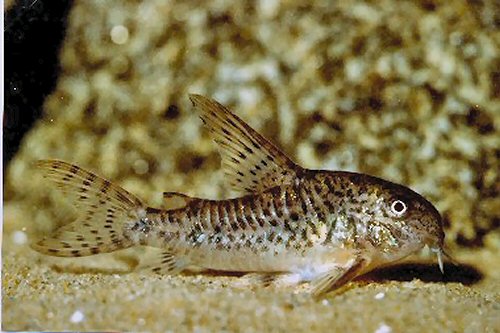
Common Name |
Steindachners Cory |
Synonyms |
None |
Family |
Callichthyidae |
Subfamily |
Corydoradinae |
Distribution |
South America: Brazil, Coastal rivers in Paraná State. Type locality: Brazil, Est. Paraná, Paranaguá (25º32'S, 48º36'W). |
Size |
Male: 4.5cm (1¾ins) Female: 5.0cm (2ins) |
Temp. |
22-26°c (71-79°f.) |
p.H. |
6.0-7.2. |
Characteristics |
Head short and compact. The male has an extremely extended dorsal fin. |
Colouration |
All fins are colourless and transparent. The fin rays are banded black and white. There are three metallic-turquoise patches along the length of the body, extending from the gill covers to the caudal fin. The first begins just behind the eyes and runs backwards to the dorsal fin, the second is just below the adipose fin, and the smallest is situated at the the base of the caudal fin. Above and surrounding these are irregular spots and patches, which extend the length of the body. The basic body colour is also visible in places, and a mottled pattern exists in the head region. The species is similar to Corydoras aurofrenatus, but the markings are different, and the males have a far more extended dorsal fin. |
Aquarium Care and Compatibility |
| A tank setup would entail a soft substrate such as sand or a small gravel and a nice plant covering around the back and sides of the aquarium. If housed in a community tank a mixture of small South American characins or the smaller varieties of Asian Rasboras would suffice, as larger fishes would intimidate these shy Cory's, and would stop them eating and would be therefore detrimental to their overall health. |
Reproduction |
U.K. Corydoras breeder Ian Fuller of www.corydorasworld.com has bred a similar species he calls Corydoras cf steindachneri. He had 8 of these fish in his tank with a pH.of 7.4 and a temperature of 74f (23.3c). They bred in the usual T-mating clinch formation after a 25% cool water change the previous day reducing the temperature to 69f (20.5c) The adult fish were moved as they were in the process of eating the eggs. The number of eggs totaled between 400-500 and he had a 90% hatch rate. |
Diet |
| The fry after 3 days feed on microworm, pre-soaked powdered flake, then progress on to Brine Shrimp naupli. Adults can be fed the usual good quality flake food, frozen bloodworm, tablet foods, white and grindal worms. |
Etymology |
Corydoras:
Cory = helmeted;
doras = leathery
skin,(helmeted Doras) cuirass. |
References |
Alexandrou,
Markos & Taylor, Martin. (2011). Evolution,
ecology and taxonomy of the Corydoradinae revisited.
|
Photo Credits |
© Alan Pinkerton |
|

If you would like to contribute to the monthly factsheets with an article, information or photos, please e-mail me. You will of course be credited for your work.
If you would like to donate any denomination of money to the site just click the above link button. All proceeds will go to running the site and hopefully to keep it going for a few years yet.
ScotCat Sources
 Etymology-genera
Etymology-specific name
Online Sources
 Search
 Fishbase
 Wikipedia
 Catalog of Fishes
 GBIF
GBIF
 Fishnet2
 iNaturalist

