SCOTCAT.COM
your internet guide to all things catfish
FACTSHEETS: June 2009 - no. 156
Trachycorystes trachycorystes (Valenciennes, 1840) |
Trachycorystes trachycorystes
A fellow aquarist has told me about a friend who kept one, and stated that it was very aggressive, and you had to watch if you put your hands in the tank as it was prone to attacking the hand that feeds it!. It is very strange indeed as the Auchenipteridae family on the whole are not known for their aggressive behavior. There are three other Trachycorystes species, T. cratensis from the Rio Granjeiro in Brazil, T. obscurus from the Rio Essequibo basin in Guyana, and T. porosus. Our factsheet of the month T. trachycorystes is the only member of this genus to be exported, but they are still not a common site in the aquarium shops.
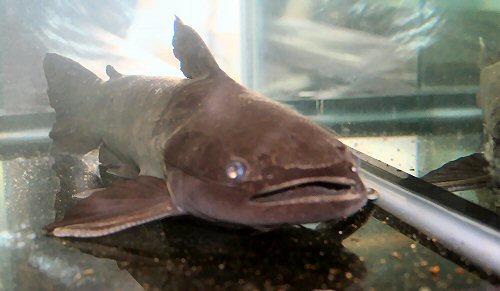
Trachycorystes trachycorystes - the mouth you have to watch!
It is reported (watkins, et al) that this catfish is an important food fish in the Iwokrama Forest in Guyana but this species may be T. obscurus (Rio Essequibo basin) alongside the larger species of the Pseudoplatystoma genus. This is a catfish for the more experienced keeper who knows what they are getting for their pound of flesh!. Provide shelter in the aquarium such as driftwood as it will hide there during the day and venture out at night for food. It may come out in the open during the day if it is relaxed and confident enough. The tank length should be at least 4" 6" ft (135cm) or over at least, and the width would need to be 18" (45cm) for an adult to turn around comfortably. Substrate is not important, using either smooth gravel or sand.
|
 o good they named it twice!
well I don't think so as this is one of the most aggresive
catfish around in the hobby and definately not suited
to your average community tank, although It is certainly
very striking looking in its all-black livery. There
is another type which has a more brown body colouration
and may turn out to be a seperate species.
o good they named it twice!
well I don't think so as this is one of the most aggresive
catfish around in the hobby and definately not suited
to your average community tank, although It is certainly
very striking looking in its all-black livery. There
is another type which has a more brown body colouration
and may turn out to be a seperate species.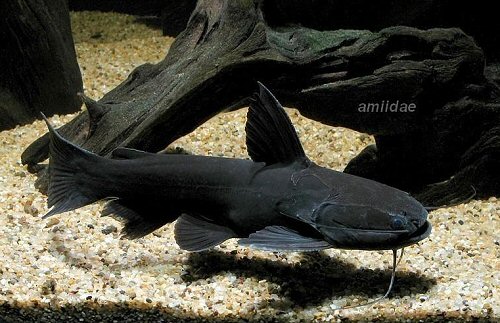
Common Name |
Black Driftwood Catfish |
Synonyms |
Auchenipterus trachycorystes, Trachycorystes typus |
Family |
Auchenipteridae |
Subfamily |
Auchenipterinae |
Distribution |
South America: Brazil, Venezuela. Amazon basin and Orinoco River subbasin. |
Size |
35.0cm (14ins) |
Temp. |
23-27°c (73-81°f) |
p.H. |
6.5-7.0. |
Characteristics |
Head is broad and depressed, the width of the cleithra almost twice the depth. The bones of the head are naked (without a covering skin) and fused, forming a solid, heavy, very rugose casque; there is a small oval fontanel. The mouth is wide, horizontal, and the lower jaw extends beyond the upper and a band of small teeth is present in each jaw, but there are none on the vomer and palatines. The dorsal and pectoral fin spines are strong, pungent, the dorsal fin spine with teeth along its anterior edge only, the longer, stronger pectoral fin spines with teeth along both edges. The adipose fin is very small, and the anal fin is of moderate length, with about 20 rays. The ventral fins have 9 or 10 rays, and the caudal fin is emarginate to slightly forked. |
Colouration |
Black all over, some species have a white underbelly. Fin edges may have a white fringe to them. |
Aquarium Care & Compatibility |
| Not to be trusted when growing into adulthood as it will quickly kill any smaller inhabitants of the tank. May be able to keep with large Cichlids but basically a fish to keep on its own. |
Reproduction |
Like all members of this family, T. trachycorystes practices oviducal fertilization. There are no known reported aquarium spawning's of this catfish but can be sexed due to the thickening of the anterior of the anal fin, as is the norm in this family, akin to the anal fins of the males of the Goodiae family of livebearers. The females store the sperm to fertilize their eggs. |
Sexual Differences |
Adult males possess a thickening of their anal fins akin to the anal fins of the males of the Goodiae family of livebearers. The females genital pore is enlarged and recessed into her abdomen. |
Diet |
| A predator but will accept worm foods, frozen shrimp and bloodworm, chunks of frozen fish, tablet and pellet foods. |
Glossary of Terms |
Adipose
fin: Fleshy finlike projection without rays,
behind the rayed dorsal fin. |
Etymology |
| Trachycorystes:
Greek, trachys, -eia,
-ys = rough + Greek, chorystes, -ou = a soldier with
helmet. |
References |
Burgess,
W.E. 1989 An
atlas of freshwater and marine catfishes. A preliminary
survey of the Siluriformes. T.F.H. Publications, Inc.,
Neptune City, New Jersey (USA). 784 p. |
Photo Credits |
|
Top © Ben
Lee @ Bottom: © Allan
James @ |


|

If you would like to contribute to the monthly factsheets with an article, information or photos, please e-mail me. You will of course be credited for your work.
If you would like to donate any denomination of money to the site just click the above link button. All proceeds will go to running the site and hopefully to keep it going for a few years yet.
ScotCat Sources
 Etymology-genera
Etymology-specific name
Other Sources
 Search
 Fishbase
 Wikipedia
 Catalog
of Fishes
Catalog
of Fishes
 GBIF
GBIF
 Fishnet2
 iNaturalist

