SCOTCAT.COM
your internet guide to all things catfish
Gephyromochlus leopardus (Hoedeman, 1961) |
Image contributors to this species: |
Mark Henry Sabaj (1) |
ScotCat Sources: |
|
|

Other Sources: |
|


Relevant Information: |
Gephyromochlus contains a single species (monotypic). Description: Dorsal spines (total): 1; Dorsal soft rays (total): 4; Anal spines: 0; Anal soft rays: 12 - 14. Habitat: Occurs in shallow creeks with sandy-muddy substrate rich in plant debris. Rarely found in principal river beds. Although not abundant, it appears to be well-adapted to its environment as evidenced by its leopard outfit which enables it to camouflage itself. The isolated captures suggest a solitary existence. Unlike the Tatia which lives mostly in estuaries, G. leopardus appears to live mainly in the upstream portion of rivers. Etymology: The genus name Gephyromochlus: gephyra, bridge; –mochlus, proposed as a subgenus of Centromochlus, “intermediate in a way” (i.e., a bridge) between that genus and Auchenipterus. The specific name leopardus: referring to leopard-like “bars and flecks” on body. Remarks: Gephyromochlus leopardus has most recently been assessed for The IUCN Red List of Threatened Species in 2020. Gephyromochlus leopardus is listed as Near Threatened under criteria B1ab(ii,iii) + 2ab(ii,iii). |
Common Name: |
None |
Synonyms: |
Centromochlus leopardus, Glanidium leoparum |
Family: |
Auchenipteridae |
Distribution: |
South America: Coastal rivers of the Guianas: French Guiana, Guyana and Suriname. Type locality: Litany River, Aloiké village, French Guiana. |
Size: |
11.0.cm. (4¼ins) |
Temp: |
22-25°c (71-77°f.) |
p.H. |
|
6.0-7.0. |
IUCN Red List |
Gephyromochlus leopardus is distributed along tributaries of the Marowijne (Maroni) River in Suriname on the border with French Guiana and also Brazil. The extent of occurrence (EOO) is 26,146 km² and the area of occupancy (AOO) is 2,536 km². The subpopulation from the Saint Laurent Du Maroni city has been severely impacted in its habitat quality. Additionally, all of the Maroni River basin, both in forest and the main channel, is suffering severe impacts from the presence of very extensive small-scale gold mining activities. There is an inferred continuing decline in AOO and habitat, and five locations based on the impacts of these threats. The EOO and AOO are slightly higher than the thresholds for criteria B1 and B2, respectively, for the Vulnerable (VU) category. Thus, Gephyromochlus leopardus is assessed as Near Threatened (NT). It is recommended to further research the status of its population, since the species is not well known, and is very rare and uncommon in scientific collections, known only from few individuals, as well as to monitor gold mining activities (IUCN 2022). |
Reference: |
|
Calegari, B.B.
2022. Gephyromochlus leopardus. The IUCN
Red List of Threatened Species 2022. |

Family: Auchenipteridae Back to Ident-A-Cat Click on Thumbnails |
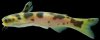 Gephyromochlus
leopardus |
If you would like to contribute to the monthly factsheets with an article, information or photos, please e-mail me. You will of course be credited for your work.

If you would like to donate any denomination of monies to the site just click the above link button. All proceeds will go to running the site and hopefully to keep it going for a few years yet.

