SCOTCAT.COM
your internet guide to all things catfish
Nanobagrus immaculatus Ng, 2008 |
Image contributors to this species: |
Hendra Tommy (2) |
ScotCat Sources: |
|

Other Sources: |
|
|


Relevant Information: |
Description: Nanobagrus immaculatus, is described from the Kahayan River drainage in southern Borneo. It is most readily distinguished from congeners in having a uniformly dark-coloured body lacking pale spots or patches (vs. pale spots or patches always present), larger eye (16.7–18.2% HL vs. 9.0–16.1), and a longer adipose-fin base (24.9–26.6% SL vs. 12.8–21.6). The synapomorphies used to diagnose Nanobagrus are reviewed and re-examined. Pseudomystus fuscus is hypothesized to be more closely related to Nanobagrus than to all other Pseudomystus and is hereby reassigned to the former genus. Dorsal spines (total): 1; Dorsal soft rays (total): 7; Anal soft rays: 11 - 13; Vertebrae: 34 - 35.; eye diameter 16.7-18.2% HL and adipose-fin base length 24.9-26.6% SL. Colouration: Body uniformly dark, lacking pale spots or patches. Etymology: The genus name Nanobagrus: Latin, nannus = small + Mozarabic bagre, Greek pagros = a fish, Dentex sp. The specific name immaculatus: derived from the Latin adjective, immaculatus, meaning unspotted or unstained, in allusion to the colouration pattern of the species, lacking dots or spots. |
Common Name: |
None |
Synonyms: |
None |
Family: |
Bagridae |
Distribution: |
Asia: Kahayan River drainage in southern Borneo, Indonesia. Type locality: Backwater stream, about 14 kilometers northwest of Palangkaraya, 2°05'06''S, 113°46'23''E, Kalimantan Tengah, southern Borneo, Indonesia. |
Size: |
3.0cm (1¼ins) |
Temp: |
24-27°C (75-81°F) |
p.H. |
|
6.5-7.0. |
IUCN Red List |
This species is known only from the Kahayan River drainage in southern Borneo. The habitat of this species (blackwater peat swamp and heath forests) has undergone large scale destruction and degradation due to logging, plantation agriculture (primarily oil palm plantation), and channelisation. Given the scope of land conversion for use in plantation agriculture, the number of locations is certainly not more than five. Additionally, these threats are severe, widespread, and capable of driving this species to extinction within a short time period. Therefore, in the light of this information and the fact that the EOO is estimated to be no more than 10,300 km2, Nanobagrus immaculatus is assessed as Vulnerable (VU) under criteria B1ab(i,ii,iii) and D2 (IUCN 2020). |
Reference: |
Ng, H.H.,
2008. A new species of Nanobagrus (Teleostei: Bagridae)
from Southern Borneo. Copeia 2008(1):93-98. |

Family: Bagridae Back to Ident-A-Cat Click on Thumbnails |
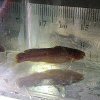 Nanobagrus
immaculatus Nanobagrus
immaculatus |
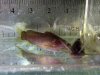 Nanobagrus
immaculatus Nanobagrus
immaculatus |
If you would like to contribute to the monthly factsheets with an article, information or photos, please e-mail me. You will of course be credited for your work.

If you would like to donate any denomination of monies to the site just click the above link button. All proceeds will go to running the site and hopefully to keep it going for a few years yet.

