SCOTCAT.COM
your internet guide to all things catfish
Pseudomystus heokhuii Lim & Ng, 2008 |
Image contributors to this species: |
Johnny Jensen's Photographic Library (1) Andrew Rushworth (1) |
ScotCat Sources: |
|

Other Sources: |
|
|


Relevant Information: |
Description: Dorsal spines (total): 1; Dorsal soft rays (total): 7; Anal soft rays: 12 - 14; Vertebrae: 35 - 36. Can be differentiated further from all congeners except Pseudomystus breviceps, Pseudomystus bomboides, Pseudomystus flavipinnis, Pseudomystus myersi, Pseudomystus siamensis, Pseudomystus robustus, Pseudomystus sobrinus and Pseudomystus stenomus in having a deeper body (17.8-21.0% SL vs. 9.0-17.0). Differs from Pseudomystus leiacanthus in having two (vs. one) dark narrow irregular bars on the caudal fin, longer pectoral spine (19.3-22.4% SL vs. 15.2-18.6), longer caudal fin (33.5-40.0% SL vs. 25.7-31.9) with pointed (vs. rounded) lobes, longer nasal and maxillary barbels (63.1-81.1% HL vs. 31.3-51.5 and 86.2-125.3% HL vs. 70.9-91.3 respectively; nasal barbel reaching to dorsal insertion of opercular flap vs. to just beyond posterior orbital margin and maxillary barbel reaching just beyond base of last pectoral-fin ray vs. to base of pectoral spine), a straight ( vs. crescentic) premaxillary tooth patch, a more sharply tapering snout when viewed dorsally and an even (vs. slightly convex) predorsal profile. Colouration: Differs from its congeners in possessing a colour pattern consisting of a pale midlateral stripe and two pale oblique bands on the sides of the body; no other congener exhibits a distinct pale midlateral stripe. Habitat: Occurs in floodplain channels and peat swamps with very acidic (pH 3.5-4.5), tannin-stained water. Etymology: The genus name Pseudomystus: Greek, pseudes = false + Greek, mystax = whiskered, used by Belon in 1553 to describe all fishes with whiskers. The species name is for one of the authors, Heok Hui Ng. |
Common Name: |
None |
Synonyms: |
None |
Family: |
Bagridae |
Distribution: |
Asia: Batang Hari and Indragiri River drainages in Sumatra, Indonesia. Type Locality: Batang Hari drainage at Rantau Panjang, Jambi, Sumatra. |
Size: |
6.5cm (2½ins) |
Temp: |
21-26°C (70-79°F) |
p.H. |
|
5.5-6.5. |
IUCN Red List |
This species is known only from the Bataang Hard and Indragiri river drainages in Sumatra. It has an Extent of Occurrence (EOO) of 3,000 km2. The habitat of this species (blackwater peat swamp and heath forests) has undergone large scale destruction and degradation due to logging, plantation agriculture (primarily oil palm plantation), and channelisation. Given the scope of land conversion for use in plantation agriculture, the number of locations is likely not more than five. Additionally, these threats are severe, widespread, and capable of driving this species to extinction within a short time period. Therefore, Pseudomystus heokhuii is assessed as Endangered under criterion B1ab(i,iii), (IUCN 2020). |
Reference: |
Froese, R. and D. Pauly.
Editors. 2009. FishBase. World Wide Web electronic
publication. www.fishbase.org, version (10/2011). |

Family: Bagridae Back to Ident-A-Cat Click on Thumbnails |
 Pseudomystus
heokhuii Pseudomystus
heokhuii Dorsal view |
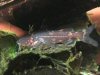 Pseudomystus
heokhuii Pseudomystus
heokhuii |
If you would like to contribute to the monthly factsheets with an article, information or photos, please e-mail me. You will of course be credited for your work.

If you would like to donate any denomination of monies to the site just click the above link button. All proceeds will go to running the site and hopefully to keep it going for a few years yet.

