SCOTCAT.COM  

your internet guide to all things catfish
≡
  • HOME
  • FACTSHEETS
    • By Month/Year
    • By Family
    • by Genus
    • by Common Names
    • By Specific Names
    • By Continent
      • Index
      • Africa
      • Asia
      • Australasia
      • Europe
      • North America
      • South America
  • GALLERIES
    • Photo Gallery
    • Art Gallery
    • Movie Gallery
    • Stamps Gallery
  • FAMILIES
    • A-B
      • Ailiidae
      • Akysidae
      • Amblycipitidae
      • Amphiliidae
      • Anchariidae
      • † Andinichthyidae
      • Ariidae
      • Aspredinidae
      • Astroblepidae
      • Auchenipteridae
      • Auchenoglanididae
      • Austroglanididae
      • Bagridae
    • C-D
      • Callichthyidae
      • Cetopsidae
      • Chacidae
      • Clariidae
      • Claroteidae
      • Cranoglanididae
      • Diplomystidae
      • Doradidae
    • H-I
      • Heptapteridae
      • Heteropneustidae
      • Horabagridae
      • Ictaluridae
    • K-L-M
      • Kryptoglanidae
      • Lacantuniidae
      • Loricariidae
      • Malapteruridae
      • Mochokidae
    • N-P
      • Nematogenyidae
      • Pangasiidae
      • Phreatobiidae
      • Pimelodidae
      • Plotosidae
      • Pseudopimelodidae
    • R-S-T
      • Ritidae
      • Schilbeidae
      • Scoloplacidae
      • Siluridae
      • Sisoridae
      • Trichomycteridae
  • ARTICLES
    • Index
    • Breeding
    • By Author
    • Cat-Articles
    • General
    • Numbered List
    • Ichthyology
    • Travel/Collecting
  • IDENT-A-CAT
  • RESOURCES
    • Citation
    • Etymology
    • Fishhouse
    • Glossary
    • Scientific Papers
    • ScotShop
  • SITE MAP
  • FB GROUP
  • HELP
    • Index
    • Catfish Anatomy
    • Convertors
    • FAQ
    • Ident-A-Cat
    • Water Chemistry

FACTSHEETS: July 2026 - no. 361

 Pseudostegophilus nemurus (Günther, 1869)


first glance, the seemingly unremarkable, the flatish catfish pictured below might appear to be a perfect addition to my home aquaria—but think again! These parasitic catfishes are well known for scraping mucus and scales from the sides of other fishes. They have numerous minute teeth on the ventral mouthparts that function as mucus scrapers. While they share the common name "Jaguar Candiru," unlike the true Candiru of the Vandellia genus—which invade the gills of larger fishes—this species does not. Nevertheless, they are not suitable aquarium fish to house with other inhabitants, although a group of them in an aquarium setup may be interesting to research, including their group habits.
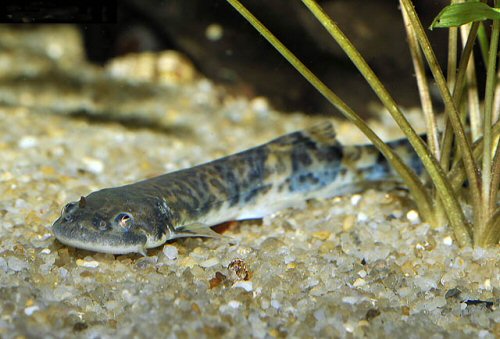
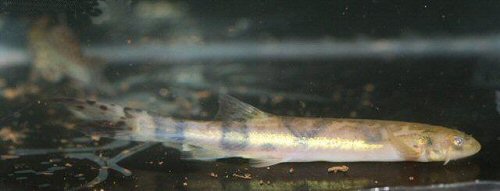


Pseudostegophilus nemurus

    Pseudostegophilus nemurus


The subfamily Stegophilinae has sucking mouths with which they can hang onto the bodies of other fishes and take chunks out of them. DoNascimiento (2015) has placed Parastegophilus in the synonymy of Pseudostegophilus. They are illegal to own in the southern U.S. states. This species is termed an Obligate parasite (see Glossary of Terms below). There are four species in this genus: P. haemomyzon (Myers, 1942), P. maculatus (Steindachner, 1879), P. paulensis Miranda Ribeiro, 1918 and our factsheet of the month, Pseudostegophilus nemurus, which is the type species for the genus.


Pseudostegophilus nemurus - filamentous upper lobe to caudal fin


Pseudostegophilus nemurus - filamentous upper lobe to caudal fin


They have appeared sporadically in the trade but usually as a by-catch. According to the available data, Pseudostegophilus nemurus occurs in the Amazon basin in Brazil, Bolivia and Peru, and P. haemomyzon occurs in the Orinoco river basin. This species does not have any conservation measures in place. However, there is broad morphological variation in the specimens identified as this species, expressed in the details of the conspicuous banded colouring. Some of these variations are geographically segregated, and it is likely that there is more than one species within what we currently call Pseudostegophilus nemurus (Queiroz et al. 2013). Taxonomic research would therefore be beneficial.

The greater presence of the scale as a food item allows the species to be classified as a lepidophagus, which is also evidenced by the morphological aspects of the buccal apparatus, which can fix and tear the scales of the prey. Lepdophagy is a trophic category presented by different taxonomic groups [e.g. Exodon paradoxus (Muller & Troschel 1844), Roeboides prognathus (Boulenger 1895), Catoprion mento (Cuvier 1819), Henonemus punctatus (Boulenger 1887), Corematodus shiranus (Boulenger 1897)], which highlights the importance of scales in the feeding of many species (Sazima, 1983; De Pinna, 1992). During the night, the fishes are more susceptible to the attack of P. nemurus because this species has greater activity in this period (Sazima, 1983; De Pinna; Zuanon, 2013). The species identified as prey of P. nemurus in the present study (T. albus and T. stellatus) are very abundant in tropical river beach environments (Duarte et al., 2010; de Oliveira et al., 2020).


Amazon River basin, Brazil and Peru


Amazon River basin, Brazil and Peru


Drainage Network of the Amazon River


Drainage Network of the Amazon River


South America: Amazon River basin, Brazil and Peru. Type locality: Upper Amazon River, Peru.


The Upper Amazon in Peru is the highly biodiverse headwater region where the glacial streams of the Andes flow together to form the main Amazon River. Centred around the remote jungle city of Iquitos, it is renowned for luxurious river expeditions and deep biodiversity.


Common Name

Jaguar Candiru

Synonyms

Stegophilus nemurus

Family

Trichomycteridae

Subfamily

Stegophilinae

Habitat

Occurs in the Amazon, Paraguay, Tocantins and Orinoco river basins, in Brazil, Ecuador, Colombia, Bolivia, Peru and Venezuela.

Distribution

South America: Amazon River basin, Brazil and Peru. Type locality: Upper Amazon River, Peru.

Size

12.0cm. (6ins)

Temp.

26-28°c (79-83°f.)

p.H.

6.0-7.0.

Characteristics

A very elongated, shark-like small fish with a blunt, rounded snout. It has a low underslung mouth. The dorsal edge of the quadrate is convex or straight. Plesiomorphically, the dorsal margin of the quadrate of trichomycterid catfishes (delimited anteriorly by the articular facet for the metapterygoid and posteriorly by the facet for the hyomandibula) is distinctly concave. The species currently included in the nominal genera Parastegophilus and Pseudostegophilus, including their respective type species, Parastegophilus (Pseudostegophilus) maculatus and Pseudostegophilus nemurus, share a unique derived state in which the dorsal margin of the quadrate is convex or straight. The small interopercular odontodes and pectoral glands (secreting a sticky substance) promote adhesion to the external surface of the host.

Colouration

A series of four bluish saddles along the body. The margin of the bands darkest; lower caudal fin lobe and tip of the upper lobe black (Miranda Ribeiro 1951, Baskin 1973, DoNascimiento and Provenzano 2006).

Aquarium Care & Compatibility

It's said to become attached to the gills, anal region and fins of dead, dying, or disabled fishes. Not recommended for home aquaria with other inhabitants. If introduced to the aquarium, they do best in a large tank with plenty of open swimming space and moderate to strong current.

Reproduction

Not recorded.

Sexual differences

Not recorded.

Diet

Become attached to the gills, anal region and fins of dead, dying, or disabled fishes. Difficult to feed with aquarium-made foods as this is a species that feeds on fish, scales and body mucus, so certainly a catfish for the specialist.

Glossary of Terms

Dorsal fin: The primary rayed fin(s) on top of the body.
Hyomandibula: Line of enlarged pores extending posteriorly from the mouth corners.
Metapterygoid: Posterior bone that ossifies in the cartilaginous palatoquadrate arch. It first appears as a rod of bone with an anterodorsally projecting process from the middle of the dorsal surface (6.4 mm). The adult metapterygoid is roughly rectangular in shape with rounded corners and an anterodorsally projecting spine that meets the entopterygoid medially in a synostosis at its posteromedial edge. The posterior end curves dorsally to form the posteroventral surface of the orbit.
Obligate parasite: A parasitic organism that cannot complete its life-cycle without exploiting a suitable host. If an obligate parasite cannot obtain a host it will fail to reproduce. This is opposed to a facultative parasite, which can act as a parasite but does not rely on its host to continue its life-cycle. Obligate parasites have evolved a variety of parasitic strategies to exploit their hosts.
Quadrate: A quadrate muscle is a skeletal muscle with a four-sided or rectangular shape (e.g., the Quadratus lumborum in the lower back).

Etymology

Pseudostegophilus: From the Greek pseudes, meaning false, stego, meaning cover and philein, meaning to like; in reference to the resemblance to Stegophilus ("lover of cover", in reference to the secretive nature), another trichomycterid genus.
nemurus: Thread-tailed, from nëma, thread, and ourá, tail, referring to filamentous upper lobe of caudal fin.

IUCN Red List

Despite the little information available on this species, it is assessed as Least Concern due to its wide range and absence of threats (IUCN 2023).

References

Brejão, G.L. 2023. Pseudostegophilus nemurus. The IUCN Red List of Threatened Species 2023.
Lucas Pires de Oliveira, Fabiano Corrêa, Ronaldo Souza da Silva, Vinicius Guerra, Lisandro Juno Soares Vieira
. 2020. Distribution extension and ecological aspects of one Trichomycteridae species in a tropical river, Amazon, Brazil.
DoNascimiento, C
. (2015): Morphological evidence for the monophyly of the subfamily of parasitic catfishes Stegophilinae (Siluriformes, Trichomycteridae) and phylogenetic diagnoses of its genera.
Copeia 103 (4): 933–960.
Ferraris, C.J. Jr., 2007. Checklist of catfishes, recent and fossil (Osteichthyes: Siluriformes), and catalogue of siluriform primary types. Zootaxa 1418:1-628.
Froese, R. and D. Pauly. Editors. 2006. FishBase. World Wide Web electronic publication.  www.fishbase.org, version (02/2006).
Sleen, van der Peter and Albert, S. James; Field guide of the Amazon, Orinoco & Guianas. Princeton University Press, Princeton and Oxford. 2018.
www.monsterfishkeepers.com/forums

Photo Credits

© Johnny Jensen @   Johnny Jensen's Photographic Library
© Robin Warne.
Map: Google Maps 2026.
Map. From the website 'PanoraGeo'

Donate towards my web hosting bill!


If you would like to contribute to the monthly factsheets with an article, information or photos, please e-mail me. You will, of course, be credited for your work.


If you would like to donate any amount of money to the site, simply click the link above. All proceeds will go to running the site and hopefully to keep it going for a few years yet.


ScotCat Sources

Etymology = Genus Etymology-genus name

Etymology = Specific name Etymology-specific name


Other Sources

Search  Search

Fishbase Fishbase

Catalog of Fishes Catalog of Fishes

Global Biodiversity Information Facility GBIF

FishNet2 FishNet2

iNaturalist iNaturalist

IUCN IUCN

  • Facebook about us + contact us + citation + translate + site map + scotshop + glossary + etymology +
  • help YouTube

©2026 SCOTCAT.COM