SCOTCAT.COM
your internet guide to all things catfish
Baryancistrus xanthellus Rapp Py-Daniel, Zuanon & Ribeiro de Oliveira, 2011 |
Image contributors to this species: |
Allan Sim (2) Danny Blundell (1) Damnyankee (1) Dave Brough (2) Yann Fulliquet (1) Allan James (2) Andy Watson (2) Dimitris Lysikatos (1) Daniel Konn-Vetterlein (1) |
ScotCat Sources: |
|

Other Sources: |
|


Relevant Information: |
Description: They are large and high backed. They have a large sucker mouth with a high number of slender and long stemmed teeth. A small membrane lies behind the last ray of the dorsal fin which joins the anal fin. Habitat: This species has been recorded from the area called Volta Grande do rio Xingu, an area immediately above Belo Monte falls, and from Rio Iriri, the larger tributary of Rio Xingu. Pictures of L085 are adult specimens of L018. The same species are L177, LDA060 and also L081 and they all have different colourations and patterns. Found in shallow fast flowing areas of water with a stony substrate. Colouration: Baryancistrus xanthellus is distinguished from all other Baryancistrus species by the presence of yellow spots along the entire body and conspicuous yellow marks on distal tip of dorsal and caudal fins.Aquarium Care: Can be problematic, especially with inexperienced aquarists, not a beginners fish. As of most of this genera the adults can be extremely territorial, especially with their own kind and other species of Baryancistrus. Prefers higher temperatures. Adults can prove to be extremely territorial. Sexual Differences: Mature males have a broader and longer head and longer pectoral fin spines. Diet: Vegetarian diet, and will also eat plants in the aquarium. Etymology: The specific name xanthellus: From the Greek xanthellus, yellow, in allusion to the bright colour of the specimens. A noun in apposition. |
Common Name: |
L018, L081, L085, L177, LDA060, Gold Nugget Pleco |
Synonyms: |
None |
Family: |
Loricariidae |
Distribution: |
South America: Pará, Rio Xingu (Altamira). |
Size: |
35.0cm. (14ins) |
Temp: |
26-30°c (79-87°f.) |
p.H. |
|
6.0-7.2. |
IUCN Red List |
Baryancistrus xanthellus is endemic to Brazil, specifically the Xingu River basin, primarily in the Volta Grande region, as well as the Curuá and Iriri rivers in the state of Pará. The species has a wide geographic distribution, but there is evidence of morphological variations (colour patterns) associated with certain locations, which may indicate the existence of genetically distinct subpopulations. It is an abundant and frequent species, associated with rocky and rapid environments, and is considered demanding in terms of water quality and dissolved oxygen levels. Currently, the main threat is related to the construction of the Belo Monte hydroelectric dam, which is expected to compromise approximately 12% of the calculated range of B. xanthellus (3,300 km² ). This impact could be even greater if other large dams are built in the Xingu River basin. Considering the extent of occurrence of the species and the expected decline in habitat quality as a result of the construction of the Belo Monte HPP, Baryancistrus xanthellus was categorised as Near Threatened (NT), approaching the Endangered (EN) category by criterion B1b(iii), (IUCN 2022). |
Reference: |
Py-Daniel, LR, J Zuanon
and RR de Oliveira (2011) Two new ornamental
loricariid catfishes of Baryancistrus from rio Xingu
drainage (Siluriformes: Hypostominae). Neotropical
Ichthyology 9, pp. 241–252. |

Family: Loricariidae Back to Ident-A-Cat Click on Thumbnails |
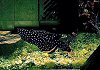 Baryancistrus
xanthellus Baryancistrus
xanthellus |
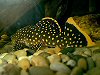 Baryancistrus
xanthellus Baryancistrus
xanthellus |
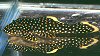 Baryancistrus
xanthellus Baryancistrus
xanthellus |
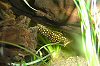 Baryancistrus
xanthellus Baryancistrus
xanthellus |
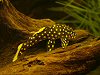 Baryancistrus
xanthellus Baryancistrus
xanthellus |
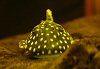 Baryancistrus
xanthellus Baryancistrus
xanthellus Head view |
 Baryancistrus
xanthellus Baryancistrus
xanthellus |
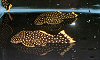 Baryancistrus
xanthellus Baryancistrus
xanthellus |
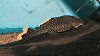 Baryancistrus
xanthellus Baryancistrus
xanthellus |
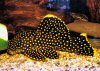 Baryancistrus
xanthellus Baryancistrus
xanthellus |
 Baryancistrus
xanthellus Baryancistrus
xanthellus |
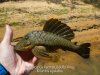 Baryancistrus
xanthellus Baryancistrus
xanthellus |
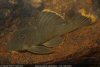 Baryancistrus
xanthellus Baryancistrus
xanthellus Near São Félix |
If you would like to contribute to the monthly factsheets with an article, information or photos, please e-mail me. You will of course be credited for your work.

If you would like to donate any denomination of monies to the site just click the above link button. All proceeds will go to running the site and hopefully to keep it going for a few years yet.

