SCOTCAT.COM
your internet guide to all things catfish
Farlowella henriquei Miranda Ribeiro, 1918 |
Image contributors to this species: |
Mitsuhiro Iwamoto (2) |
ScotCat Sources: |
|
|

Other Sources: |
|


Relevant Information: |
Aquarium Care: Not an easy catfish to keep as there have been many unexplained deaths attributed to this species (and other Farlowella) and as such would need dedicated care from an experienced catfish keeper who has worked with this species or its close cousins from the easier kept Sturisoma genera. As this is a very timid species, if housed with other inhabitants you would be better keeping away from boisterous fish such as some of the Barb species (such as tigers) and definitely Cichlids. Better companions would be the unobtrusive Corydoras species and small Characins or Rasboras. Needs a high oxygen content in the aquarium with regular water changes to keep the water in pristine condition. Prefers a dark substrate with a dense vegetation, floating and long leaved plants where they will hang on to. Diet: They are mostly vegetarian with algae being their number one source of food for adults and young fry so the above mentioned foods along with vegetable laden tablets should suffice. Etymology: The genus name Farlowella: –ella (L.), diminutive connoting endearment: in honour of American physician and botanist (specialising in algae) William Gilson Farlow (1844–1919), Harvard University. The specific name henriquei: In honour of Capt. Henrique Silva (no other information available), who collected holotype. |
Common Name: |
None |
Synonyms: |
None |
Family: |
Loricariidae |
Distribution: |
South America: Araguaia River basin, Brazil. Type locality: Rio Vermelho, aff. do Araguaya (Sta. Rita das Antas) [Brazil]. |
Size: |
16.5cm (6½ins) |
Temp: |
22-26°c (71-79°f.) |
p.H. |
|
6.0-7.0. |
IUCN Red List |
Farlowella henriquei is endemic to Brazil and known from the type locality in the Vermelho River, Araguaia River basin, and also from the Tocantins River basin (Acari-pucum) and downstream from the Tucuruí dam. However, these records are scarce and old, and there is taxonomic uncertainty for the species due to its great similarity to F. amazona . Hydroelectric dams, such as Tucuruí, can be a threat, but it is not possible to quantify the level of impact on the F. henriquei population due to taxonomic uncertainty and lack of biological information. For this reason, the species has been categorized as Data Deficient (DD), (IUCN 2022). |
Reference: |
Chico Mendes Institute
for Biodiversity Conservation (ICMBio).
2022. Farlowella henriquei. The IUCN Red
List of Threatened Species 2022. |

Family: Loricariidae Back to Ident-A-Cat Click on Thumbnails |
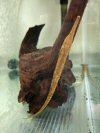 Farlowella
henriquei Farlowella
henriquei |
 Farlowella
henriquei Farlowella
henriquei |
If you would like to contribute to the monthly factsheets with an article, information or photos, please e-mail me. You will of course be credited for your work.

If you would like to donate any denomination of monies to the site just click the above link button. All proceeds will go to running the site and hopefully to keep it going for a few years yet.

