SCOTCAT.COM
your internet guide to all things catfish
Pseudancistrus barbatus (Valenciennes, 1840) |
Image contributors to this species: |
Raphael Covain (1) Karsten Schönherr (1) Mark Henry Sabaj (2) |
ScotCat Sources: |
|

Other Sources: |
|
|


Relevant Information: |
Habitat: Occurs in rapids where it lives in the rocky anfractuosities in the strong current zones. Fished by harpoons or bows in the shallow zones. Aquarium Care: Not the easiest species to maintain in the aquarium as it will need pristine water conditions with well filtered water which should not be too hard. Warm water should be the norm. Adult males are very territorial and will not get on with other large Loricariid catfish. Sexual Differences: The length of the male snout bristles might be related with the hierarchic level of the individual within the population. Males have a broad head and posses long bristles along the edge of the snout. Diet: Aufwuch grazer, mainly vegetarian, with lettuce, spinach, cucumber and courgette (zucchini), vegetarian flake and tablets. Will eat other foods also such as insect larvae, zooplankton and soft wood but will need to be kept on a mainly green diet. Etymology: The specific name barbatus: Bearded, alluding to bristles. |
Common Name: |
Bearded catfish |
Synonyms: |
Hypostomus barbatus, Hypostomus guttatus |
Family: |
Loricariidae |
Distribution: |
South America: Oyapock, Mana, Maroni, Suriname, Corantijn and Essequibo River basins. Type locality: Surinam. |
Size: |
20.0cm. (8ins) |
Temp: |
26-30°c (79-87°f) |
p.H. |
|
6.0-7.0. |
IUCN Red List |
Pseudancistrus barbatus is restricted to rivers basins in French Guiana, where it occurs in the Marowijne River at the border with Suriname, in Mana River, and in Oyapock River at the border with Brazil. The extent of occurrence (EOO) is estimated at 87,877 km2, and the area of occupancy (AOO) at 40,288 km2. There are local impacts in the lower portion of Oyapock basin in the coastal line of French Guiana close to the populated areas, and also along the main channel of Marowijne River basin along several cities, associated with pollution, increase of sediment, and agriculture activities impacting the ecosystem. Additionally, the species is sought after as part of a small-scale fishery by local communities, and illegal gold mining is fairly widespread in French Guiana. Except for local impacts, the overall distribution region seems relatively well preserved and there are no major threats. Thus, Pseudancistrus barbatus is assessed as Least Concern (LC), (IUCN 2022). |
Reference: |
|
Calegari, B.B.
2022. Pseudancistrus barbatus. The IUCN Red
List of Threatened Species 2022. |

Family: Loricariidae Back to Ident-A-Cat Click on Thumbnails |
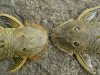 Pseudancistrus
barbatus Pseudancistrus
barbatus Pair-female on right |
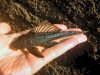 Pseudancistrus
barbatus Pseudancistrus
barbatusFrom Palumeu, Suriname |
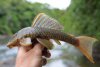 Pseudancistrus
barbatus Pseudancistrus
barbatusFrom the Oyapock |
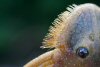 Pseudancistrus
barbatus Pseudancistrus
barbatus Male bristles on snout |
If you would like to contribute to the monthly factsheets with an article, information or photos, please e-mail me. You will of course be credited for your work.

If you would like to donate any denomination of monies to the site just click the above link button. All proceeds will go to running the site and hopefully to keep it going for a few years yet.

