SCOTCAT.COM  

your internet guide to all things catfish
≡
  • HOME
  • FACTSHEETS
    • By Month/Year
    • By Family
    • by Genus
    • by Common Names
    • By Specific Names
    • By Continent
      • Index
      • Africa
      • Asia
      • Australasia
      • Europe
      • North America
      • South America
  • GALLERIES
    • Photo Gallery
    • Art Gallery
    • Movie Gallery
    • Stamps Gallery
  • FAMILIES
    • A-B
      • Ailiidae
      • Akysidae
      • Amblycipitidae
      • Amphiliidae
      • Anchariidae
      • † Andinichthyidae
      • Ariidae
      • Aspredinidae
      • Astroblepidae
      • Auchenipteridae
      • Auchenoglanididae
      • Austroglanididae
      • Bagridae
    • C-D
      • Callichthyidae
      • Cetopsidae
      • Chacidae
      • Clariidae
      • Claroteidae
      • Cranoglanididae
      • Diplomystidae
      • Doradidae
    • H-I
      • Heptapteridae
      • Heteropneustidae
      • Horabagridae
      • Ictaluridae
    • K-L-M
      • Kryptoglanidae
      • Lacantuniidae
      • Loricariidae
      • Malapteruridae
      • Mochokidae
    • N-P
      • Nematogenyidae
      • Pangasiidae
      • Phreatobiidae
      • Pimelodidae
      • Plotosidae
      • Pseudopimelodidae
    • R-S-T
      • Ritidae
      • Schilbeidae
      • Scoloplacidae
      • Siluridae
      • Sisoridae
      • Trichomycteridae
  • ARTICLES
    • Index
    • Breeding
    • By Author
    • Cat-Articles
    • General
    • Numbered List
    • Ichthyology
    • Travel/Collecting
  • IDENT-A-CAT
  • RESOURCES
    • Citation
    • Etymology
    • Fishhouse
    • Glossary
    • Scientific Papers
    • ScotShop
  • SITE MAP
  • FB GROUP
  • HELP
    • Index
    • Catfish Anatomy
    • Convertors
    • FAQ
    • Ident-A-Cat
    • Water Chemistry

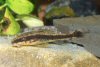
Pseudotothyris janeirensis Britski & Garavello, 1984


Image contributors to this species:

Hans-Georg Evers (1)

ScotCat Sources:

Etymology = Genus  Etymology = Specific name

Other Sources:

Search  Factsheet  Wikipedia  Catalog of Fishes  Global Biodiversity Information Facility  FishNet2  iNaturalist  IUCN

Relevant Information:

Description: Dorsal soft rays (total): 8-9; Anal soft rays: 5 - 6; Vertebrae: 28. Distinguished from all congeners by possessing dorsal-fin spinelet (vs. absent); transverse dark saddles on the dorsum absent (vs. present); subocular cheek plate always absent (vs. generally present); and odontodes on lateral plates aligned in well-defined series (vs. randomly distributed). It can be diagnosed from Pseudotothyris obtusa by having abdomen almost entirely naked, except for one to three lateral abdominal plates and one to two preanal plates (vs. abdomen partially or totally covered by scattered plates); 31-35 teeth on upper pharyngeal toothplate (vs. 20-30); and 18-23 teeth on ceratobranchial 5 (vs. 12-15 ). It differs differs from Pseudotothyris ignota by having the anterior margin of snout completely covered by odontodes (vs. anterior margin of snout with an odontode-free band). Habitat: This species is found in the Rio da Taquara and the Rio Lilico in the state of Rio de Janeiro and the specific name is tantamount to this state. This species is quite rare in its habitat due to pollution. Collected from a lentic environment, regionally known as açude, a kind of water reservoir. It is uncommon for Pseudotothyris and for the majority of the members of Hypoptopomatinae to occur in this type of habitat. Aquarium Care: It has been reported that this a difficult species to acclimatise to aquarium life and good water management is a must. Diet: Artemia naupli and vegetable foods. Etymology: The genus name Pseudotothyris: pseudo-, from pseúdes, false, i.e., although this genus may resemble Otothyris, such an appearance is false. The specific name janeirensis: From Rio de Janeiro or the State off.

Common Name:

None

Synonyms:

None

Family:

Loricariidae

Distribution:

South America: Brazil, The state of Rio de Janeiro. Type locality: Rio dos Macacos, Represa Engenho da Serra, Paulo de Frontin, Rio de Janeiro, Brazil.

Size:

4.0cm. (1½ins)

Temp:

18-24°c (63-75°f)

p.H.

6.5-7.0.

IUCN Red List

Pseudotothyris janeirensis is endemic to Brazil, considered to be of low abundance, occurring in lowland areas of coastal rivers in the state of Rio de Janeiro. The calculated Extent of Occurrence (EOO) is 10,262 km². The high degree of degradation of the basin imposes threats that cannot yet be quantified, but which characterize a continued decline in habitat quality. There is no concrete information on population fragmentation, nor on the number of locations. Thus, Pseudotothyris janeirensis was categorised as Near Threatened (NT), approaching the Vulnerable (VU) category by criterion B1b(iii), (IUCN 2022).

Reference:

Chico Mendes Institute for Biodiversity Conservation (ICMBio). 2022. Pseudotothyris janeirensis. The IUCN Red List of Threatened Species 2022.
Evers, H.-G. & I.Seidel
: Mergus, Baensch Catfish Atlas Volume 1, 1st English edn., 2005. Pp.944.
Ferraris, C.J. Jr., 2007. Checklist of catfishes, recent and fossil (Osteichthyes: Siluriformes), and catalogue of siluriform primary types. Zootaxa 1418:1-628.
Froese, R. and D. Pauly. Editors. 2021. FishBase. World Wide Web electronic publication. www.fishbase.org, ( 06/2021 ).
Martins, F.O., H.A. Britski and F. Langeani, 2014. Systematics of Pseudotothyris (Loricariidae: Hypoptopomatinae). Zool. J. Linn. Soc. 170:822-874.
The ETYFish Project Fish Name Etymology Database © Christopher Scharpf.


Back to Family page

Family: Loricariidae  Back to Ident-A-Cat  Click on Thumbnails

Click for full imagePseudotothyris janeirensis


If you would like to contribute to the monthly factsheets with an article, information or photos, please e-mail me. You will of course be credited for your work.


Donate towards my web hosting bill!


If you would like to donate any denomination of monies to the site just click the above link button. All proceeds will go to running the site and hopefully to keep it going for a few years yet.

  • Facebook about us + contact us + citation + translate + site map + scotshop + glossary + etymology +
  • help YouTube

©2026 SCOTCAT.COM