SCOTCAT.COM
your internet guide to all things catfish
Rhinotocinclus loxochelis Reis RE, Lehmann A. P., 2022 |
Image contributors to this species: |
ScotCat Sources: |
|
|

Other Sources: |
|


Relevant Information: |
A new genus has been erected, Rhinotocinclus, (2022) with the type species of Parotocinclus longirostris Garavello, 1988. Abstract: A new genus of Hypopopomatinae armored catfish is described from the northern portions of South America, namely the Amazon, Orinoco and Guianan coastal drainages. The new genus is diagnosed from all remaining hypoptopomatines by having the canal cheek plate on the ventral surface of the head posteriorly elongated and contacting the cleithrum, in addition to other features that distinguish the new genus from specific genera. Five new species are described and 18 species currently allocated in Parotocinclus, Hisonotus, and Curculionichthys are transferred to the new genus and rediagnosed. Parotocinclus amazonensis and P. aripuanensis are considered junior synonyms of P. britskii. The secondary sexual dimorphism of the members of the new genus is detailed and illustrated. Morphological characters are used to delimit four phenotypic groups of species that might have phylogenetic significance, which still have to be properly tested. A key to the species is offered and diagnoses, illustrations, and distribution maps are provided for all species (Reis & Lehmann 2022). Description: Rhinotocinclus loxochelis is distinguished from all congeners by having the dominant colour pattern formed by four dark bars on body somewhat fragmented and inclined, such that they connect to form a zig-zag pattern (vs. dominant colour pattern formed by dark bars separated and distinct, or dark bars wide and partially coalesced, or formed by a dark stripe from the snout tip, through the eye and extending to end of caudal peduncle). Rhinotocinclus loxochelis is further distinguished from R. britskii, R. discolor, R. eppleyi, R. isabelae, R. kwarup, R. longirostris, R. pilosus, R. polyochrus, R. variola, and R. yaka by lacking an adipose fin (vs. adipose fin present). Rhinotocinclus loxochelis is further distinguished from congeners, except R. marginalis, R. bockmanni, R. dani, and R. pentakelis, by having small platelets at adipose-fin position (vs. small platelets absent). Rhinotocinclus loxochelis is distinguished from R. bockmanni by lacking a triangular dark spot at the dorsal-fin membrane (vs. dorsal-fin dark spot present), and from R. hera by having yellow teeth cusps (vs. light ochre cusps). Rhinotocinclus loxochelis is further distinguished from R. marginalis by the dark bar 2 on body reaching to the ventral midline (vs. dark bars on body barely passing lateral dark stripe), and by the deeper caudal peduncle 10.3–11.2% vs. 9.1–10.1% SL) and longer pectoral-fin spine (30.4–32.1% vs. 26.7–30.3% SL); and from R. dani by the deeper body (body depth 18.3–20.4% vs. 16.3–18.3% SL, caudal peduncle depth 10.3–11.2% vs. 8.8–9.9% SL, and head depth 44.9–49.4% vs. 38.0–43.5% HL) (Reis & Lehmann 2022). Etymology: Rhinotocinclus masc., from the Greek ????s (Rhinos), beak, snout and Otocinclus, a genus of Hypoptopomatinae, in allusion to the conspicuous and elegant snout of most of its species. The specific name loxochelis: From the Greek (loxos), slanting, crosswise, and (kelis), stain, spot, in allusion to the broken and oblique dark bars of the species. A noun in apposition (Reis & Lehmann 2022). |
Common Name: |
None |
Synonyms: |
None |
Family: |
Loricariidae |
Distribution: |
South America: Known from creeks tributary to the rio Jamanxim, rio Tapajós basin, in the Jamanxim National Forest, Pará, Brazil. |
Size: |
2.5cm. (1ins) |
Temp: |
22-26°c (71-79°f.) |
p.H. |
|
6.5-7.2. |
IUCN Red List |
Not Evaluated. |
Reference: |
|
Reis RE, Lehmann A. P. A new genus of armored catfish (Siluriformes: Loricariidae) from the Greater Amazon, with a review of the species and description of five new species. Neotrop Ichthyol. 2022. |

Family: Loricariidae Back to Ident-A-Cat Click on Thumbnails |
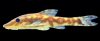 Rhinotocinclus
loxochelis Rhinotocinclus
loxochelisHolotype-creek in Jamanxim National Forest, Itaituba, Pará, Brazil |
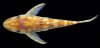 Rhinotocinclus
loxochelis Rhinotocinclus
loxochelisDorsal view-holotype-creek in Jamanxim National Forest, Itaituba, Pará, Brazil |
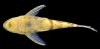 Rhinotocinclus
loxochelis Rhinotocinclus
loxochelisVentral view-holotype-creek in Jamanxim National Forest, Itaituba, Pará, Brazil |
If you would like to contribute to the monthly factsheets with an article, information or photos, please e-mail me. You will of course be credited for your work.

If you would like to donate any denomination of monies to the site just click the above link button. All proceeds will go to running the site and hopefully to keep it going for a few years yet.

