SCOTCAT.COM
your internet guide to all things catfish
Scobinancistrus pariolispos Isbrücker & Nijssen 1989 |
Image contributors to this species: |
Mark Henry Sabaj (1) |
ScotCat Sources: |
|

Other Sources: |
|


Relevant Information: |
Description: The body shape is described as being elongate and flattened and the body is completely covered with small spines. The mouth is described as being inferior with lips forming a disc-like shape and the teeth are arranged in rows. The eyes have a peg-shaped iris lobe which is typical of most species of Loricariid. The adipose fin consists of a spiny projection which supports a membrane. Aquarium Care: An ideal addition to an aquarium containing such fish as South American cichlids, discus and angelfish, just as long as the other occupants are not too aggressive and can withstand the higher water temperatures. They will get territorial as they mature. Sexual Diffences: The males tend to be more slender and larger than the females. The males tend to develop bristles around the cheeks and head, with larger spines or odontodes being present along the leading edge of the pectoral fin ray. Diet: Readily accepts a mixed and varied diet which includes sinking foods such as catfish pellets, frozen bloodworm and any other good quality foods which sink to the substrate. These catfish also have a preference to feed upon meatier foods such as dead fish, mussels and prawns. Etymology: The specific name pariolispos: pario-, from pareiá, cheek; líspos, smooth, referring to weakly developed odontodes in males (hence, having smooth rather than spiny cheeks). |
Common Name: |
Golden Cloud Pleco |
Synonyms: |
None |
Family: |
Loricariidae |
Distribution: |
Brazil: Tocantins and Tapajós River basins. |
Size: |
25.0cm. (9¾ins) |
Temp: |
24-29°c (75-85°f) |
p.H. |
|
5.8-7.2. |
IUCN Red List |
Scobinancistrus pariolispos is endemic to Brazil, occurring in the basins of the Xingu, Tocantins, Araguaia, and Tapajós rivers, in the states of Pará and Tocantins. The species is frequent and moderately abundant, associated with rocky areas and rapids. The geographic distribution of S. pariolispos is wide, but there is evidence of morphological variations in colour patterns associated with certain localities, which may indicate the existence of genetically distinct subpopulations. Specimens are collected for the aquarium trade and commercial fishing, but these activities apparently do not have a significant impact on the species' subpopulations. The main threat to its subpopulations of S. pariolispos is related to the construction of hydroelectric dams (HDDs) in its area of occurrence: on the Xingu River (Belo Monte HPD), Tocantins River (Marabá HPD), Araguaia River (Santa Isabel HPD), and in the drainage basins of the Tapajós River (São Luiz, Jatobá, Jamanxim, Cachoeira do Caí, Cachoeira dos Patos, and Jardim do Ouro HPDs). Considering the area of the river stretches where the species has confirmed records, it was inferred that approximately 31% will be impacted by the planned dams. Given the current Brazilian energy planning for the Amazon basin and the constructions already planned for the river basins where the species occurs, there will be a considerable loss of habitat, with a decrease in its area of occupancy. Thus, it is suspected that this would lead to a population reduction greater than 30% in 35 years or three generations, categorising Scobinancistrus pariolispos as Vulnerable (VU) under criterion A3c (IUCN 2022). |
Reference: |
|
Chico Mendes Institute
for Biodiversity Conservation (ICMBio). 2022.
Scobinancistrus pariolispos. The IUCN Red
List of Threatened Species 2022. |

Family: Loricariidae Back to Ident-A-Cat Click on Thumbnails |
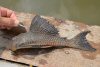 Scobinancistrus
pariolispos Scobinancistrus
pariolisposTocantins basin |
If you would like to contribute to the monthly factsheets with an article, information or photos, please e-mail me. You will of course be credited for your work.

If you would like to donate any denomination of monies to the site just click the above link button. All proceeds will go to running the site and hopefully to keep it going for a few years yet.

