SCOTCAT.COM
your internet guide to all things catfish
Spectracanthicus punctatissimus (Steindachner, 1881) |
Image contributors to this species: |
Alan Raeburn (2) Johnny Jensen's Photographic Library (2) Daniel Konn-Vetterlein (1) Haakon Haagensen (2) |
ScotCat Sources: |
|

Other Sources: |
|


Relevant Information: |
Description: Spectracanthicus punctatissimus can be distinguished from all congeners by having 12-14 vertebrae from first neural spine not including hypural plate (vs.8-11 in remaining species). It further differs from its congeners (except from S. murinus) by having yellowish bars on tip of dorsal and caudal fins; from S. immaculatus and S. zuanoni by having small yellowish dots covering body (vs.colour pattern uniform, with no dots or large white spots, respectively); and from S. tocantinensis by having the rounded dorsal profile of snout (vs.snout pointed). Spectracanthicus punctatissimus differs from S. murinus by presence of a bar-shaped eversible opercle with conspicuous odontodes (vs. triangle-shaped opercle not eversible, without conspicuous odontodes) and by the presence of 4 unbranched anal-fin rays (vs. 3 anal-fin unbranched rays). Aquarium Care: Should be no problem in the aquarium but would need a strong current and oxygen rich water due to the high temperatures enjoyed by this genus. Sexual Differences: Males have a longer and broader head and a larger growth of odontodes behind the gill covers and on the pectoral fin spines. Diet: Omnivore. A varied diet with both vegetable and other foods such as tablet and frozen. Etymology: The specific name punctatissimus: Latin for very spotted, referring to white or light-blue dots on head, body and fins. Remarks: As of 2019, L016 and L315 are now believed to be this species and also the genus of Oligancistrus is now a synonym of Spectracanthicus. |
Common Name: |
Peppermint Pleco, L016, L030, L315 |
Synonyms: |
Chaetostomus punctatissimus, Parancistrus punctatissimus, Hypostomus niveatus, Oligancistrus punctatissimus. |
Family: |
Loricariidae |
Distribution: |
Brazil: Pará, Rio Xingu (Altamira). |
Size: |
15.0cm. (6ins) |
Temp: |
26-30°c (79-87°f) |
p.H. |
|
6.0-7.2. |
IUCN Red List |
Spectracanthicus punctatissimus is endemic to Brazil, widely distributed in the Xingu River basin upstream of Belo Monte, in the state of Pará. The species is frequent and abundant, inhabiting rapids and rocky areas. The expected impacts from the installation of the Belo Monte hydroelectric power plant (UHE) will compromise approximately 12% of the calculated extent of occurrence (EOO) for the species. It is sold as an ornamental fish, but with current exploitation levels, this activity is not considered a significant impact. Currently, the species is not at risk of extinction. For this reason, S. punctatissimus has been categorised as Least Concern (LC), (IUCN 2022). |
Reference: |
Chamon, C.C. and L.H.
Rapp Py-Daniel, 2014. Taxonomic revision
of Spectracanthicus Nijssen & Isbrücker (Loricariidae:
Hypostominae: Ancistrini), with description of three
new species. Neotrop. Ichthyol. 12(1):1-25. |

Family: Loricariidae Back to Ident-A-Cat Click on Thumbnails |
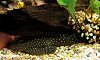 Spectracanthicus
punctatissimus Spectracanthicus
punctatissimus |
 Spectracanthicus
punctatissimus Spectracanthicus
punctatissimus |
 Spectracanthicus
punctatissimus Spectracanthicus
punctatissimus |
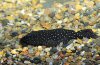 Spectracanthicus
punctatissimus Spectracanthicus
punctatissimus |
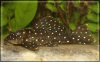 Spectracanthicus
punctatissimus Spectracanthicus
punctatissimus |
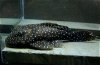 Spectracanthicus punctatissimus
 |
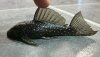 Spectracanthicus
punctatissimus Spectracanthicus
punctatissimusShowing dorsal fin |
If you would like to contribute to the monthly factsheets with an article, information or photos, please e-mail me. You will of course be credited for your work.

If you would like to donate any denomination of monies to the site just click the above link button. All proceeds will go to running the site and hopefully to keep it going for a few years yet.

