SCOTCAT.COM
your internet guide to all things catfish
Synodontis macrophthalmus Poll, 1971 |
Image contributors to this species: |
Max Poll Révision des Synodontis Africains (Famille Mochocidae) (3) |
ScotCat Sources: |
|

Other Sources: |
|
|


Relevant Information: |
Description: Dorsal spines (total): 1; Dorsal soft rays (total): 7; Anal spines: 0; Anal soft rays: 13. Diagnosis: eyes remarkably large, 26.3% of head length, only comparable with some Synodontis species from the Congo River basin. Gill slits not extending ventrally beyond pectoral-fin insertions; post-orbital length at most 60% of snout length; maxillary barbels broadly fringed, shorter than head, unbranched and not tuberculate, but with a distinct basal membrane; mandibular barbels with simple and more or less thick ramifications, especially those of the inner pair; width of premaxillary tooth plate comprised at most 1.8 times in eye diameter; mandibular teeth numbering 19; pectoral-fin spines of holotype broken off, but in the basal region, denticulations are stronger on inner than on outer margin; dorsal-fin spine also mutilated, but remaining basal stump smooth anteriorly; humeral process granulate, concave on upper margin, not keeled ventrally; adipose fin rather long, low and distinctly separated from the rayed dorsal fin; outer margin of caudal fin black-edged. Habitat: This species is restricted to two locations at Ampem, Volta basin in Ghana and at the Pendjari river in Benin. In Benin the species is located in a National Park. Colouration: Only known specimen (holotype) light, outer caudal-fin lobes are dark-edged. Aquarium Care: This species has not been imported so far (2019) so the maintenance is not known but probably the genus-typical requirements for this genera. Etymology: The specific name macrophthalmus: Big-eyed, from makrós, long or large, and ophthalmós, eye, referring to its very large eyes compared with congeners in the Congo. |
Common Name: |
None |
Synonyms: |
Synodontis macrophthalma |
Family: |
Mochokidae |
Distribution: |
Africa: Only known from the type locality in the Volta basin in Ghana. Type locality: Ampem, Volta Lake (Ghana). |
Size: |
14.5cm. (5¾ins) |
Temp: |
22-27°C (71-81°F) |
p.H. |
|
6.5-7.5. |
IUCN Red List |
This species is restricted to Ampem in the Volta basin, Ghana. It has an extent of occurrence (EOO) of 62 km2. The quality of its habitat is probably declining due to the major threats of agricultural pollution and deforestation, while the population is threatened by over exploitation. There is a single location based on these threats. This species is therefore assessed as Critically Endangered B1ab(iii), (IUCN 2020). |
Reference: |
Dankwa, H.
2020. Synodontis macrophthalmus. The IUCN
Red List of Threatened Species 2020. |

Family: Mochokidae Back to Ident-A-Cat Click on Thumbnails |
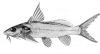 Synodontis
macrophthalmus |
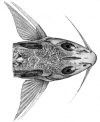 Synodontis
macrophthalmus Dorsal head view |
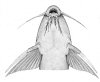 Synodontis
macrophthalmus Ventral view |
If you would like to contribute to the monthly factsheets with an article, information or photos, please e-mail me. You will of course be credited for your work.

If you would like to donate any denomination of monies to the site just click the above link button. All proceeds will go to running the site and hopefully to keep it going for a few years yet.

