SCOTCAT.COM
your internet guide to all things catfish
Pangasius krempfi Fang & Chaux, 1949 |
Image contributors to this species: |
Fishes of Mainland Southeast Asia (1) MUSËUM Nal Hist NATURELLE (3) |
ScotCat Sources: |
|
|

Other Sources: |
|


Relevant Information: |
Description: Dorsal spines (total): 1; Dorsal soft rays (total): 6-7; Anal spines: 4; Anal soft rays: 31 - 34. Body depth 4.5-5.0 times in SL (Ref. 43281). Dorsum sky blue; submarginal caudal-fin stripes absent; no humeral spot; vomerine teeth separate at midline, joined to palatine teeth on each side forming long crescentic patches; 18-22 gill rakers in first arch. Body dark blackish gray on top and sides, silver gray on abdomen and fins lightly yellow. Migrating but the direction is unknown. Taxonomy of this species may be problematic. Habitat: Unique among pangasiid species in the Mekong in spending a major part of its life in marine coastal waters. Reproduction: Migrates into the Mekong River (but not into any other rivers) in order to breed. Regarded to be anadromous. It was hypothesised that at least two populations in the Mekong undertake migration. One population migrates during May-September from just south of Khone Falls upstream to spawning grounds along the mainstream Mekong all the way to Chiang Khong near the Lao-Thai-Myanmar border. The other population migrates downstream from around Stung Treng to unknown spawning grounds somewhere between Stung Treng and Kompong Cham in Cambodia during the spawning season between May and August. When water level starts to fall in October, the fish moves back to the main river to initiate an upstream dispersal migration, reaching the stretch just below the Khone Falls. Stays in deep pools within the mainstream during the dry season. Only two specimens of the fish were collected on April 5, 1956 and September 10, 1957 in Beihai City, Guangxi. Another on November 22, 1963 at Shanwei City of Guangdong Province. Diet: Dietary habits have not been studied. Etymology: The specific name krempfi: In honour of French marine biologist Armand Krempf (1879–1969), Nha Trang Institute of Oceanography (Vietnam), who collected holotype. |
Common Name: |
Chinese pangasid-catfish |
Synonyms: |
Sinopangasius semicultratus |
Family: |
Pangasiidae |
Distribution: |
Asia: Mekong and Hue River basins, and along coast of South China Sea of Vietnam and Guandong, China. Type locality: en mer .... à Bong-Lao [Vietnam]. |
Size: |
120.0cm. (4ft.0ins) |
Temp: |
22-28°C (71-83°F) |
p.H. |
|
7.0-8.0. |
IUCN Red List |
Levels of population decline are significant but even though the catch per unit effort data doesn't show a large decline, this data was for 1993-1999 and recent anecdotal data indicate larger recent declines. The species generation length is estimated to be seven years and it is suspected that the species population has declined by more than 30% over the past 21 years (since 1990). However, it is probable that a large dam will be built on the Mekong within the next 3 generations (21 years) which will cause a major decline in species population as the majority of the species population migrates up the Mekong. If a proposed dam is given permission to be built, the species should be reassessed looking at the impacts of the dam upon the species migrating population, and so this species is catorgised as Vulnerable A2d, but needs updating (IUCN 2011). |
Reference: |
Baird, I.
2011. Pangasius krempfi. The IUCN Red List
of Threatened Species 2011. |

Family: Pangasiidae Back to Ident-A-Cat Click on Thumbnails |
 Pangasius
krempfi Pangasius
krempfi |
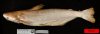 Pangasius krempfi
Holotype-lateral view |
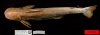 Pangasius
krempfi Pangasius
krempfiHolotype-dorsal view |
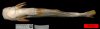 Pangasius
krempfi Pangasius
krempfiHolotype-ventral view |
If you would like to contribute to the monthly factsheets with an article, information or photos, please e-mail me. You will of course be credited for your work.

If you would like to donate any denomination of monies to the site just click the above link button. All proceeds will go to running the site and hopefully to keep it going for a few years yet.

