SCOTCAT.COM
your internet guide to all things catfish
Pangasius polyuranodon Bleeker, 1852 |
Image contributors to this species: |
Original Source (1) Ian Baird (1) |
ScotCat Sources: |
|
|

Other Sources: |
|


Relevant Information: |
Description: Dorsal spines (total): 2; Dorsal soft rays (total): 6-8; Anal spines: 0; Anal soft rays: 33 - 43. Body somewhat elongated with short predorsal length (25.2-29.2% SL); a long caudal peduncle (17.2-21.8% SL); short head length (16.1-20.1% SL); and, short mandibular barbels (length 11.7-42.2% HL). Swim bladder 3-chambered, extending to above anal-fin base. Dorsum dark blue to blue-black; 3-4 lowermost principal caudal rays white; vomerine teeth appearing as 2 joined patches in juveniles; vomerine teeth united into quadrangular patch, 1.5 times broader than long, not confluent with palatine teeth patch; anal fin base elongate, its length 3.1-3.6 times in SL; dorsal and pectoral fin spines slender; snout blunt. Habitat: Found in lakes and rivers. Occurs in estuaries and lower reaches but has also been observed in the upper reaches during the rainy season. Diet: Species is omnivorous with a tendency to opportunism. Etymology: The specific name polyuranodon: poly-, many; urano-, from ouranískos, roof of mouth; odon, from odoús, tooth, referring to its large, square group of vomerine teeth. |
Common Name: |
None |
Synonyms: |
Pangasius juaro, Pseudopangasius polyuranodon |
Family: |
Pangasiidae |
Distribution: |
Asia: Rivers of Sumatra and northern, western and southern Borneo. Type locality: Bandjermassing, in fluviis. |
Size: |
80.0cm. (32ins) |
Temp: |
22-28°C (71-83°F) |
p.H. |
|
6.5-7.5. |
IUCN Red List |
Although there is no detailed information on the population size and trend of this species, it is still abundant throughout its known distribution. While there may be localised or regional threats, they are unlikely to affect this species on a range-wide scale, and it is found within several protected areas. Therefore, it is assessed as Least Concern (IUCN 2019). |
Reference: |
Ferraris, C.J. Jr.,
2007. Checklist of catfishes, recent and fossil (Osteichthyes:
Siluriformes), and catalogue of siluriform primary
types. Zootaxa 1418:1-628. |

Family: Pangasiidae Back to Ident-A-Cat Click on Thumbnails |
 Pangasius polyuranodon
Line drawing |
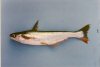 Pangasius
polyuranodon Pangasius
polyuranodon |
If you would like to contribute to the monthly factsheets with an article, information or photos, please e-mail me. You will of course be credited for your work.

If you would like to donate any denomination of monies to the site just click the above link button. All proceeds will go to running the site and hopefully to keep it going for a few years yet.

