SCOTCAT.COM
your internet guide to all things catfish
Brachyplatystoma vaillantii (Valenciennes, 1840) |
Image contributors to this species: |
Nishant Kakani (2) Enrico Richter (1) Allan James (1) Liam Irons-Mclean (1) Erling Holm (1) |
ScotCat Sources: |
|
|

Other Sources: |
|


Relevant Information: |
Description: Resembles B. filamentosum, but B. vaillantii has a larger adipose fin and does not grow as large as the former. Habitat: In the Amazon, They congregate in schools at the Rio Madeira rapids every four to five years (Goulding 1981). These schools apparently originate in the Amazon estuaries and migrate upstream as far as the Rio Solimoes. it can sometimes be caught in the upper part up to the foot of the Andean range where it appears to be more rare than Brachyplatystoma filamentosum and but never in the zones prone to flood. Reproductive migrations probably occur like in other Brachyplatystoma. Usually caught with long lines and drift nets. Its flesh of excellent quality is highly appreciated. Etymology: The specific name vaillantii: In honour of François Levaillant (1753–1824), French explorer, naturalist and zoological collector, who brought the types to Europe. |
Common Name: |
Laulao catfish, Piramutaba (Brazil). |
Synonyms: |
Platystoma vaillantii, Piramutana piramuta, Bagrus piramuta, Bagrus reticulatus, Brachyplatystoma parnahybae. |
Family: |
Pimelodidae |
Distribution: |
South America: Amazon and Orinoco River basins and major rivers of the Guianas and northeastern Brazil. |
Size: |
140.0cm. (4ft 8ins) |
Temp: |
22-27°C (71-81°F) |
p.H. |
|
6.0-7.2. |
IUCN Red List |
Despite the little information available on this species, it has a wide range and no apparent threats that put the species at risk of extinction. Therefore, it is assessed as Least Concern (IUCN 2024). |
Reference: |
Burgess, W.E.
1989 An atlas of freshwater and marine catfishes.
A preliminary survey of the Siluriformes. T.F.H. Publications,
Inc., Neptune City, New Jersey (USA). 784 p. |

Family: Pimelodidae Back to Ident-A-Cat Click on Thumbnails |
 Brachyplatystoma vaillantii
 |
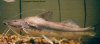 Brachyplatystoma
vaillantii Brachyplatystoma
vaillantii |
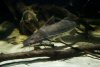 Brachyplatystoma
vaillantii Brachyplatystoma
vaillantii |
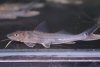 Brachyplatystoma
vaillantii Brachyplatystoma
vaillantiiJuvenile |
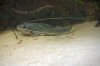 Brachyplatystoma
vaillantii Brachyplatystoma
vaillantii |
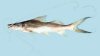 Brachyplatystoma
vaillantii Brachyplatystoma
vaillantii |
If you would like to contribute to the monthly factsheets with an article, information or photos, please e-mail me. You will of course be credited for your work.

If you would like to donate any denomination of monies to the site just click the above link button. All proceeds will go to running the site and hopefully to keep it going for a few years yet.

