SCOTCAT.COM
your internet guide to all things catfish
Steindachneridion parahybae (Steindachner, 1877) |
Image contributors to this species: |
Carla Natacha Marcolino Polaz (2) Guilherme Souza (1) |
ScotCat Sources: |

|
Other Sources: |
|


Relevant Information: |
The export of this large species is very rare as they have not been caught in any great numbers. It is classed as endangered in its natural habitat. The main threats to its existence are the construction of dams, riparian habitat destruction, water pollution and fishing. Description: Pectoral, adipose and pelvic fins small sized; pelvic fin short, never reaching anus; color pattern combining dark brown lines with large dark brown dots on dorsum of head and trunk; 15-17 gill-rakers on first branchial arch. Etymology: The specific name parahybae: From the Rio Parahyba, Brazil. Remarks: The first specimen is a juvenile captured in Pirassununga, São Paulo State, Brazil in 2010. The second specimen was photographed by the image contributor in CESP Aquaculture Station, Paraibuna, São Paulo State in 2009. |
Common Name: |
None |
Synonyms: |
Platystoma parahybae. |
Family: |
Pimelodidae |
Distribution: |
South America: Paraíba do Sul and Jequitinhonha river basins. Type locality: Rio Parahyba bei Juiz de Fora; Rio Jequitin-honha, Brazil. |
Size: |
100.0cm. (3ft 4ins) |
Temp: |
22-27°C (71-81°F) |
p.H. |
|
6.0-7.2. |
IUCN Red List |
Steindachneridion parahybae originally occurred throughout the Paraíba do Sul River basin, in the states of São Paulo, Rio de Janeiro, and Minas Gerais. It is a rare and scarce species, closely associated with rocky areas in pools near rapids. The area of occupancy (AOO) calculated based on confirmed localities of occurrence of the species is 28 km². The various dams in the Paraíba do Sul River basin cause severe fragmentation of the population, since individuals do not inhabit the reservoirs. The dams are responsible for altering or eliminating the lotic environments occupied by this species, which, together with siltation and domestic and industrial pollution, promote the continued decline of the area of occupancy, extent, and quality of the habitat. Thus, S. parahybae was listed in the Endangered (EN) category, (IUCN 2021). |
Reference: |
Chico Mendes Institute
for Biodiversity Conservation (ICMBio).
2021. Steindachneridion parahybae. IUCN Red
List of Threatened Species 2021. |

Family: Pimelodidae Back to Ident-A-Cat Click on Thumbnails |
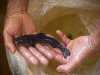 Steindachneridion parahybae
Juvenile |
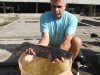 Steindachneridion
parahybae Steindachneridion
parahybae |
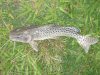 Steindachneridion
parahybae Steindachneridion
parahybaeDorsal view |
If you would like to contribute to the monthly factsheets with an article, information or photos, please e-mail me. You will of course be credited for your work.

If you would like to donate any denomination of monies to the site just click the above link button. All proceeds will go to running the site and hopefully to keep it going for a few years yet.

