SCOTCAT.COM
your internet guide to all things catfish
Zungaro jahu (Ihering, 1898) |
Image contributors to this species: |
Julio Endler (2) |
ScotCat Sources: |
|
|

Other Sources: |
|


Relevant Information: |
Zungaro jahu and Z. zungaro are the two valid species of the genus Zungaro. The Amazonian species, Z. zungaro, is listed as "overexploited or endangered by overexploitation" in Brazil (MMA, 2004). Jau (Z. jahu) is listed as being vulnerable in two Brazilian states, ie, Minas Gerais and Paraná (Machado et al, 1998;. & Mikich Bérnils, 2004). The Minas Gerais List Has been recently revised, but has not yet been published. Jau will be listed as critically endangered in the new Minas Gerais list. It is an important commercial and sport fish, and substantial commercial landings still Occur in long, free-flowing river stretches (Matthew et al., 2004). However, jaú Has Been overexploited in Paraguay River and Parana River (Augustine et al. 2003; Resende, 2003). Also, it has Practically disappeared in the southern part of its distribution area (Quirós, 1993). It used to be abundant in the Rio Grande (Azevedo, 1965), but now Occurs in only a few places (Godinho, 1998). In addition to the fragile conservation status of jaú, its biology and ecology are poorly known (Augustine et al. 2003; Resende, 2003). Habitat: Zungaro jahu (Ihering, 1898), is endemic to the rivers that form the La Plata River basin (in Paraná river, Paraguay and Uruguay River), occurring in Argentina, Bolivia, Brazil, and Paraguay (Lundberg & Littmann, 2003 ; Zaniboni Filho & Schulz, 2003). Jau is one of the largest Neotropical catfishes and may reach a weight of up to 150 kg (Ihering, 1929). It is a main stem migratory species (Agostinho et al., 2003, Resende, 2003), but its migratory movements are poorly known. Reproduction: Jau Reaches maturity at 70 cm (total length) and spawns from December to February in the upper Paraná River (Agostinho et al., 2003). Jau is nocturnal and piscivorous, and adults prefer deeper habitats in large rivers (Augustine et al. 2003; Resende, 2003). Etymology: The specific name jahu: Presumably local name for this catfish along the Rio Paraná in São Paulo, Brazil. |
Common Name: |
Jau, Manguruyu |
Synonyms: |
Paulicea jahu |
Family: |
Pimelodidae |
Distribution: |
South America: Paraná-Paraguay River basin. Type locality: Sao Paulo [Brazil]. |
Size: |
140.0cm. (4ft 8ins) |
Temp: |
20-24°C (67-75°F) |
p.H. |
|
6.0-7.5. |
IUCN Red List |
Zungaro jahu is present in La Plata River basins, including Paraná, Paraguay and Uruguay drainages, but has records mainly for the Paraná and Paraguay river basins. The subpopulations of these basins have very distinct situations regarding their conservation status. In the Paraná River basin, the species is quite compromised, having suffered a severe decline, mainly due to the construction of a series of dams since the late 1970s. In the Paraguay River basin, in the Pantanal region, fishing data from the last 20 years do not indicate a reduction in the catch of the species in professional artisanal fishing. The generation length of the species is estimated at about 10 years. Although the area of the Paraná River basin is larger than that of the Paraguay River, we consider that the population of the species is divided equally between the basins, due to the higher productivity of the Paraguay River basin (Pantanal floodplain). The subpopulations of these two basins do not have interconnectivity, and contributions to the subpopulations occurring in upper Paraná are not expected, totally compromised by the fragmentation caused by successive dams. A decline of at least 50% is suspected only in the subpopulation of the Paraná River basin in the last 30 years (three generations). The Pantanal subpopulations are considered stable. Therefore, a total population reduction of 25% is estimated over the last three generations. Thus, Zungaro jahu was classified as Near Threatened (NT), approaching Vulnerable (VU) A2cd, (IUCN 2023). |
Reference: |
Carlos Bernardo Mascarenhas
Alves; Luiz Gustavo Martins da Silva and Alexandre
Lima Godinho, Radiotelemetry of a female
jaú, Zungaro jahu (Ihering, 1898) (Siluriformes:
Pimelodidae), passed upstream of Funil Dam, Rio Grande,
Brazil. Neotrop. Ichthyol. vol.5 no.2 Porto Alegre
2007. |

Family: Pimelodidae Back to Ident-A-Cat Click on Thumbnails |
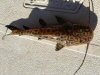 Zungaro jahu
Juvenile |
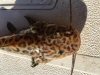 Zungaro
jahu Zungaro
jahu Juvenile head view |
If you would like to contribute to the monthly factsheets with an article, information or photos, please e-mail me. You will of course be credited for your work.

If you would like to donate any denomination of monies to the site just click the above link button. All proceeds will go to running the site and hopefully to keep it going for a few years yet.

