SCOTCAT.COM
your internet guide to all things catfish
Exostoma labiatum (McClelland, 1842) |
Image contributors to this species: |
Freshwater Fishes of China in Coloured Illustrations (2) Zhou Hang (1) |
ScotCat Sources: |
|

Other Sources: |
|


Relevant Information: |
Description: Exostoma is distinguished from Glyptosternon, Glaridoglanis, Pareuchiloglanis, Euchiloglanis and Parachiloglanis by having a continuous post-labial groove. Exostoma is distinguished from Pseudexostoma and Oreoglanis by having homodont (vs. heterodont) dentition in the lower jaw. It is further distinguished from Oreoglanis by having oar-shaped, distally flattened (vs. pointed) teeth in the upper jaw, and from Pseudexostoma by having homodont (vs. heterodont) teeth in the upper jaw. Exostoma is distinguished from Myersglanis by having tooth patches separated in the upper jaw and oar-shaped, distally flattened teeth in both jaws (vs. tooth patches juxtaposed and pointed teeth in both jaws). Exostoma is further distinguished from Pseudexostoma and Oreoglanis by having 10–11 branched pectoral rays (vs. 16–18). Etymology: The specific name labiatum: Latin for lipped, referring to its multilobate lips, “reflected and spread continuously around the mouth, so as to form a broad flat sucker”. |
Common Name: |
Burmese bat catfish |
Synonyms: |
Glyptosternon labiatus, Exostoma labiatus |
Family: |
Sisoridae |
Distribution: |
Asia: Brahmaputra drainage, northeast India (Hora & Silas, 1952b; Chu et al., 1999; Jayaram, 1999). Reported from the Salween drainage, Myanmar (Kottelat, 1989) and the Irrawaddy drainage, China (Chu et al., 1999).Type locality: Mishmee Hills, Meghalaya, India. |
Size: |
10.0cm. (4ins) |
Temp: |
20-24°c (67-75°f.) |
p.H. |
|
6.5-7.5. |
IUCN Red List |
Exostoma labiatum has been recorded from a few locations in India (Meghalaya and Arunachal Pradesh) and China (Tibet), but its distribution range is inferred to be wide in the Brahmaputra River drainage. Although there is insufficient information on distribution, biology and population, lack of any known or identified threats to the species makes it a candidate for Least Concern, but needs updating, (IUCN 2010). |
Reference: |
Ng, H.H. 2010.
Exostoma labiatum. The IUCN Red List of Threatened
Species 2010. |

Family: Sisoridae Back to Ident-A-Cat Click on Thumbnails |
 Exostoma labiatum
 |
 Exostoma
labiatum Exostoma
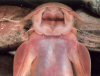
labiatumShowing the pectorals striated to form an adhesive apparatus |
 Exostoma
labiatum Exostoma
labiatum |
If you would like to contribute to the monthly factsheets with an article, information or photos, please e-mail me. You will of course be credited for your work.

If you would like to donate any denomination of monies to the site just click the above link button. All proceeds will go to running the site and hopefully to keep it going for a few years yet.

