SCOTCAT.COM
your internet guide to all things catfish
Glyptothorax laosensis Fowler, 1934 |
Image contributors to this species: |
Freshwater Fishes of China in Coloured Illustrations (1) Zhou Hang (1) Cheilinus Aquarium Photography (3) |
ScotCat Sources: |
|

Other Sources: |
|


Relevant Information: |
Description: Glyptothorax is distinguished from all other sisorid genera by having an adhesive apparatus on the thorax with with grooves parallel or oblique to the longitudinal axis of the body (vs. thoracic adhesive grooves transverse to the longitudinal axis of the body in Pseudecheneis, and thoracic adhesive apparatus absent in all other genera). Habitat: Adults inhabit flowing waters of small and medium-sized streams. Found over coarse substrates and in small upland streams with alternating pools, waterfalls and rapids. Colouration: G. laosensis has a blackish body; a yellowish stripe along the middle of the side and one along the dorsal mid-line; head and body smooth, covered by small tubercles, all more or less of same size; usually a black bar or almost entirely black on anal fin. Diet: Feeds on aquatic insect larvae. Etymology: The specific name laosensis: –ensis, Latin suffix denoting place: Laos (which Fowler defined as “Siam,” now Thailand), where type locality (Bua Yai, Mekong River drainage) is situated, but also occurs in Laos (and China). |
Common Name: |
None |
Synonyms: |
None |
Family: |
Sisoridae |
Distribution: |
Asia: Chao Phraya and Mekong drainages, China, Laos and Thailand. Type Locality: Bua Yai [Mekong drainage], E. Thailand. |
Size: |
11.0cm. (4¼ins) |
Temp: |
18-23°c (63-73°f.) |
p.H. |
|
6.0-7.0. |
IUCN Red List |
The species has a wide distribution and is considered Least Concern, but does need updating, (IUCN 2012). |
Reference: |
Alfred W. Thomson &
Lawrence M. Page; 30 October 2006. Genera
of the Asian Catfish Families Sisoridae and Erethistidae
(Teleostei: Siluriformes) (Zootaxa 1345). |

Family: Sisoridae Back to Ident-A-Cat Click on Thumbnails |
 Glyptothorax laosensis
 |
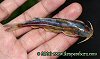 Glyptothorax
laosensis Glyptothorax
laosensis |
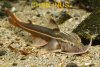 Glyptothorax
laosensis Glyptothorax
laosensis |
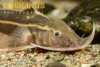 Glyptothorax
laosensis Glyptothorax
laosensisHead view |
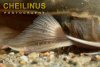 Glyptothorax
laosensis Glyptothorax
laosensisPectoral view |
If you would like to contribute to the monthly factsheets with an article, information or photos, please e-mail me. You will of course be credited for your work.

If you would like to donate any denomination of monies to the site just click the above link button. All proceeds will go to running the site and hopefully to keep it going for a few years yet.

