SCOTCAT.COM
your internet guide to all things catfish
Oreoglanis macroptera (Vinciguerra, 1890) |
Image contributors to this species: |
Zhou Hang (6) |
ScotCat Sources: |
|

Other Sources: |
|


Relevant Information: |
Description: Dorsal soft rays (total): 6; Anal soft rays: 3 - 4; Vertebrae: 37 - 41. Lower lip lacking a median notch and having an entire posterior margin. Caudal fin emarginate. Male genital papilla immediately behind the anus in a depression terminating posteriorly with a straight transverse wall. Found in mountain streams. Oreoglanis is distinguished from Glyptosternon, Glaridoglanis, Euchiloglanis, Pareuchiloglanis and Parachiloglanis by having a continuous post-labial groove. It is distinguished from Pareuchiloglanis, Glyptosternon, Euchiloglanis, Myersglanis, and Parachiloglanis by having heterodont dentition in the lower jaw characterised by an inner row of pointed teeth and an outer row of short, spatulate (shovel-like) teeth (vs. a single band of conical teeth). Oreoglanis is distinguished from Pseudexostoma by having upper jaw teeth pointed, in two patches, joined into a continuous band (vs. heterodont dentition in two separated patches). It is distinguished from Exostoma by having the upper jaw teeth pointed, in two patches, joined into a continuous band (vs. having oar-shaped, distally flatted teeth in two separated patches), and 16–18 (vs. 10–11) branched pectoralrays. Etymology: The specific name macroptera: macro-, from makrós, long or large; ptera, from pterón or ptéryx, fin, referring to its large pectoral fins, which extend far beyond belly and dorsal-fin base. Remarks: Still found on some online sources as Oreoglanis macropterum. |
Common Name: |
None |
Synonyms: |
Euchiloglanis macropterus, Exostoma macropterum, Oreoglanis macropterum, Glyptosternum macropternum |
Family: |
Sisoridae |
Distribution: |
Asia: Irrawaddy and Salween drainages, Myanmar and China. Type locality: Khahyen Hills, Upper Myanmar [Burma]. |
Size: |
10.0cm. (4ins) |
Temp: |
20-24°c (67-75°f.) |
p.H. |
|
6.0-7.0. |
IUCN Red List |
Although there is little information on the distribution, population (and its trends), and biology of Oreoglanis macropterus (macroptera), available published data from field surveys indicates that it is a relatively common species. Given the fact that this species inhabits areas where fishing and other anthropogenic pressures are relatively low, it is therefore assessed as Least Concern, but needs updating, (IUCN 2010). |
Reference: |
Alfred W. Thomson &
Lawrence M. Page; 30 October 2006. Genera
of the Asian Catfish Families Sisoridae and Erethistidae
(Teleostei: Siluriformes) (Zootaxa 1345). |

Family: Sisoridae Back to Ident-A-Cat Click on Thumbnails |
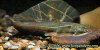 Oreoglanis macroptera
 |
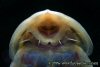 Oreoglanis
macroptera Oreoglanis
macropteraShowing mouth |
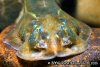 Oreoglanis
macroptera Oreoglanis
macropteraHead view |
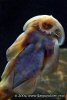 Oreoglanis
macroptera Oreoglanis
macropteraVentral view |
 Oreoglanis
macroptera Oreoglanis
macropteraVentral view |
 Oreoglanis
macroptera Oreoglanis
macroptera |
If you would like to contribute to the monthly factsheets with an article, information or photos, please e-mail me. You will of course be credited for your work.

If you would like to donate any denomination of monies to the site just click the above link button. All proceeds will go to running the site and hopefully to keep it going for a few years yet.

