SCOTCAT.COM
your internet guide to all things catfish
Cathorops arenatus (Valenciennes, 1840) |
Image contributors to this species: |
IHUNTA (3) |
ScotCat Sources: |
|

Other Sources: |
|
|


Relevant Information: |
Description: Body relatively short; head a little depressed, profile a little convex; snout short; shield on top of head relatively long, with irregularly distributed patches of fine granules behind level of eyes, no granules on front extensions of shield; groove along center-top of head short, with irregular inner margins that are narrowest at the center, where they touch or nearly touch; bony process between head shield and dorsal fin base long, relatively narrow behind, its profile convex; bony plate at base of dorsal fin relatively wide and short; eyes small, 4.7-7.1% of SL; 2 pairs of close-set nostrils, those close to eyes; no fleshy furrow extends across snout and connects rear nostrils; 3 pairs of barbells (on chin and both jaws), top barbell long (27.3-41.4% SL), reaching the middle of the pectoral fin spine; mouth wide, lower jaws a little arched; lips relatively thick, lower lips thicker; roof of mouth with 1 pair of relatively small, well separated, oval tooth patches (narrower and smaller in male), equipped with large molar-like teeth; top jaw tooth bands fused, relatively short and narrow; each lower jaw with an elongate, teardrop-shaped band of teeth, pointed behind, front teeth smaller than larger, molar-like rear teeth on the broad front part of that patch; gill opening restricted to sides by adhesion of gill membranes to breast; gill rakers 17-23 (6-8+11-14) on first arch, 16-20 (4-7+11-14) on second arch, present on rear surfaces of first two gill arches, no papillae between front rakers; dorsal fin spine long and thick, longer than pectoral fin spine, inner 2/3 of front edge of spine with granules, outer 1/3 serrated, rear edges with short serrations; adipose dorsal fin small, low, its base short (<1/2 length of base of anal fin); pectoral spines long and thick, inner 2/3 of front of spine with granules, outer 1/3 serrated, rear edges with short serrations; anal fin 21-24 rays, its base longer than its height; tail base relatively deep, depth 8.1-10.1% of SL; tail fin deeply forked; a complete lateral line, with branches to top and bottom base of tail fin, no scales. Colouration: Preserved fish brownish, paler below; sides yellowish in life. Diet: Benthic worms, Insects, Bony fishes. Habitat: Lives in estuaries. Etymology: The specific name arenatus: Latin for sandy or sanded, presumably referring to “yellowish gray fins dusted with fine black dust” (translation). |
Common Name: |
Yellow sea catfish |
Synonyms: |
Arius arenatus, Arius fissus, Cathorops fissus |
Family: |
Ariidae |
Distribution: |
Southwestern Atlantic: Atlantic coastal rivers from Guyana to northeastern Brazil: Brazil, French Guiana, Guyana and Suriname. |
Size: |
23.0cm. (9ins) |
Temp: |
- |
p.H. |
|
- |
IUCN Red List |
This species is widely distributed and common where it occurs in coastal marine and estuarine habitats. There are no known major threats. Therefore, it is listed as Least Concern, but needs updating (IUCN 2015). |
Reference: |
biogeodb.stri.si.edu/caribbean/en/thefishes/species/4466. |

Family: Ariidae Back to Ident-A-Cat Click on Thumbnails |
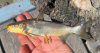 Cathorops
arenatus Commewijne, Alkmaar, Commewijne, Suriname |
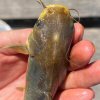 Cathorops
arenatus Head view-Commewijne, Alkmaar, Commewijne, Suriname |
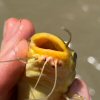 Cathorops
arenatus Mouth view-Commewijne, Alkmaar, Commewijne, Suriname |
If you would like to contribute to the monthly factsheets with an article, information or photos, please e-mail me. You will of course be credited for your work.

If you would like to donate any denomination of monies to the site just click the above link button. All proceeds will go to running the site and hopefully to keep it going for a few years yet.

