SCOTCAT.COM
your internet guide to all things catfish
Trachelyichthys displicatus Calegari, Akama, Ferraris, & Reis, 2026 |
Image contributors to this species: |
ScotCat Sources: |
|
|

Other Sources: |
|

Relevant Information: |
Description: Trachelyichthys displicatus differs from all congeners except T. gaiophanes, by having four free pterygiophores supporting the dorsal fin (vs. three free pterygiophores supporting the dorsal fin). The new species differs from all congeners, except T. exilis, by having a long posterior process of the coracoid, distinctly surpassing the end of the pectoral-fin base, to approximately one-third of the adpressed pectoral-fin spine (vs. short posterior process of the coracoid reaching approximately to the end of the pectoral-fin base); and from T. exilis by having the transformator process of the tripus extending well past the end of the Müllerian-ramus base, reaching to the proximal portion of the parapophysis of the fifth vertebra (vs. transformator process reaching to the end or slightly surpassing the base of the Müllerian ramus, never reaching the parapophysis of the fifth vertebra. Trachelyichthys displicatus is also distinguished from congeners, except T. exilis, by having a deeper body (depth at anterior nuchal plate 22.9–27.9 vs. 16.7–20.2% SL; distance from dorsal-fin origin to pectoral-fin origin 26.0–30.7 vs. 21.5–25.6% SL). The new species further differs from T. decaradiatus, T. exilis, and T. varii, by having dorsal procurrent caudal-fin rays reaching anteriorly to the tip of the neural spine of the sixth vertebra anterior to the caudal complex centrum (vs. procurrent rays reaching anteriorly to the tip of the fourth vertebra anterior to the caudal complex centrum). Trachelichthys displicatus further differs from T. gaiophanes and T. epachrus by lacking a ventrolateral expansion of the posterior nuchal plate (vs. posterior nuchal plate ventrolaterally expanded); and by the colour pattern composed of a pale cream to light brown ground colour with large darker irregular spots on the body (vs. uniform brown colouration of the body), (Calegari, B. B. et al. 2026). Habitat: The new species is known from several blackwater tributaries along the main channel of the Rio Amazonas basin and lower portions of the Xingu, Tapajós, Negro and Tefé rivers, near their confluences with the Rio Amazonas. Colouration: Overall colouration pattern strongly contrasting dark spots and light colouration, similar to preserved specimens, but body somewhat translucent. Aquarium Care: Keeping this species is not too much of a problem as long as the water is kept clean and not too alkaline with a p.H.of between 6.5 and 7.0. They do like a planted aquarium where they like to hide out during the day. Diet: In the aquarium a good mixture of dry food such as flake and tablet. Worm food such as bloodworm, whiteworm and grindal. Etymology: Trachelyichthys: trachely, referring to close similarity to and relationship with Trachelyopterus; ichthys; fish. The specific name displicatus: From the Latin displicos, masculine, meaning spread, well distributed, in allusion to the wider distribution of the species compared to congeners. An adjective. |
Common Name: |
None |
Synonyms: |
None |
Family: |
Auchenipteridae |
Distribution: |
South America: Rio Amazonas, in Amazonas and Pará States of Brazil. |
Size: |
7.0cm (2¾ins) |
Temp: |
22-25°c (71-77°f.) |
p.H. |
|
6.5-7.0. |
IUCN Red List |
Trachelyichthys displicatus is known from several localities along the Rio Amazonas, in Amazonas and Pará States of Brazil. Despite data on abundance or population tendencies are unknown, no specific threats were identified, and we recommend T. displicatus is categorised as Least Concern (LC), (IUCN 2026). |
Reference: |
Calegari, B. B., Akama,
A., Ferraris Jr., C., & Reis, R. E..
(2026). Hidden diversity of the catfish genus Trachelyichthys
(Siluriformes: Auchenipteridae): a revisionary study
with description of four new species from the Amazon
basin. Neotropical Ichthyology, 24(2), e250200. |

Family: Auchenipteridae Back to Ident-A-Cat Click on Thumbnails |
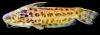 Trachelyichthys
displicatus Trachelyichthys
displicatusHolotype-male-igarapé Juá, 7 km W of Santarém, Pará, Brazil |
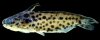 Trachelyichthys
displicatus Trachelyichthys
displicatus Paratype-Xingu River, Pará, Brazil |
If you would like to contribute to the monthly factsheets with an article, information or photos, please e-mail me. You will of course be credited for your work.

If you would like to donate any denomination of monies to the site just click the above link button. All proceeds will go to running the site and hopefully to keep it going for a few years yet.

