SCOTCAT.COM
your internet guide to all things catfish
Trachelyichthys varii Calegari, Akama, Ferraris, & Reis, 2026 |
Image contributors to this species: |
José Cézar Nolasco (2) |
ScotCat Sources: |
|
|

Other Sources: |
|

Relevant Information: |
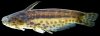
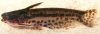
Description: Trachelyichthys varii differs from all congeners by having a dense concentration of black spots that form a conspicuous midlateral dark stripe reaching to the caudal peduncle (vs. no midlateral dark stripe; uniform brown coloration in T. gaiophanes and T. epachrus; or when black or brown spots present, never forming a continuous stripe, although sometimes horizontally aligned, but still disconnected from each other in T. exilis, T. decaradiatus, and T. displicatus). Additionally, the new species differs from T. gaiophanes and T. displicatus, by the possession of three free pterygiophores supporting the dorsal-fin soft rays (vs. four free pterygiophores). The new species further differs from T. gaiophanes and T. epachrus by having the posterior nuchal plate not expanded lateroventrally (vs. posterior nuchal plate expanded lateroventrally); and from T. epachrus by having fewer total anal-fin rays, 36–38 (vs. 42–45). Trachelyichthys varii is further distinguished from T. decaradiatus by having a narrower body (width at antero-lateral cleithrum 24.0–25.0 vs. 26.3% SL). Colouration: Overall colouration pattern similar to that described for specimens preserved in alcohol, but with increased contrast between ground colour and spots. Conspicuous wide black stripe at midlateral line formed by dense concentration of black spots, sometimes slightly interrupted near caudal fin due to disconnected black spots, (Calegari, B. B. et al. 2026). Habitat: The new species is known from the rio Jufari and its tributaries, a blackwater affluent of the north bank of rio Negro, upstream from the confluence with rio Branco, Amazon basin, Roraima, Brazil. Aquarium Care: Keeping this species is not too much of a problem as long as the water is kept clean and not too alkaline with a p.H.of between 6.5 and 7.0. They do like a planted aquarium where they like to hide out during the day. Diet: In the aquarium a good mixture of dry food such as flake and tablet. Worm food such as bloodworm, whiteworm and grindal, (Calegari, B. B. et al. 2026). Etymology: Trachelyichthys: trachely, referring to close similarity to and relationship with Trachelyopterus; ichthys; fish. The specific name varii: Named in honour of our dear friend Richard P. Vari, who prematurely passed away during the early process of preparing this manuscript. This tribute is in recognition for his great devotion and contributions to the study of the Neotropical auchenipterid fishes, and for his unlimited willingness to help young ichthyologists to develop their careers. A noun in the genitive case. |
Common Name: |
None |
Synonyms: |
None |
Family: |
Auchenipteridae |
Distribution: |
South America: Rio Jufari and its tributaries, a blackwater affluent of the north bank of Rio Negro, upstream from the confluence with Rio Branco, Amazon basin, Roraima, Brazil. |
Size: |
4.5cm (1¾ins) |
Temp: |
22-25°c (71-77°f.) |
p.H. |
|
6.5-7.0. |
IUCN Red List |
Not Evaluated. |
Reference: |
Calegari, B. B., Akama,
A., Ferraris Jr., C., & Reis, R. E..
(2026). Hidden diversity of the catfish genus Trachelyichthys
(Siluriformes: Auchenipteridae): a revisionary study
with description of four new species from the Amazon
basin. Neotropical Ichthyology, 24(2), e250200. |

Family: Auchenipteridae Back to Ident-A-Cat Click on Thumbnails |
 Trachelyichthys
varii Trachelyichthys
variiHolotype-male-Caracaraí, igarapé Tubana, tributary to Rio Jufari, Rio Negro drainage, Roraima, Brazil |
 Trachelyichthys
varii Trachelyichthys
variiLive specimen collected at type locality |
If you would like to contribute to the monthly factsheets with an article, information or photos, please e-mail me. You will of course be credited for your work.

If you would like to donate any denomination of monies to the site just click the above link button. All proceeds will go to running the site and hopefully to keep it going for a few years yet.

