SCOTCAT.COM  

your internet guide to all things catfish
≡
  • HOME
  • FACTSHEETS
    • By Month/Year
    • By Family
    • by Genus
    • by Common Names
    • By Specific Names
    • By Continent
      • Index
      • Africa
      • Asia
      • Australasia
      • Europe
      • North America
      • South America
  • GALLERIES
    • Photo Gallery
    • Art Gallery
    • Movie Gallery
    • Stamps Gallery
  • FAMILIES
    • A-B
      • Ailiidae
      • Akysidae
      • Amblycipitidae
      • Amphiliidae
      • Anchariidae
      • † Andinichthyidae
      • Ariidae
      • Aspredinidae
      • Astroblepidae
      • Auchenipteridae
      • Auchenoglanididae
      • Austroglanididae
      • Bagridae
    • C-D
      • Callichthyidae
      • Cetopsidae
      • Chacidae
      • Clariidae
      • Claroteidae
      • Cranoglanididae
      • Diplomystidae
      • Doradidae
    • H-I
      • Heptapteridae
      • Heteropneustidae
      • Horabagridae
      • Ictaluridae
    • K-L-M
      • Kryptoglanidae
      • Lacantuniidae
      • Loricariidae
      • Malapteruridae
      • Mochokidae
    • N-P
      • Nematogenyidae
      • Pangasiidae
      • Phreatobiidae
      • Pimelodidae
      • Plotosidae
      • Pseudopimelodidae
    • R-S-T
      • Ritidae
      • Schilbeidae
      • Scoloplacidae
      • Siluridae
      • Sisoridae
      • Trichomycteridae
  • ARTICLES
    • Index
    • Breeding
    • By Author
    • Cat-Articles
    • General
    • Numbered List
    • Ichthyology
    • Travel/Collecting
  • IDENT-A-CAT
  • RESOURCES
    • Citation
    • Etymology
    • Fishhouse
    • Glossary
    • Scientific Papers
    • ScotShop
  • SITE MAP
  • FB GROUP
  • HELP
    • Index
    • Catfish Anatomy
    • Convertors
    • FAQ
    • Ident-A-Cat
    • Water Chemistry

FACTSHEETS: April 2026 - no. 358

 Parailia congica Boulenger, 1899


he Schilbids are a small family of catfish found in Africa and Asia, and are not regularly exported to the hobby; however, the smaller species make great aquarium inhabitants. Our factsheet subject this month is the "African Glass Catfish" Parailia congica, a catfish that is not all that common in the hobby but will do well if kept in a shoal of six individuals or more.


Parailia congica

    Parailia congica


A similar species that is more readily exported is Parailia pellucida. You can tell the difference between the two as this species has an adipose fin, which P. congica does not possess. They are schooling species, confined to larger rivers, and most active during the night.


Parailia congica - head view


Parailia congica - head view


There are at the moment (2026) only five species described in this genus: Parailia congica Boulenger, 1899; Parailia occidentalis (Pellegrin, 1901); Parailia pellucida (Boulenger, 1901); Parailia somalensis (Vinciguerra, 1897); and Parailia spiniserrata Svensson, 1933.


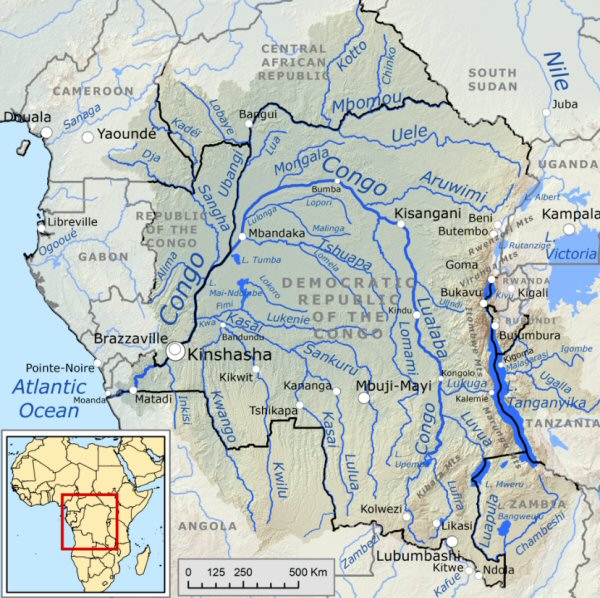
Congo Basin


 Africa: Congo Basin. Type locality: Ebinga (rivière du lac Léopold II).


The Congo Basin is a sedimentary basin located in Central Africa, specifically in the region known as West Equatorial Africa, adjacent to the Congo River. The Congo Basin region is sometimes known simply as the Congo. It contains some of the largest tropical rainforests in the world and is an important source of water used in agriculture and energy generation (Wikipedia 2026).


Common Name

African glass catfish

Synonyms

Parailia congiga, P. longifilis.

Family

Schilbeidae

Subfamily

-

Habitat

Endemic from the Congo basin, where it has been collected in the Lower Basin, Pool Malebo, the Kasai Subsystem, the middle Congo and the Uele Ubangui System, as well as in the Lualaba (including the Upemba System).

Distribution

Africa: Congo Basin. Type locality: Ebinga (rivière du lac Léopold II).

Size

9.0cm. (3½ins)

Temp.

23-26°C (73-79°F)

p.H.

6.5-7.2.

Characteristics

4 pairs of barbels. An adipose fin is always absent; inner side of the pectoral spine without serrations.

Colouration

Base colour pale (light yellow brownish), with small dark points on sides (unless along the lateral line), head and back; chin and belly unspeckled; all fins finely speckled; a longitudinal indistinct grey tail stripe is often observed just above the level of the stripe and often observed just above the level of the caudal fork.

Aquarium Care & Compatibility

It is better to keep them in groups of at least six, as they do not perform well as solitary animals. A delicate catfish for the aquarium, so it would need good filtration and regular water changes adhered to. This is a mid-water swimmer in the aquarium.

Reproduction

Oviparous, eggs are unguarded.

Sexual differences

Not recorded.

Diet

In its natural habitat it feeds mainly on aquatic and small terrestrial insects. In the aquarium, daphnia and frozen mosquito larvae. In its natural habitat the stomachs contained remains of insect larvae and a few small worms (de Vos 1995).

Glossary of Terms

Adipose fin: Fleshy finlike projection without rays, behind the rayed dorsal fin.
Barbels
: Whisker-like structure on the heads of most catfish.
Caudal fork
: The narrow part of a fish's body to which the caudal or tail fin is attached.
Genera
: A taxonomic rank in biology grouping closely related species above species and below family.
Lateral line
: A sensory line, along the sides of the body.
Oviparous
: Describing a species that lays eggs.
Pectoral fin: The paired fins just behind the head.

Etymology

Parailia: The generic name of para-, near, referring to similarity to Ailia (now in Ailiidae), from which it differs in the absence of vomerine teeth and adipose fin (Parailia spiniserrata).
congica: Referring to the origin of the type material of this species, the Congo Basin.

IUCN Red List

The species is widespread or without major threats throughout the Central Africa assessment region and is assessed as Least Concern but needs updating (IUCN 2010).

References

Baensch, H.A. and R. Riehl 1985 Aquarien atlas. Band 2. Mergus, Verlag für Natur- und Heimtierkunde GmbH, Melle, Germany. 1216 p.
De Vos, L. 1995 A systematic revision of the African Schilbeidae (Teleostei, Siluriformes). With an annotated bibliography. Ann. Mus. R. Afr. Centr., Sci. Zool., 271:1-450.
Ferraris, C.J. Jr., 2007. Checklist of catfishes, recent and fossil (Osteichthyes: Siluriformes), and catalogue of siluriform primary types. Zootaxa 1418:1-628.
Froese, R. and D. Pauly. Editors. 2009. FishBase. World Wide Web electronic publication. www.fishbase.org, version (11/2009).
Moelants, T. 2010. Parailia congica. The IUCN Red List of Threatened Species 2010.

Photo Credits

© Hippocampus Bildarchiv From the book Aqualog Photo Collection and is used with permission.
© Map: Wikipedia 2026.

Donate towards my web hosting bill!


If you would like to contribute to the monthly factsheets with an article, information or photos, please e-mail me. You will, of course, be credited for your work.


If you would like to donate any amount of money to the site, simply click the link above. All proceeds will go to running the site and hopefully to keep it going for a few years yet.


ScotCat Sources

Etymology = Genus Etymology-genus name

Etymology = Species Etymology-specific name


Other Sources

Search  Search

FishBase Fishbase

Catalog of Fishes Catalog of Fishes

Global Biodiversity Information Facility GBIF

FishNet2 FishNet2

iNaturalist iNaturalist

IUCN IUCN

  • Facebook about us + contact us + citation + translate + site map + scotshop + glossary + etymology +
  • help YouTube

©2026 SCOTCAT.COM