SCOTCAT.COM
your internet guide to all things catfish
Ancistomus snethlageae (Steindachner, 1911) |
Image contributors to this species: |
Adrian Payne (1) Johnny Jensen's Photographic Library (3) Haakon Haagensen (2) |
ScotCat Sources: |
|

Other Sources: |
|
|


Relevant Information: |
The genera Ancistomus has been reserected again on the latest paper by Armbruster et al. (2015). Peckoltia feldbergae, Hemiancistrus micrommatos, Ancistrus snethlageae, Hemiancistrus spilomma, and Hemiancistrus spinosissimus have all been transfered into this genus.The former name of Hemiancistrus/Ancistrus snethlageae is now moved into Ancistomus. For more information consult the paper referenced in the table by Armbruster, et al. 2015. In some publications this species has been placed in the Hemiancistrus genus which are very similar but are longer bodied and possess a naked ventral region. Sexual Differences: Males have a longer and broader head with longer bristles behind the gill-cover and the pectoral spines. The body of sexually mature males have fine odontodes on the scutes of the posterior part of the body. Aquarium Care: No problem to keep and seem to be non-aggressive in a group of individuals. Should be kept in warm and soft to medium hard waters. Juveniles posses a white edging to the caudal and dorsal fins. Diet: Vegetarian with added tablet foods and fine to medium sized live and frozen foods such as mosquito larvae and brine shrimp. Etymology: The specific name snethlageae: In honour of German ornithologist Maria Emilie Snethlage (1868–1929), who collected holotype. Remarks: Some searches still bring up the name of Hemiancistrus snethlageae. |
Common Name: |
White-edged pleco, L141, L215 |
Synonyms: |
Lasiancistrus snethlageae, Ancistrus snethlageae, Peckoltia snethlageae, Hemiancistrus snethlageae. |
Family: |
Loricariidae |
Distribution: |
Brazil: Pará, Rio Tapajós (Santarém- Jacaréacanga). Type locality: Rio Tapajoz bei Villa Braga und Goyana, Brazil. |
Size: |
18.0cm. (7¼ins) |
Temp: |
25-30°c (77-87°f.) |
p.H. |
|
6.0-7.2. |
IUCN Red List |
Ancistomus snethlageae is endemic to Brazil and occurs in the middle Tapajós and Jamanxim river basins in the state of Pará. The species is infrequent and not very abundant, associated with rocky areas and rapids. There is evidence of morphological variations, such as colour patterns, related to certain localities, which may indicate the existence of genetically distinct subpopulations. Specimens are collected for the aquarium market, but this apparently does not represent a significant impact on the A. snethlageae subpopulations. The main threat to its subpopulations is related to the construction of dams in the Tapajós and Jamanxim river drainages. The hydroelectric plants of São Luiz, Jatobá, Jamanxim, Cachoeira do Caí, Cachoeira dos Patos, and Jardim do Ouro are planned in the areas of known occurrence of the species. Considering the area of the stretches where the species has confirmed records, it was inferred that about 50% of this area will be impacted by the planned dams. Considering the current Brazilian energy planning for the Amazon basin and the constructions already planned for the river basins where A. snethlageae occurs, there will be a considerable loss of habitat, with a decrease in its area of occupation. Thus, it is suspected that this would lead to a population reduction of at least 50% in 25.5 years or three generational periods, categorizing Ancistomus snethlageae as Endangered (EN) under criterion A3c., (IUCN 2022). |
Reference: |
|
Armbruster, J.W,
2004. Phylogenetic relationships of the suckermouth
armoured catfishes (Loricariidae) with emphasis on
the Hypostominae and the Ancistrinae. |

Family: Loricariidae Back to Ident-A-Cat Click on Thumbnails |
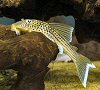 Ansistomus snethlageae
 |
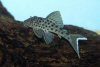 Ansistomus
snethlageae Ansistomus
snethlageae |
 Ansistomus
snethlageae Ansistomus
snethlageae |
 Ansistomus
snethlageae Ansistomus
snethlageae |
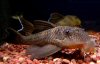 Ansistomus
snethlageae Ansistomus
snethlageaeHead view |
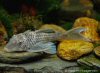 Ansistomus
snethlageae Ansistomus
snethlageae |
If you would like to contribute to the monthly factsheets with an article, information or photos, please e-mail me. You will of course be credited for your work.

If you would like to donate any denomination of monies to the site just click the above link button. All proceeds will go to running the site and hopefully to keep it going for a few years yet.

