SCOTCAT.COM
your internet guide to all things catfish
Panaqolus claustellifer Tan, de Souza & Armbruster, 2016 |
Image contributors to this species: |
ScotCat Sources: |
|

Other Sources: |
|


Relevant Information: |
A new species of Panaqolus is described from material from the Takutu River and the mainstream Rio Branco. It had previously been given the L-number of 306 before this description. Description: The new species is diagnosed from congeners by its colour pattern consisting of dark and light bars on the body, bands on the fins, and with dots and vermiculations absent (vs. no bars in P. albomaculatus, P. nix, P. nocturnus, and P. koko, vs. fins unbanded in P. albomaculatus, P. dentex, P. koko, and P. nix , and vs. dots and vermiculations present in P. albivermis and P. maccus ). The new species is diagnosed from barred species of Panaqolus by its specific bar number and orientation and colour pattern on its head, with bars oriented in a anteroventral-posterodorsal direction (vs. anterodorsal-posteroventral bars in P. gnomus ), having consistently 5 bars (n = 4) on the trunk that do not increase with size (vs. number increasing with size in P. purusiensis and vs. 6-12 in P. changae ), and the colour pattern on the head of straight lines extending from posterior to the eye to the snout margin, splitting in the middle portion of the line in larger specimens (vs. small, dense reticulate lines in P. changae ). Biogeographically, we infer that the new species ancestrally originated in the Amazon river, dispersing to the Takutu River after the Amazon captured part of the Proto-Berbice. (Milton Tan et.al. 2016). The differences between the Panaqolus and the Panaque genera is that the latter has an oval shaped mouth and the jaws have very large spatulate teeth with a single cusp, arranged in a v form and Panaqolus have a small number of spatulate teeth and are also a smaller genus. Aquarium Care: Peaceful in the aquarium but not suitable for planted tanks as they are plant eaters. Tank set-up should contain wood of some description as the Panaques need this in their diet. Plants will not work too well as they will be eaten so plenty of wood scattered around the tank with a few caves for spawning activities on a sand or small rounded gravel bed will do just fine. Provide strong aeration due to the higher temperatures involved. Diet: All Panaques and also the Panaqolus genera are wood eaters so would need this in an aquarium set-up. Feed also vegetable foods such as cucumber, courgette (zucchini) and sinking tablets. Sexual Differences: Males have long interopercular spines and their body is adorned with hair-like spines. Etymology: From the Latin claustellum, meaning keyhole, and the Latin fero, meaning to bear. Refers to the dark brown lines on the snout surrounding a keyhole-like shape of light-brown base colouration. Treated as a masculine adjective. |
Common Name: |
L306, LDA064 |
Synonyms: |
None |
Family: |
Loricariidae |
Distribution: |
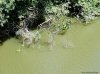
South America: Takutu river and the mainstream rio Branco of Brazil and Guyana. |
Size: |
10.0cm (4ins) |
Temp: |
25-28°c (77-83°f.) |
p.H. |
|
6.0-7.5. |
IUCN Red List |
Although the species' range is subject to threats, this species occupies a large range across Guyana and Brazil and given that the species does not meet or approach any threatened category, it is assessed as Least Concern (IUCN 2024). |
Reference: |
Milton Tan , Lesley
S. de Souza, Jonathan W. Armbruster. 2016.
A new species of Panaqolus (Siluriformes: Loricariidae)
from the rio Branco Neotropical ichthyology vol.14
no.2, 2016 Epub July 07, 2016. |

Family: Loricariidae Back to Ident-A-Cat Click on Thumbnails |
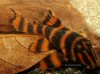 Panaqolus claustellifer
 |
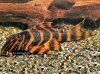 Panaqolus
claustellifer Panaqolus
claustellifer |
 Panaqolus
claustellifer Panaqolus
claustelliferLocation habitat |
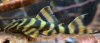 Panaqolus
claustellifer Panaqolus
claustellifer |
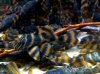 Panaqolus
claustellifer Panaqolus
claustellifer |
If you would like to contribute to the monthly factsheets with an article, information or photos, please e-mail me. You will of course be credited for your work.

If you would like to donate any denomination of monies to the site just click the above link button. All proceeds will go to running the site and hopefully to keep it going for a few years yet.

