SCOTCAT.COM
your internet guide to all things catfish
Peckoltia vittata Steindachner, 1881 |
Image contributors to this species: |
Allan James (3) Johnny Jensen's Photographic Library (2) Haakon Haagensen (1) |
ScotCat Sources: |
|


Other Sources: |
|


Relevant Information: |
Most specimens have a very regularely striped pattern, but colour tones can be variable depending on mood and colour of substrate. Description: The Peckoltia genera possesses a medium sized mouth with the same amount of teeth in the lower and upper jaw. The lower end of the caudal fin is usually oblique and only slightly indented. Aquarium Care: Feeds on plants and roots; in groups of 5 or more individuals; minimum aquarium size 80 cm. Sexual Differences: Males have bristles behind the gill covers, on the pectoral fin spines and on the posterior part of the body. They also posses bristles on the upper caudal fin rays. Diet: Omnivores, easy to feed with frozen and live foods and also tablet and flake food. Should be kept at slightly higher temperatures and have a requirement for a higher oxygen intake. Etymology: The specific name vittata: meaning banded, striped. Remarks: It is not entirely certain that L015 is indeed Peckoltia vittata but the original description is too inaccurate to tell which of these similar Peckoltia forms it may refer to. |
Common Name: |
Candy Striped Peckoltia, L015 |
Synonyms: |
Chaetostomus vittatus |
Family: |
Loricariidae |
Distribution: |
Brazil: Middle and lower Amazon River basin. Type locality: Amazonen-Strom, Tajapouru, Xingu bei Porto de Moz, Rio Madeira, Brazil. |
Size: |
14.0cm. (5½ins) |
Temp: |
26-30°c (79-87°f) |
p.H. |
|
6.0-7.5. |
IUCN Red List |
Peckoltia vittata is widely distributed in the middle and lower Amazon River basin, including the Madeira, Xingu, Trombetas, Tocantins, and Tapajós rivers. It is a frequent and abundant species, and no significant threats have been identified that would put it at risk of extinction. For this reason, Peckoltia vittata has been categorised as Least Concern (LC), (IUCN 2022). |
Reference: |
Chico Mendes Institute
for Biodiversity Conservation (ICMBio). 2022.
Peckoltia vittata. IUCN Red List of Threatened
Species 2022. |

Family: Loricariidae Back to Ident-A-Cat Click on Thumbnails |
 Peckoltia
vittata Peckoltia
vittata |
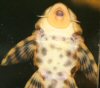 Peckoltia
vittata Peckoltia
vittata Mouth view |
 Peckoltia
vittata Peckoltia
vittata |
 Peckoltia
vittata Peckoltia
vittata |
 Peckoltia
vittata Peckoltia
vittata |
 Peckoltia
vittata Peckoltia
vittata |
If you would like to contribute to the monthly factsheets with an article, information or photos, please e-mail me. You will of course be credited for your work.

If you would like to donate any denomination of monies to the site just click the above link button. All proceeds will go to running the site and hopefully to keep it going for a few years yet.

