SCOTCAT.COM
your internet guide to all things catfish
Rhinolekos capetinga Roxo FF, Ochoa LE, Silva GSC, Oliveira C (2015) |
Image contributors to this species: |
Fábio F. Roxo (3) |
ScotCat Sources: |
|
|

Other Sources: |
|


Relevant Information: |
Description: Rhinolekos capetinga diffrs from R. garavelloi and R. schaeferi in that it has a lower number of vertebrae, 31 (vs. 32) and the anterior portion of the compound supraneural-fist dorsal-fi proximal radial contacts the neural spine at the 9th vertebra (vs. 10th, Fig. 2a). The new species can be distinguished from R. britskii by the absence of transverse dark bands in the pectoral, pelvic and anal-fin rays (vs. present), lower number of plates in the dorsal series 24–28 (vs. 30–35), lack of odontodes on the ventral tip of the snout (vs. tip of snout completely covered by odontodes), and by having a greater prenasal length, 41–60% of HL (vs. 32–40% of HL). Moreover, the new species differs from R. schaeferi by the absence of accessory teeth (vs. present) and from all congeners by the smaller head length, 20–27% of SL (vs. 28–32% of SL in R. britskii; 29–35% of SL in R. garavelloi; 29–32% of SL in R. schaeferi), and by the greater snout length, 61–85% of HL (vs. 52–57% of SL in R. britskii; 49–60% of SL in R. garavelloi; 53–59% of SL in R. schaeferi). It diffrs from R. britskii and R. garavelloi by the smaller caudal-peduncle depth, 6–9% of SL (vs. 9–11% of SL in R. britskii and 10–13% of SL in R. garavelloi); it differs from R. garavelloi by the smaller thoracic length 10–15% of SL (vs. 18–21% of SL), and by the smaller folded dorsal-fin length, 14–21% of SL (vs. 22–26% of SL). Adult males are distinguished by having a papilla at the urogenital opening (vs. papilla absent in females), and by an unbranched pectoral- and pelvic-fin ray supporting a dermal flp on their proximal dorsal surface in males. Habitat: Occurs on flat areas of the córrego da Branca and córrego Roncador, rio Tocantins basin, in areas with shallow clear waters, about 1 m depth and median to fast current flow. Found in association with the vegetation that covers the bottom and the border of the headwaters. Etymology: The specific name (capetinga) is taken from the Tupi-guarani dialect in reference to the old and unused name of São João D´Aliança municipality. The name 'capetinga" refers to white, or clear water. A noun in apposition. |
Common Name: |
None |
Synonyms: |
None |
Family: |
Loricariidae |
Distribution: |
South America: Brazil, known from two localities at the córrego da Branca and one locality at the córrego Roncador, all drainages of the rio Tocantizinho, rio Tocantins basin. |
Size: |
4.0cm. (1¾ins) |
Temp: |
23-27°c (73-81°f) |
p.H. |
|
6.0-7.5. |
IUCN Red List |
Rhinolekos capetinga is known from two collection localities at córrego da Branca and one locality at the córrego Roncador, tributaries of the Tocantizinho River in the Tocantins River basin, Goiás State, Brazil. Extent of occurrence (EOO) and area of occupancy (AOO) are estimated to be 8 km2. Total population size and population trend are unknown. The number of threat-based locations where the species occurs cannot be determined with accuracy given limited information on the scope of existing threats and limited ichthyological survey in adjacent drainages where suitable habitat may exist, but continuing decline in habitat quality can be inferred based on the presence of regionally pervasive threats that include agricultural production, cattle ranching, gold mining, and sedimentation. Therefore, R. capetinga is assessed as Near Threatened under criterion B1ab(ii)+2ab(iii), (IUCN 2021). |
Reference: |
Froese, R. and D. Pauly.
Editors. 2020. FishBase. World Wide Web electronic
publication. www.fishbase.org, version (04/2020). |

Family: Loricariidae Back to Ident-A-Cat Click on Thumbnails |
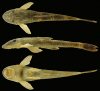 Rhinolekos capetinga
Holotype male, 37.5 mm SL, Goiás State, rio Tocantins basin, Brazil |
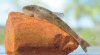 Rhinolekos
capetinga Rhinolekos
capetingaLive specimen of holotype male, 37.5 mm SL, rio Tocantins basin, Goiás State, Brazil |
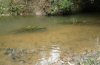 Location
for Rhinolekos capetinga Location
for Rhinolekos capetingaType locality at córrego da Branca–14°53'47.2"S, 47°34'58.4"W |
SIf you would like to contribute to the monthly factsheets with an article, information or photos, please e-mail me. You will of course be credited for your work.

If you would like to donate any denomination of monies to the site just click the above link button. All proceeds will go to running the site and hopefully to keep it going for a few years yet.

