SCOTCAT.COM
your internet guide to all things catfish
Rineloricaria anhaguapitan Ghazzi, 2008 |
Image contributors to this species: |
Miriam S. Ghazzi (1) |
ScotCat Sources: |
|
|

Other Sources: |
|


Relevant Information: |
Description: Rineloricaria anhanguapitan is distinguished from other species of the genus by the region of bare shoulder girdle and abdomen completely covered for 3-5 sets of plates not reaching the height of insertion of the pectoral fins, with an elongated plate or two to three shorter than this, contacting laterally the first lateral abdominal plate. In addition to the following combination helps to differentiate it from the other species: the tip of the snout with extended nude area. After reaching the previous more pore channel extending earlier to orbits, forked between the nostrils. Couple of different crests of the parietosupraoccipital and pre-dorsal. The upper rim of the orbit highlight, extending earlier; postorbital with about half of the eye; orbit 1.1 times in the interorbital distance. Rounded to oval eye, partially covered by a small iris diverticulum. Aquarium Care: As with all Rineloricaria provide long leaved plants or bamboo stalks for them to hang on to. Diet: Omnivore. Vegetable food such as cucumber and other various foods such as tablet, flake and frozen. Reproduction: The Rineloricaria species are usually cave spawners, where the female will place their eggs after the male has cleaned inside. The male will then guard and fan the eggs until hatching. The eggs will hatch in 4-5 days whereas the male can now be removed. More breeding information can be found here in the articles breeding section. Etymology: The specific name anhaguapitan: Named for the devil, called Anhaguapitã in Tupí lengend, whose clash with St. Peter, in which the saint became dead birds and the devil became rain and small stones, created the Uruguay River of southern Brazil, where this catfish occurs. Remarks: More information in the referenced paper (Ghazzi, 2008). |
Common Name: |
None |
Synonyms: |
None |
Family: |
Loricariidae |
Distribution: |
South America: Tributaries of the Rio Passo Fundo of the upper Rio Uruguay, Brazil. |
Size: |
12.5cm. (5ins) |
Temp: |
20-24°c (67-75°f) |
p.H. |
|
6.0-7.0. |
IUCN Red List |
Rineloricaria anhaguapitan is endemic to Brazil, occurring in the Passo Fundo and Erechim river basins in Rio Grande do Sul, where it is frequent but not very abundant. The species also inhabits lentic environments and has been captured in the lake of the Passo Fundo hydroelectric plant. Although there are hydroelectric projects planned for the basin, no apparent threats have been detected that would endanger its population. Therefore, Rineloricaria anhaguapitan is categorised as Least Concern (LC), (IUCN 2022). |
Reference: |
Chico Mendes Institute
for Biodiversity Conservation (ICMBio).
2022. Rineloricaria anhaguapitan. The IUCN
Red List of Threatened Species 2022. |

Family: Loricariidae Back to Ident-A-Cat Click on Thumbnails |
 Rineloricaria
anhaguapitan Rineloricaria
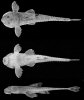
anhaguapitanDorsal, ventral & lateral view |
If you would like to contribute to the monthly factsheets with an article, information or photos, please e-mail me. You will of course be credited for your work.

If you would like to donate any denomination of monies to the site just click the above link button. All proceeds will go to running the site and hopefully to keep it going for a few years yet.

