SCOTCAT.COM
your internet guide to all things catfish
Aguarunichthys tocantinsensis Zuanon, Rapp Py-Daniel & Jégu, 1993 |
Image contributors to this species: |
Allan James (3) |
ScotCat Sources: |

|
Other Sources: |
|


Relevant Information: |
Description: Dorsal spines (total): 1; Dorsal soft rays (total): 6; Anal spines: 5; Anal soft rays: 7 - 9. Habitat: Collected in areas with strong currents, rocky bottom. Aquarium Care: Very much a catfish for the larger aquarium to be kept by the more serious catfish keeper. As with most species in this genera it will be predatory so would need to be kept with fish that are not too small although this species would be better to be kept on its own as other fish will be seen as prey. A large tank would be needed no smaller than 2 metres (6ft) long and a depth of 70cm (28ins) with powerful filtration, to give it plenty of swimming space. Diet: Earthworms, fish fillets, frozen foods such as whole and unbroken smelts, shrimp or mussel meat. Tablet and pellet foods will also be taken. Etymology: The specific name tocantinsensis: From the Tocantins river basin. |
Common Name: |
None |
Synonyms: |
None |
Family: |
Pimelodidae |
Distribution: |
South America: Tocantins River basin, Brazil. Type locality: Brazil: Pará State: Tocantins River drainage, rapids above Marabá. |
Size: |
32.0cm. (13ins) |
Temp: |
22-27°C (71-81°F) |
p.H. |
|
6.0-7.2. |
IUCN Red List |
Aguarunichthys tocantinsensis is endemic to Brazil and occurs in the Tocantins and Araguaia river basins, in the states of Goiás, Mato Grosso, Pará, and Tocantins, where it is infrequent and not very abundant. The estimated area of occupancy (AOO) is 6,140 km². Habitat loss and fragmentation represent the main threats to this species, which is found in areas with strong currents and rocky bottoms, locations that have been heavily impacted by the construction of hydroelectric power plants (HPPs). The area loss, represented by the sum of the areas affected by the Tucuruí, Marabá, Serra Quebrada, Estreito, Tupiratins, Lajeado, Peixe Angical, São Salvador, Cana Brava, Serra da Mesa, and Santa Isabel hydroelectric reservoirs in the Tocantins and Araguaia rivers was estimated at 3,815 km², which represents more than 60% of the species' AOO. Considering a period of three generational periods equivalent to 27 years, both the impacts that have already occurred and those predicted or projected for the basin allow us to estimate a population reduction of more than 50%. For these reasons, Aguarunichthys tocantinsensis was categorised as Endangered (EN), according to criterion A4c (IUCN 2021). |
Reference: |
Chico Mendes Institute
for Biodiversity Conservation (ICMBio).
2021. Aguarunichthys tocantinsensis. IUCN Red List
of Threatened Species 2021. |

Family: Pimelodidae Back to Ident-A-Cat Click on Thumbnails |
 Aguarunichthys tocantinsensis
 |
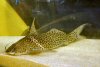 Aguarunichthys
tocantinsensis Aguarunichthys
tocantinsensis |
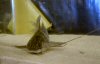 Aguarunichthys
tocantinsensis Aguarunichthys
tocantinsensisHead view |
If you would like to contribute to the monthly factsheets with an article, information or photos, please e-mail me. You will of course be credited for your work.

If you would like to donate any denomination of monies to the site just click the above link button. All proceeds will go to running the site and hopefully to keep it going for a few years yet.

