SCOTCAT.COM
your internet guide to all things catfish
Pimelodus tetramerus Ribeiro & Lucena, 2006 |
Image contributors to this species: |
Allan James (2) Iain Briggs (3) |
ScotCat Sources: |
|
|

Other Sources: |
|


Relevant Information: |
Colouration: This species is distinguished from its congeners by having four dark stripes on the sides of the body, the most dorsal beginning just behind the pre-dorsal plate and finishing at the end of the adipose-fin base; the second, wider than the first one, running just above the lateral line and extending from the lateral border of the supra-occipital process to the caudal fin base; both stripes above are fragmented on its anterior portion, forming dark points that may join to form a vermiculate pattern; the dark dots and the vermiculate pattern extend over the dorsum, anterior to the dorsal-fin and head; third stripe, also wide, runs just below the lateral line and begin near the upper region of the postcleithral process and extends until the caudal fin base; fourth stripe, shorter than the three others, and absent in a few cases, begins above of the postcleithral process and ends nearly the pelvic fin; presence of a narrow light stripe on the lateral line, with about 1/3 of the width of the third dark stripe, and a dark longitudinal bar on the ventral lobe of caudal fin. Aquarium Care: Active during the day and will do better in a small shoal. A good addition to a medium tank and will get on with other fish but will eat very small fish or fry. Diet: Any aquarium fish food such as flake, live or frozen. Etymology: The specific name tetrameus: Ancient Greek, meaning "devided in four parts", referring to the body pattern. Remarks: A good way to identify this species from the other striped pims is the two bands on the caudal fin. |
Common Name: |
Striped Pimelodus |
Synonyms: |
None |
Family: |
Pimelodidae |
Distribution: |
South America: Brazil, Tapajós and Tocantins rivers. |
Size: |
17.0cm. (6¾ins) |
Temp: |
22-27°C (71-81°F) |
p.H. |
|
6.0-7.2. |
IUCN Red List |
Pimelodus tetramerus is endemic to Brazil and occurs in tributaries and the main channel of the Araguaia, Tocantins, and Tapajós rivers. It inhabits different types of environments, from river channels to marginal lagoons and hydroelectric reservoirs. No direct threats have been identified that would put the species at risk of extinction. For this reason, Pimelodus tetramerus has been categorised as Least Concern (LC), (IUCN 2022). |
Reference: |
Chico Mendes Institute
for Biodiversity Conservation (ICMBio).
2022. Pimelodus tetramerus. IUCN Red List
of Threatened Species 2022. |

Family: Pimelodidae Back to Ident-A-Cat Click on Thumbnails |
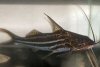 Pimelodus tetramerus
 |
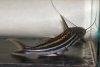 Pimelodus
tetramerus Pimelodus
tetramerus |
 Pimelodus
tetramerus Pimelodus
tetramerus |
 Pimelodus
tetramerus Pimelodus
tetramerus |
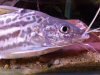 Pimelodus
tetramerus Pimelodus
tetramerusHead view |
If you would like to contribute to the monthly factsheets with an article, information or photos, please e-mail me. You will of course be credited for your work.

If you would like to donate any denomination of monies to the site just click the above link button. All proceeds will go to running the site and hopefully to keep it going for a few years yet.

