SCOTCAT.COM
your internet guide to all things catfish
Sorubim trigonocephalus Miranda Ribeiro, 1920 |
Image contributors to this species: |
Leandro Sousa (1) |
ScotCat Sources: |

|
Other Sources: |
|


Relevant Information: |
Description: Dorsal spines (total): 2; Dorsal soft rays (total): 6; Anal soft rays: 19 - 22; Vertebrae: 58. Distinguished from its congeners by the following combination of characters: snout very elongated, triangular or arrowhead shaped in dorsal and ventral view; exposed portion of premaxillary tooth patch as long as wide. Habitat: Littmann (2007) and Ohara et al. (2011) cite the species as being rare in nature and consequently in zoological collections. However, Ohara and Neuhaus (2016) report that recent expeditions in rivers draining the Brazilian shield yielded many individuals of this species, indicating that S. trigonocephalus is relatively common in the upper/middle Tapajós River and is also recorded in the Xingu River. Aquarium Care: Anything large enough will fit into its mouth so you should choose tankmates carefully. Large Cichlids or Plecos would be good companions or larger Characins, but they will also co-exist with one another, so 2 or 3 individuals brought together as juveniles in a larger tank (min. 6ft x 2ft x 2ft) would also be a good choice. Diet: In the aquarium it is important to try and wean them of live food so as not too make them too dependent on it and also not forgetting the disease factor as well. They will take a variety of larger foods such as earthworms, frozen bloodworms, tablet and pellet food. You can try prawns and also frozen fish pieces such as lancefish etc. Etymology: The specific name trigonocephalus: Name from Latin 'trigonocephalus' referring to the triangular ('trigono-) shape of the head ('-cephalus) in dorsal or ventral views. |
Common Name: |
Arrowhead shovelnose |
Synonyms: |
None |
Family: |
Pimelodidae |
Distribution: |
South America: Tapajós and Xingu River basins, southern tributaries to lower Amazon system (Brazil). |
Size: |
50.5cm. (22ins) |
Temp: |
23-30°C (73-87°F) |
p.H. |
|
6.5-7.5. |
IUCN Red List |
Sorubim trigonocephalus was described based on only three specimens, supposedly from the Madeira, Xingu, and Tapajós rivers. Recent collections in the headwaters of the Xingu River resulted in the acquisition of additional specimens and the confirmation of its presence in that basin. On the other hand, intensive and recent collections along the Madeira River did not reveal the presence of specimens of this species. There is no biological and ecological information on S. trigonocephalus , nor on direct threats that could put the population at risk of extinction. For this reason, Sorubim trigonocephalus was categorised as Least Concern (LC), (IUCN 2022). |
Reference: |
Chico Mendes Institute
for Biodiversity Conservation (ICMBio). 2022.
Sorubim trigonocephalus. The IUCN Red List
of Threatened Species 2022. |

Family: Pimelodidae Back to Ident-A-Cat Click on Thumbnails |
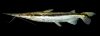 Sorubim trigonocephalus
 |
If you would like to contribute to the monthly factsheets with an article, information or photos, please e-mail me. You will of course be credited for your work.

If you would like to donate any denomination of monies to the site just click the above link button. All proceeds will go to running the site and hopefully to keep it going for a few years yet.

