SCOTCAT.COM
your internet guide to all things catfish
Glyptothorax schmidti (Volz 1904) |
Image contributors to this species: |
Piscesilim (3) Allan James (1) Mark Goh (1) |
ScotCat Sources: |
|

Other Sources: |
|


Relevant Information: |
Description: Dorsal spines (total): 1; Dorsal soft rays (total): 6; Anal soft rays: 10 - 11; Vertebrae: 35 - 38. Can be differentiated from all members of the Glyptothorax except Glyptothorax indicus in having the unculiferous ridges of the thoracic adhesive apparatus extending anteriorly onto the gular region (vs. gular region without unculiferous ridges). Differs from Glyptothorax indicus in having a wider head (19.1-22.6% SL vs. 16.3-18.9), larger eye (8.4-11.6% HL vs. 6.2-8.1), shorter nasal barbels (not reaching anterior orbital margin vs. reaching to middle of orbit; 24.5-37.1% HL vs. 37.8-52.5), a narrower thoracic adhesive apparatus (in a rhomboidal, somewhat U-shaped field vs. a more laterally divergent chevron-shaped field), pelvic-fin origin at (vs. posterior) vertical through base of last dorsal-fin ray, a more steeply-sloping posterior margin of the adipose fin, and the presence ( vs. absence) of light and dark vertical bands on the caudal peduncle. Etymology: The specific name schmidti: In honour of geologist Carl Schmidt (1862–1923), Basel University (Switzerland), to whom Volz owed his “trip around the world” (translation). Remarks: According to Eshmeyer's Catalog of Fishes, G. siamensis is now a synonym of G. schmidti (2021). |
Common Name: |
None |
Synonyms: |
Callomystax schmidti, Glyptothorax siamensis |
Family: |
Sisoridae |
Distribution: |
Asia: Sumatra, Indonesia. |
Size: |
8.5cm. (3½ins) |
Temp: |
20-24°c (67-75°f.) |
p.H. |
|
6.0-7.2. |
IUCN Red List |
This species is reported from river drainages in northern Sumatra and the northern Malay Peninsula. Although there is no detailed information on the population status of this species, survey data indicates that it is still abundant in many parts of its known distribution and the population trend is thus suspected to be stable or declining at a rate that precludes it from a threatened category. While there may be localised or regional threats, they are unlikely to affect this species on a range-wide scale, and it is found within several protected areas. Therefore, it is assessed as Least Concern, (IUCN 2019). |
Reference: |
Ng, H.H. 2019.
Glyptothorax schmidti. The IUCN Red List
of Threatened Species 2019. |

Family: Sisoridae Back to Ident-A-Cat Click on Thumbnails |
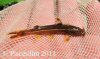 Glyptothorax schmidti
 |
 Glyptothorax
schmidti Glyptothorax
schmidtiDorsal view |
 Glyptothorax
schmidti Glyptothorax
schmidtiVentrall view |
 Glyptothorax
schmidti Glyptothorax
schmidti |
 Glyptothorax
schmidti Glyptothorax
schmidti |
If you would like to contribute to the monthly factsheets with an article, information or photos, please e-mail me. You will of course be credited for your work.

If you would like to donate any denomination of monies to the site just click the above link button. All proceeds will go to running the site and hopefully to keep it going for a few years yet.

