SCOTCAT.COM
your internet guide to all things catfish
Peckoltia otali Fisch-Muller & Covain, 2012 |
Image contributors to this species: |
Joe Martra (3) Raphael Covain (1) Michael Huthart (2) Oliver Lucanus (1) |
ScotCat Sources: |
|

Other Sources: |
|


Relevant Information: |
Description: Dorsal spines (total): 2; Dorsal soft rays (total): 7; Anal soft rays: 5. This species can be diagnosed from all other congeners by a unique colour pattern of adults, and from Guianese species by its specific barcode sequence (JF747005). Habitat: In rapids, it occurs mostly in sunny and shallow clear water, swiftly flowing currents, with medium-sized rocks substrate. Colouration: Colour pattern consists of numerous blackish-brown spots of irregular size and shape, distributed on head and on entire body except naked ventral areas, resulting in a mottled aspect of dorsum, while spots are aligned to form transverse bands on fins, at least on caudal fin. Juvenile specimens present large transversal blackish bands, or dorsal saddles, on the body that are similar to those characteristic of several Peckoltia including the type species Peckoltia vittata. Brown spots on posterior part of the body are also present in Peckoltia oligospila, Peckoltia sabaji, Peckoltia capitulata and Peckoltia simulata, but in these species spots are rounded, comparatively larger and regularly spaced, and they usually do not form bands on fins. It is further distinguished from these species by having a deeper body (22.5-25.7% SL, mean 23.8, vs. less than 23.4 at occiput; 12.4-13.8% SL, mean 13.1, vs. less than 11.7 at caudal peduncle) and a wider body (33.8-37.1% SL, mean 35.2, vs. less than 32.7 at cleithrum). Differs from Peckoltia bachi that is also mottled, by having the eye high on the head (vs. low) and a much narrower interorbital (29.8-34.4% HL, mean 32.6, vs. 57.9-59.9, mean 58.8. Aquarium Care: Should be kept at slightly higher temperatures and have a requirement for a higher oxygen intake. Peacfull inhabitants of an aquarium. Sexual Differences: Males have bristles behind the gill covers, on the pectoral fin spines and on the posterior part of the body. They also posses bristles on the upper caudal fin rays. Diet: Omnivores, easy to feed with frozen and live foods and also tablets, pellets and flake food. Soft wood should be included in aquarium. Should be kept at slightly higher temperatures and have a requirement for a higher oxygen intake. Remarks: The specific name 'otali' is a Wayana Amerindian name meaning secret, in reference to the colouration of the species, similar to its biotope, making it difficult to observe. Wayana Amerindians live on the sides of the Upper Maroni River basin where the new species was found. A noun in apposition. |
Common Name: |
None |
Synonyms: |
None |
Family: |
Loricariidae |
Distribution: |
South America: Upper Marowijne River basin in French Guiana and Suriname. Type Locality: Marowijne River. |
Size: |
8.0cm. (3¼ins) |
Temp: |
25-29°c (77-85°f) |
p.H. |
|
6.0-7.5. |
Reference: |
Fisch-Muller, S., J.I.
Montoya-Burgos, P.-Y. Le Bail and R. Covain,
2012. Diversity of the Ancistrini (Siluriformes: Locariidae)
from the Guianas: the Panaque group, a molecular appraisal
with description of new species. Cybium 36(1):163-193. |

Family: Loricariidae Back to Ident-A-Cat Click on Thumbnails |
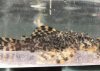 Peckoltia otali
 |
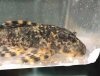 Peckoltia
otali Peckoltia
otaliHead view |
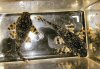 Peckoltia
otali Peckoltia
otali Dorsal view |
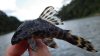 Peckoltia
otali Peckoltia
otali |
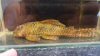 Peckoltia
otali Peckoltia
otali |
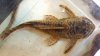 Peckoltia
otali Peckoltia
otali Dorsal view |
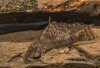 Peckoltia otali
 |
If you would like to contribute to the monthly factsheets with an article, information or photos, please e-mail me. You will of course be credited for your work.

If you would like to donate any denomination of monies to the site just click the above link button. All proceeds will go to running the site and hopefully to keep it going for a few years yet.

