SCOTCAT.COM
your internet guide to all things catfish
Pseudacanthicus major Chamon & Costa e Silva, 2018 |
Image contributors to this species: |
Johnny Jensen's Photographic Library (2) Mark Henry Sabaj (1) Jorge Garcia (1) |
ScotCat Sources: |
|

Other Sources: |
|
|


Relevant Information: |
The genus Pseudacanthicus currently comprises the following six described species distributed in the Amazon and Tocantins basins, and coastal drainages from Guyana to French Guyana: P. serratus, P. fordii, P. histrix, P. spinosus, P. leopardus, P. pitanga, and P. pirarara. Herein we describe P. major, from the Rio Tocantins basin, one of the largest loricariid species known. Description: The new species is distinguished from its congeners by the following combination of characters: having body colour pattern with dark brown background without spots or blotches and dorsal and caudal fins with transversal white bands; anterior process of compound pterotic with no contacting with the posterior margin of the orbit and by the absence of a conspicuous crest on the posterior edge of parieto-supraocciptal. Other osteological characteristics are further used to diagnose P. major from others congeners. A discussion on gigantism and miniaturization in freshwater fish, ornamental fisheries activities, threats and conservation of the new species are also provided (Chamon et al. 2018). Aquarium Care: Would need a large tank as they grow very big and are territorial. Diet: As with all of this genera they are carnivores and would need to be fed on frozen foods such as Artemia, mosquito larvae, mysis and shrimp. They can also be fed pellet and tablet foods. Etymology: The specific name meaning Larger; senior to another, colluding to the large size of this Loracarid. Remarks: The Tocantins in Brazil is the only river where 3 species of Pseudacanthicus occur together, P. pitanga, P. major and P. sp. (L079), (Mark Henry Sabaj 2019). |
Common Name: |
Synonyms: |
None |
Family: |
Loricariidae |
Distribution: |
Brazil: Rio Tocantins. Type Locality: Rio Areias near to the confluence with Rio Tocantins, Porto Nacional, Brazil, 1050'30"S, 4823'35"W. |
Size: |
60.0cm. (24ins) |
Temp: |
25-29°c (77-85°f) |
p.H. |
|
6.0-7.5. |
IUCN Red List |
Not Evaluated. |
Reference: |
Chamon, Carine C.;
Silva, Thiago Costa E. Pseudacanthicus major:
description of one of the largest known Loricariidae
(Hypostominae: Ancistrini), a species from rio Tocantins
basin, Brazil. Zootaxa, [S.l.], v. 4387, n. 3, p.
499–510, feb. 2018. ISSN 1175-5334. |

Family: Loricariidae Back to Ident-A-Cat Click on Thumbnails |
 Pseudacanthicus
major Pseudacanthicus
major |
 Pseudacanthicus
major Pseudacanthicus
major |
 Pseudacanthicus
major Pseudacanthicus
major |
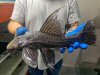 Pseudacanthicus
major Pseudacanthicus
major |
If you would like to contribute to the monthly factsheets with an article, information or photos, please e-mail me. You will of course be credited for your work.

If you would like to donate any denomination of monies to the site just click the above link button. All proceeds will go to running the site and hopefully to keep it going for a few years yet.

