SCOTCAT.COM
your internet guide to all things catfish
Pseudoplatystoma corruscans (Spix & Agassiz, 1829) |
Image contributors to this species: |
Johnny Jensen's Photographic Library (1) Frants Lehmann (2 Stamps) Jean-Francois Helias (1) Peru Aquarium Group (1) Liam Irons-Mclean (4) Allan James (2) |
ScotCat Sources: |
|
|

Other Sources: |
|


Relevant Information: |
Now found in Thailand, Asia, where this large South American Pim has now been introduced to large ponds and fishing lakes for sport fishing along with other similar sized members of the Pimelodidae family such as Pseudoplatystoma fasciatum, Sorubimichthys planiceps and the Red Tail Catfish Phractocephalus hemiolopterus. There has been 5 new species described by Buitrago-Suárez, U.A. and B.M. Burr in 2007, to go alongside P. tigrinum, P. fasciatum and P. corruscans. These species are P. punctifer (Castelnau), P. reticulatum Eigenmann & Eigenmann, P. orinocoensen, P. metaense, and P. magdaleniatum. So far P. punctifer is the only species that has not been accepted in some publications in print and on the internet. Two species (P. punctifer ? and P. tigrinum) are sympatric in the Amazon Basin, two (P. metaense and P. orinocoense) are sympatric in the Orinoco Basin, and two others, P. corruscans and P. reticulatum, are sympatric in the Paraná. Pseudoplatystoma magdaleniatum and P. fasciatum each occur as the only species of Pseudoplatystoma in their respective individual ranges. Aquarium Care: Its tank should have a shaded area at the back such as a large branch and plants to hide under as it is nocturnal, and also the lighting should not be too bright. Should not be kept with any fish that is smaller than itself and it also should be housed in a very large tank. The best companions would probably be large Pacu's or similar sized fish that would not be swallowed. In my opinion this wonderful looking Pim should only be kept in Public Aquariums as it can damage its large nose if kept in too confined an area, it can get jumpy too if feels its barbels on the tank sides as it turns around. It can also go of its food as well, if it is anyway disturbed. Diet: In their natural habitat they eat other fish such as characins and other catfish, they also eat freshwater crabs. In the aquarium a diet of earthworms, freshwater fish such as trout and also shrimp and prawns. You should only feed when it starts looking actively for it, as they will rest for a few days after feeding to digest their food. Etymology: The specific name corruscans: Apparent misspelling of coruscans (L.), flaming or flashing or glittering, probably referring to bright colouration, yellow-orange above and silver below. |
Common Name: |
Spotted shovelnose |
Synonyms: |
Sorubim caparary, Platystoma corruscans, Platystoma coruscans, Silurus macrocephalus |
Family: |
Pimelodidae |
Distribution: |
South America: Sao Francisco and Paraná River basins. Type locality: In flumine S. Francisci, Brazil. |
Size: |
150.0cm. (5ft 4ins) |
Temp: |
22-26°C (71-77°F) |
p.H. |
|
6.0-7.0. |
IUCN Red List |
Pseudoplatystoma corruscans can be found in the San Francisco and La Plata river basins in South America. Decreased commercial fishing landings have been recorded at some points in the São Francisco and Paraná basins, which suggests a decline in the subpopulations in at least these two basins. The reduction in population size is directly linked to two main factors: the construction of hydroelectric plants and overfishing, while there may be additional impacts of hybridisation with congeners and pollution. It is expected that there will be contributions from individuals from the subpopulations of Argentina and Paraguay to the Pantanal, where the subpopulations are still in the best state of conservation. However, contributions are not expected for the subpopulations occurring in the upper Paraná and São Francisco, which are more affected by the fragmentation caused by successive dams. Based on the reductions in fishing landings attested to various areas, a population decline of 25% in the last 45 years (three generations) is suspected. Thus, Pseudoplatystoma corruscans is categorised as Near Threatened (NT), because it approaches VU A2bcde, (IUCN 2023). |
Reference: |
Buitrago-Suárez,
U.A. and B.M. Burr, 2007. Taxonomy of the
catfish genus Pseudoplatystoma Bleeker (Siluriformes:
Pimelodidae) with recognition of eight species. Zootaxa
1512:1-38. |

Family: Pimelodidae Back to Ident-A-Cat Click on Thumbnails |
 Pseudoplatystoma
corruscans |
 Pseudoplatystoma
corruscans Stamp |
 Pseudoplatystoma
corruscans Stamp |
 Pseudoplatystoma
corruscans Caught in a Lake in Thailand, Asia. |
 Pseudoplatystoma
corruscans |
 Pseudoplatystoma
corruscans Leucistic specimen |
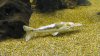 Pseudoplatystoma
corruscans Leucistic specimen |
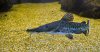 Pseudoplatystoma
corruscans |
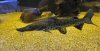 Pseudoplatystoma
corruscans |
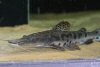 Pseudoplatystoma
corruscans |
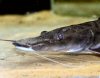 Pseudoplatystoma
corruscans Head view |
If you would like to contribute to the monthly factsheets with an article, information or photos, please e-mail me. You will of course be credited for your work.

If you would like to donate any denomination of monies to the site just click the above link button. All proceeds will go to running the site and hopefully to keep it going for a few years yet.

