SCOTCAT.COM
your internet guide to all things catfish
Pseudoplatystoma metaense Buitrago-Suárez & Burr, 2007 |
Image contributors to this species: |
Alfredo Pérez (1) Mark Henry Sabaj (1) Cortés Hernández, M. et al 2023 (1) |
ScotCat Sources: |
|
|

Other Sources: |
|


Relevant Information: |
Description: Vertebrae: 35. Can be diagnosed by a combination of the following characters: dark spots randomly distributed over dusky region on body; side of body with few (no more than 5) straight dark vertical bars; 2 or 3 loop-like bars; adipose fin with 5-7 spots; surrounding areas over dorsal procurrent caudal rays with 5-8 spots; 35 vertebrae; and pectoral and pelvic fins pale with no dusky pigmentation. There has been 5 new species described by Buitrago-Suárez, U.A. and B.M. Burr in 2007, to go alongside P. tigrinum, P. fasciatum and P. corruscans. These species are P. punctifer (Castelnau), P. reticulatum Eigenmann & Eigenmann, P. orinocoensen, P. metaense, and P. magdaleniatum. So far P. punctifer is the only species that has not been accepted in some publications in print and on the internet. Two species (P. punctifer ? and P. tigrinum) are sympatric in the Amazon Basin, two (P. metaense and P. orinocoense) are sympatric in the Orinoco Basin, and two others, P. corruscans and P. reticulatum, are sympatric in the Paraná. Pseudoplatystoma magdaleniatum and P. fasciatum each occur as the only species of Pseudoplatystoma in their respective individual ranges. Aquarium Care: Its tank should have a shaded area at the back such as a large branch and plants to hide under as it is nocturnal, and also the lighting should not be too bright. Should not be kept with any fish that is smaller than itself and it also should be housed in a very large tank. The best companions would probably be large Pacu's or similar sized fish that would not be swallowed. Carry out weekly water changes. Diet: In their natural habitat they eat other fish such as characins and other catfish, they also eat freshwater crabs. In the aquarium a diet of earthworms, freshwater fish such as trout and also shrimp and prawns. You should only feed when it starts looking actively for it, as they will rest for a few days after feeding to digest their food. Etymology: The specific name metaense: refers to the type locality, Meta River, a tributary of the Orinoco River in Colombia and Venezuela. |
Common Name: |
None |
Synonyms: |
None |
Family: |
Pimelodidae |
Distribution: |
South America: Orinoco River in Colombia and Venezuela. Type Locality: Metica River, about 1.5 kilometers east of Rajote, 3°56'N, 73°03'W, Meta River, dept. of Meta, Colombia. |
Size: |
60.0cm. (24ins) |
Temp: |
24-28°C (75-83°F) |
p.H. |
|
6.5-8.0. |
IUCN Red List |
Pseudoplatystoma metaense has a wide distribution in Colombia and Venezuela. It is one of the most important commercial fishes in the Orinoco River Basin. Due an increase in fishing pressure from 1996 to 2020, the species has experienced population reductions. Although fishing regulations exist related to minimum capture and although there is a ban for commercialisation during the reproductive period, these are not strictly enforced, especially in Venezuela. Over the last 14 years (approximately three generation lengths) there has been a 50-60% reduction in CPUE. Therefore, a population decline of 50-60% is estimated and this species is listed as Endangered, (IUCN 2023). |
Reference: |
Buitrago-Suárez,
U.A. and B.M. Burr,
2007. Taxonomy of the catfish genus Pseudoplatystoma
Bleeker (Siluriformes: Pimelodidae) with recognition
of eight species. Zootaxa 1512:1-38. |

Family: Pimelodidae Back to Ident-A-Cat Click on Thumbnails |
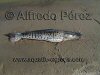 Pseudoplatystoma metaense
 |
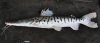 Pseudoplatystoma metaense
Rio Apure, Venezuela |
 Pseudoplatystoma
metaense Pseudoplatystoma
metaense |
If you would like to contribute to the monthly factsheets with an article, information or photos, please e-mail me. You will of course be credited for your work.

If you would like to donate any denomination of monies to the site just click the above link button. All proceeds will go to running the site and hopefully to keep it going for a few years yet.

