SCOTCAT.COM
your internet guide to all things catfish
Panaqolus tankei Cramer CA, Melo de Sousa L (2016) |
Image contributors to this species: |
Haakon Haagensen (3) Andreas Tanke (1) |
ScotCat Sources: |
|

Other Sources: |
|


Relevant Information: |
Formerly known before its description as Panaqolus sp. (L398). Panaqolus tankei is described from the Xingu River, Brazil. Description: The differences between the Panaqolus and the Panaque genera is that the latter has an oval shaped mouth and the jaws have very large spatulate teeth with a single cusp, arranged in a v form and Panaqolus have a small number of spatulate teeth and are also a smaller genus. Habitat: The species is only known from the lower Xingu River, downstream Belo Monte Waterfalls. Panaqolus tankei are usually found on fallen trees and sunken wood alongside the riverbank, in depths varying from 1 to 10 m. Colouration: The new species is diagnosed from P. albomaculatus, P. dentex, P. nix, P. nocturnus, and Pseudoqolus koko by its colour pattern consisting of dark and light diagonal bars on the body and bands on the fins (vs. body and fins without bars or bands); from P. albivermis, P. maccus and P. purusiensis by the width of the dark bars being more or less the same of the light bars (vs. dark bars at least two or three times wider than light bars) and from P. changae by the absence of vermiculation on the head (vs. vermiculation present on head). The new species differs from P. gnomus by the orientation of the bars from posterodorsal to anteroventral direction (vs. anterodorsal to posteroventral direction), and from P. claustellifer by the orientation of the bands in the dorsal fin that are not parallel to the margin (vs. parallel to the margin). Aquarium Care: Peacful in the aquarium but not suitable for planted tanks as they are plant eaters. Tank set-up should contain wood of some description as the Panaques need this in their diet. Plants will not work too well as they will be eaten so plenty of wood scattered around the tank with a few caves for spawning activities on a sand or small rounded gravel bed will do just fine. Provide strong aeration due to the higher temperatures involved. Diet: All Panaques and also the Panaqolus genera are wood eaters so would need this in an aquarium set-up. Feed also vegetable foods such as cucumber, courgette (zucchini) and sinking tablets. Sexual Differences: Males have long interopercular spines and their body is adorned with hair-like spines. Etymology: A patronym in honour of Andreas Tanke, a German aquarist very dedicated to the genus Panaqolus, studying its behavior, reproduction, and differences between known forms, keeping these fishes in the aquarium, visiting their habitats, and publishing his findings. He probably was the first to reproduce Panaqolus tankei in captivity. For his (successful) efforts to improve communications between aquarists and scientists to join their forces in an era of less and less money for research and an ever accelerating destruction of natural habitats. |
Common Name: |
Synonyms: |
Family: |
Loricariidae |
Distribution: |
South America: Rio Xingu, Vitória, Brazil. |
Size: |
14.0cm (5¾ins) |
Temp: |
26-30°c (79-87°f.) |
p.H. |
|
6.0-7.5. |
IUCN Red List |
Not Evaluated. |
Reference: |
Cramer CA, Melo de
Sousa L (2016) A New Species of Tiger Pleco
Panaqolus (Siluriformes: Loricariidae) from the Xingu
Basin, Brazil. PLoS ONE 11(11). |

Family: Loricariidae Back to Ident-A-Cat Click on Thumbnails |
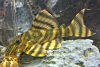 Panaqolus tankei
 |
 Panaqolus
tankei Panaqolus
tankei |
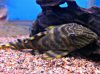 Panaqolus
tankei Panaqolus
tankei |
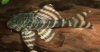 Panaqolus
tankei Panaqolus
tankeiFrom the region of Porto de Moz with more and finer lines on the head |
If you would like to contribute to the monthly factsheets with an article, information or photos, please e-mail me. You will of course be credited for your work.

If you would like to donate any denomination of monies to the site just click the above link button. All proceeds will go to running the site and hopefully to keep it going for a few years yet.

