SCOTCAT.COM
your internet guide to all things catfish
| Corydoras (Hoplisoma) cf. sanchesi Nijssen & Isbrücker, 1967 |
by Ian Fuller |
Hoplisoma cf. sanchesi
Conditions: Spawning: During this locked position, both fish would quiver for a few seconds. Between 3 and 7 light orange coloured eggs would be deposited into the females ventral fin pouch. The pair would then part, with the male wandering off rummaging in the gravel for food, and the female just leaning on one pectoral fin resting. She would rest for anything up to ten minutes before scurrying off looking for a suitable place to place her eggs. Most of the eggs were deposited in the Java Moss, with just one or two stuck to the tank sides and a couple on the side of the filter. Based on the first spawning the eggs will take four days to hatch, and the fry are large enough to take newly hatched brine shrimp three days after hatching. Further foods will be micro worm and powdered flake, followed by larger offerings of grindal worms and sifted Daphnia, as the fry get larger. When the fry get to around 12mm whole tablet food will also be given. The fry swarm all over these tablets when they are offered. It’s a magic sight to see dozens of fry gathered all around and feeding so avidly. Small water changes are made every day once the fry are feeding, with particular care being taken to use water of exactly the same temperature. If the temperature differs by more than a degree it can wipe out a complete brood. These water changes are essential if the fry are to develop to their full potential.
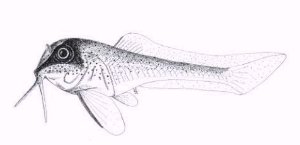
Fry at 7 days
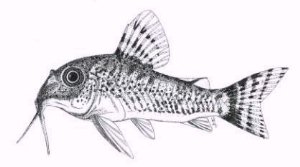
Juvenile at 1 month
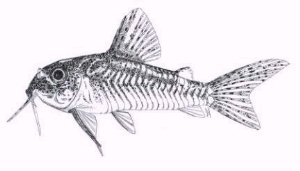
10 weeks Lineage: Placed in Lineage 9, the "short-snouted" species with the designated type species: C. punctatus. A revision in the future would constitute the resurrection of the genus name Hoplisoma (Agassiz, 1846). Update: As of the latest revision (Dias et al 2024) Corydoras cf. sanchesi has now been placed in Lineage 9 and has the new genus name of Hoplisoma Photo and Drawings are by the Author
|
 first
spawned H. cf. sanchesi in September 98.
I consider it to have been a successful spawning, in
as much as I have raised two fry up to adult colour.
Both fry are now over 22mm long and doing well. The
details that follow are of the spawning I have been
observing today, 21st November 1998.
first
spawned H. cf. sanchesi in September 98.
I consider it to have been a successful spawning, in
as much as I have raised two fry up to adult colour.
Both fry are now over 22mm long and doing well. The
details that follow are of the spawning I have been
observing today, 21st November 1998.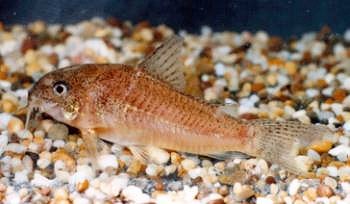

If you would like to contribute an article, please e-mail me. You will of course be credited for your work.
If you would like to donate any denomination of money to the site just click the above link button. All proceeds will go to running the site and hopefully to keep it going for a few years yet.
Print or e-mail this factsheet below


