SCOTCAT.COM
your internet guide to all things catfish
| Better than its reputation, a look at Cephalosilurus fowleri |
by Wolfgang Ros |
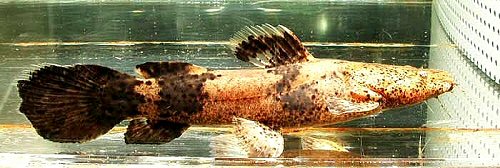
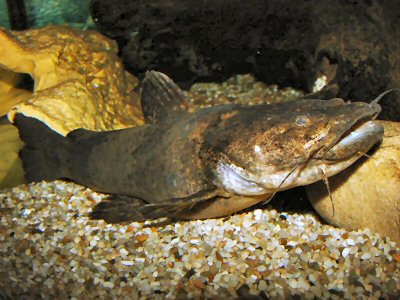
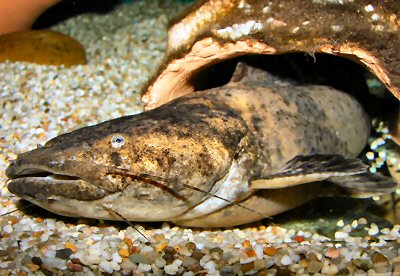
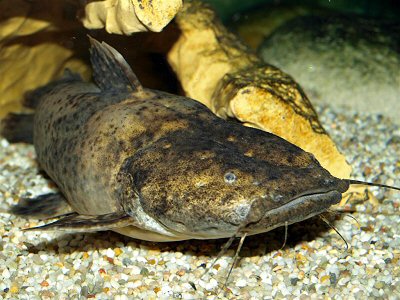
C. fowleri, 35 cm in length with its typically rubiginous colouring
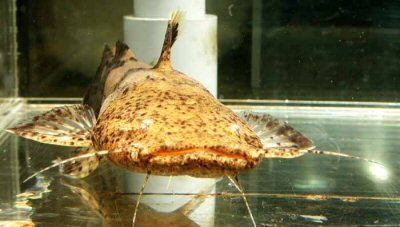
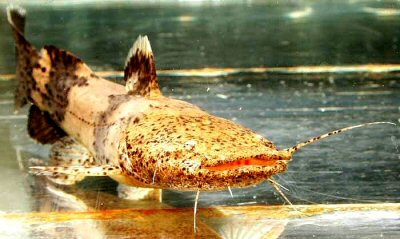
Four species have been described to the genus Cephalosilurus resident in South America. Three of them have been introduced for keeping in the aquarium, C. apurensis, C. nigricaudus and C. fowleri. From their form they are only little differences from each other. Their trademark is the big head with the little eyes and short barbles but with an almost head wide mouth. They are sluggish animals which hardly move and only lie waiting for prey. C. fowleri is to be found exclusively in the Rio São Francisco of Brazil and there mainly in the more calm flowing river sections. Acquisition: Species
identification:
In terms of colour these three are attractive young specimens of 14 cm in length
Young specimens are more brightly coloured and often almost orange. The juvenile colouration is primarily because of the contrasts arising by two more or less clear dark body stripes, a slight grain with black-brown spots and the dark tail, anal, adipose and dorsal fins are very striking. At about 20 centimetres these contrasts fade away increasingly and the orange as a rule gives way to a rubiginous, up to deep brown, with dark spots with the colour dress fitting better on the natural surroundings. But even so animals with a yellowish basic colouring are not rare. Aside from the colouring C. fowleri is different from C. apurensis and C. nigricaudus by its slimmer shape and its flat head. Moreover it almost completely lacks the spots on the underside of the belly. Preconditions
for keeping in the aquarium:
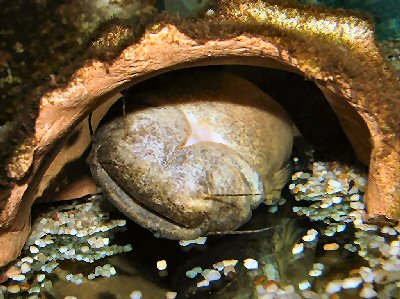
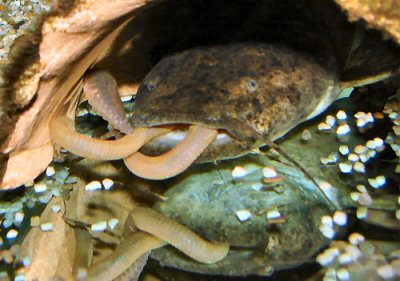
View of C. fowleri sleeping on its back in cave
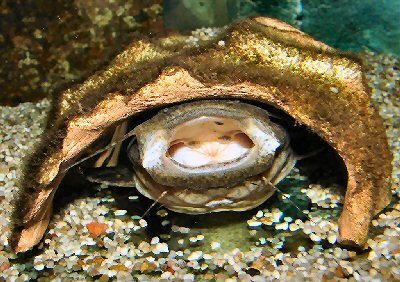
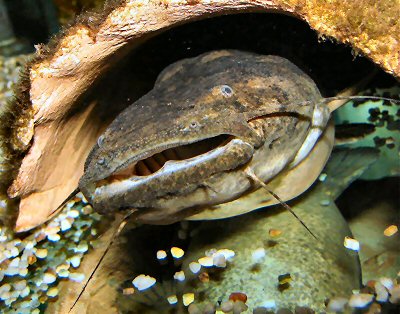
Behaviour: Already a medium-sized specimen can have tremendous strength and is able to move, apparently without great effort, even a heavy shelter by pressure with the head and moving around with the tail fin to a place seeming more pleasant for it. In this behaviour a similarity consists to the other Cephalosilurus species which also live with pleasure in an accommodation and "fit it out" according to their wishes. If the previous hiding place has got too small, then the keeper puts a bigger one in addition to the original one. When C. fowleri has gratefully accepted it after some nights, thereupon the earlier shelter can be removed. The keeper does not need to worry if his specimen needs much time for the acclimatisation, because C. fowleri normally at first will almost at all times hides itself and eats, for a Cephalosilurus species, only moderately even if it enjoys itself in apparently good health. Not until after some months does it get a little more active. While C. apurensis, due to its greater appetite, already has at times finds its way out from its hiding place even during the day, C. fowleri however still lives predominantly in seclusion, often laying on its back and taking an unusual resting position in its shelter, however this catfish becomes wide awake if food is given. It immediately comes out, snaps at the chunks which sink nearby and quickly retires again. As in the case of all Cephalosilurus species the keeper can observe in that C. fowleri helps its digestion of larger food pieces by regular turns of its body, by rubbing of the epigastrium (the region lying on or over the stomach, just below the sternum) at the feeding place, and by tearing its mouth wide open.
Like its genus comrades C. fowleri, after swallowing larger chunks, tears its mouth wide open a few times
If the acclimatisation process is completed, C. fowleri at the latest, at nightfall, moves around through the tank before it returns into its accommodation. Besides that the animal can be seen as soon as it is hungry, then particularly fully-grown specimens can sometimes lean, the head held high, against the side glass of the tank. But after feeding they also love to rest in their hiding-places and to digest the food there, also then if it is only behind a big root.
In a moment this specimen will leave its hiding place to stalk
C. fowleri makes its swimming movements more jerkily and faster than its plump, far more portly appearing genus comrades. Its agility is of benefit to it also at hunting time. So C. fowleri is not only reliant like the other Cephalosilurus species on waiting motionlessly and disguised very well that fish of corresponding size fall below the attack circle, which seems to be worthwhile for a sudden bite.
A rare sight: C. fowleri completely outside of its hiding place
In fact as an active hunter in addition it can search the ground between stones and woods with, from time to time, astonishingly quick movements and when tracking down scared prey it can push forward like a torpedo as quick as a flash. As soon as the prey is grasped once with the gigantic mouth, it is hold firmly tight with the help of the strong jaw and a multiplicity of smaller pointed teeth, which are arranged in several rows. This hunting method I could observe a few times of my specimen, and with turning out the aquarium light it hunted a few two or three centimetres long young Archocentrus nigrofasciatus which had run for shelter under roots and between stones With the growing of these animals and primarily at their keeping in too small aquaria, a little caution is demanded. Because then their aggressiveness can maybe increase. Possible aggression can even be aimed at the tank facilities like big stones or wood but also technical equipment. With the keeping of C. fowleri one therefore places heater, pump etc. best protected behind an adequately strong glass case or wholly outside the aquarium. This unpredictable behaviour is probably generally typical with the genus Cephalosilurus, however with C. fowleri fortunately it is much more weakly expressed. Nutrition:
C. fowleri with its first prey, a thick nightcrawler
Like all Cephalosilurus species C. fowleri also moves little and therefore does not burn up much energy. Its big stomach is able to digest large portions however this should happen over several days like in nature. It is best that the keeper accustoms it to a firm feeding rhythm and gives only food every three to four days. This procedure, which is recommended for individual keeping, however can get problematic with other fish socialized specimens. Particularly in the summer months, if the temperature in the aquarium rises over the usual 25 ° Celsius, one must take into consideration the increased metabolism of the animals by an increase of food. otherwise it can happen that they try to overpower equal long co-inhabitants due to their increased appetite. In principle however, this danger with C. fowleri seems to be given far less than C. apurensis and C. nigricaudus who are much more greedy. It is easily recognizable when C. fowleri is hungry, because then its accommodation does not have the function as a rest room any more but now serves as a starting point for surprise attacks. The animal gets noticeably more restless and altogether more attentive, it is then ready for a sudden attack. Relations
to the keeper:
Here the hungry predator has already become aware of me, and thereupon partly leaves its dwelling place
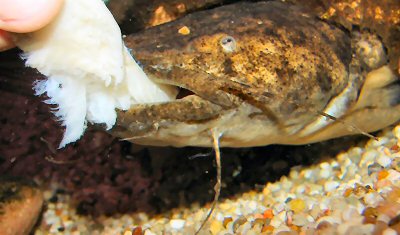
C. fowleri snapping at a given piece of fish fillet
Growth
and final size: Its slower growth suggests a smaller final size than C. apurensis which obliges the keeper with the care of this species in the aquarium. The maximum length given at Fishbase for a C. fowleri male of 40.5 centimetres should be approximately correct. (Fishbase website, status of May 4th, 2008). If one compares the final lengths having been noted for the individual Cephalosilurus species then the impression is given, though, as if C. fowleri is the largest of the genus. So for male specimens of C. apurensis a final length of barely 29 centimetres is given (Fishbase website, status of May 4th, 2008). Actually this species might get the biggest with 60 to 75 centimetres. On various occasions in predatory fish forums specimens are showed of supposedly, C. fowleri, but on on closer examination turn out to be C. apurensis. Also the final size of over 70 centimetres ascribed to C. fowleri in some Japanese books could be explained also.
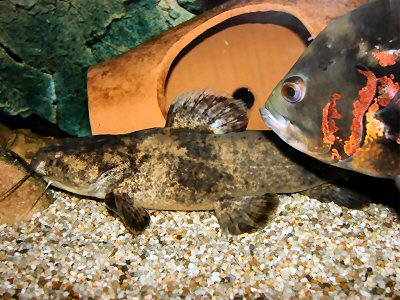
This species can safely be socialized with bigger cichlids
Socialisation:
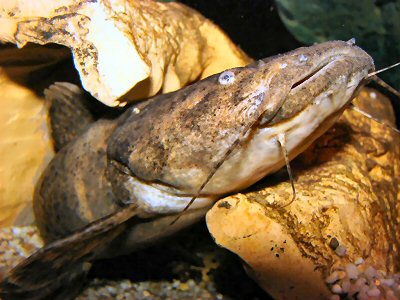
C. fowleri in lurking position – big specimens tend to dominant behaviour, which however is weaker than with C. apurensis and C. nigricaudus
With this aggressiveness it is important to distinguish strictly between the intra-species aggression and the aggression towards other fish species. With intra-species aggression C. fowleri behaves extremely aggressively and territorially. At the latest at night, even in a big tank, the strongest animal will have pressed its smaller comrade after a short time so that its death can only be prevented by moving to another tank. The same is valid if one is trying to socialize different Cephalosilurus species. After a short skirmish C. fowleri drove my C. apurensis back, which I had added as a trial, and which is not only a little bigger but seems also fundamentally stronger due to its bigger body mass. C. nigricaudus seems to surpass C. fowleri in aggressiveness, though. Towards other big fish species C. fowleri altogether acts peacefully, while C. apurensis and C. nigricaudus know how to keep everybody at a distance who approach their hiding places, by threatening gestures and if required, by biting. The territorial behaviour of C. fowleri is far less strongly pronounced. My C. fowleri fends off smaller L-catfish only when they want to tackle it, are too near or stay even in its cave. On the other hand this specimen also has marked its area after some time in which it tolerates certain, pre-dominantly staying in the upper half, co-inhabitants. Bottom dwellers however know to keep at bay primarily at night. Obviously it has already got accustomed to some Heros efasciatus since they have been living together along with it, I could never observe aggressions towards them. Of course the keeping of C. fowleri in adequate big tanks together with Potamotrygon species, with big Characins like the Red Pacu (Piaractus brachypomus) and also other predator catfish like Lophiosilurus alexandri which is also living in the Rio São Francisco, is conceivable. The keeper should avoid socialization with territory forming species though, because only a few centimetres more in the body length can suddenly lead to a radical change in the nature of C. fowleri. Presumably this change is connected with the beginning of sexual maturity and a behaviour which therefore is becoming more territorial. Primarily females then shall offer increased self-confidence and play the rulers over all co-habitants. For moving purposes it is helpful in such a case if the keeper can resort to a further tank if necessary. Differences
between the sexes: Summary: Editor update - December 2021: Cephalosilurus is now synonymized with Lophiosilurus so this species is now Lophiosilurus fowleri (Shibatta, Oscar A. et al, 2021) Literature:
This article came out in July 2008 (p. 3-7) in the German Online Aquarium-magazine (OAM) published by Sebastian Karkus. Mention must be
made also of our debt to Takafumi limura (Rayon
Vert Aqua corporation Japan
|
 mong
the representatives of this genus, Cephalosilurus
fowleri is regarded as having the worst reputation.
The information which pertains to this species so far
can be summarized in this way: Grows very big, extremely
aggressive, voracious and is also a very expensive acquisition,
but is this view well founded?
mong
the representatives of this genus, Cephalosilurus
fowleri is regarded as having the worst reputation.
The information which pertains to this species so far
can be summarized in this way: Grows very big, extremely
aggressive, voracious and is also a very expensive acquisition,
but is this view well founded?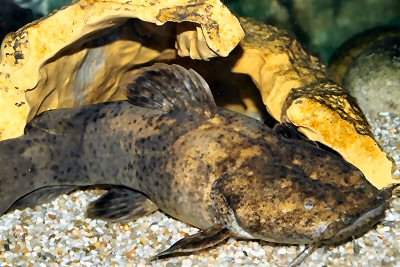


If you would like to contribute an article, please e-mail me. You will of course be credited for your work.
If you would like to donate any denomination of money to the site just click the above link button. All proceeds will go to running the site and hopefully to keep it going for a few years yet.
Print or e-mail this article below


