SCOTCAT.COM
your internet guide to all things catfish
| How Do You Solve a Problem Like Pangasius? |
by Daphne Layley |
Eventually, after several minutes, I began to get the gist of the problem. The small catfish which they had inherited with their secondhand 6 foot tank was now over eighteen inches long. It could hardly turn around, as the tank was only eighteen inches wide. It had developed the rather frightening habit of charging from one end of its aquarium to the other in a mad panic and ramming its head against the end pane of glass. Apparently, every few minutes there was a loud thwacking sound as the fish hit the glass, and its poor owner was terrified that it was either going to hurt itself badly, or break the glass and flood the living room floor, or both! I was told that it already had a large bulbous lump on the end of its snout, caused by repeated poundings.....
Pangasius sanitwongsei
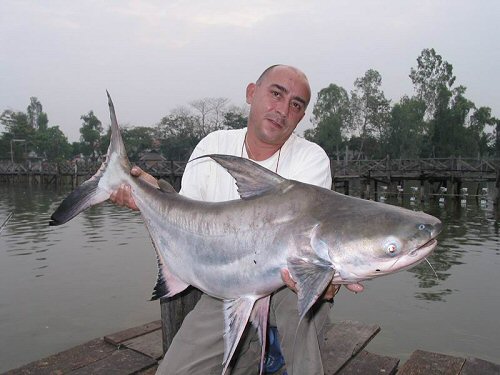
After a few questions, the identity of the catfish was established – a member of the Pangasius genus, I was not in the least surprised by this revelation – I’m afraid I’ve heard it many times before, but I was very concerned with the next bit of information that my in-depth questioning produced. As if it wasn’t bad enough that there was a large psychotic catfish needing a new home, I identified it as a Paroon Shark, Pangasius sanitwongsei, one of the five largest species of catfish in the world, with a maximum size of over nine feet. Its owners were very fond of it, and had tried to re-home it to caring homes many times but no one would take it. They had asked all the fish shops in their area – they had telephoned various zoos and Sea-Life Centres, but to no avail. They were desperate – could we help them? I was reminded of an incident in which I was involved a couple of months ago whilst browsing in a well known West London aquatic store. I noticed two aquariums, each containing a species of Asian catfish which I knew to be completely unsuitable for sale to the general public. Both species were members of the Pangasiidae family, Pangasius hypophthalmus, and Pangasius sanitwongsei. They were small specimens, 2 to 3 inches long, and were for sale for less than £7.00 each. P. hypophthalmus can attain a length of 52 inches (130cm), whilst P. sanitwongsei can easily be included in a short list of some of the world’s largest catfish, at a maximum length of 120 inches (300cm).There was no mention on either aquarium of the huge size which these fish can attain. In order to clarify the situation, and to ascertain whether or not the shop staff were aware of the complications that can arise when these potentially massive species outgrow their owners’ aquariums, I approached an assistant and asked him to accompany me to the relevant tanks. Once there, I indicated the two species in question, and asked him how large each would grow, and if they were suitable for a 24” community aquarium. He confidently assured me that the P. hypophthalmus would grow to 8 – 9 inches, and was therefore fine for my community tank, but that the P. sanitwongsei would grow to 18 – 20 inches, and would need slightly larger quarters.
I “respectfully” suggested to the manager that the staff should better acquaint themselves with the physical characteristics and requirements of the species on sale. Nowadays, some conscientious shops have a ‘No Big Fish’ policy, but there are many shops that are still happy to sell juveniles of species that soon grow far too huge for their tanks. Sometimes, it’s the fault of the customer for not asking “how big will it grow?”, but in the above case, I did ask all the right questions, and I was given all the wrong answers!. Of all the catfish that outgrow their aquariums, Pangasius species are the ones most often requiring re-homing to larger quarters, ranking more numerous than the Amazonian Red-tailed Catfish, Phractocephalus hemioliopterus, at a ratio of 2 to 1. What can be done to help these poor unfortunate fish whose only fault is that they grow too large for a small community tank? We need to convince retailers that it is not good business practice to sell these future tank-busters in the first instance, if only out of concern for the ultimate fate of the poor creatures. We also need to teach customers who insist on purchasing these tank-busting species that owning a pet is a huge responsibility and that it is encumbent upon potential buyers to acquaint themselves, before the purchase, with the maximum size that their desired pet could reach. Think of it this way - if the animal in question was warm-blooded, cuddly and covered in fur or feathers, it would be a criminal offence to house it in a cage so small that it couldn’t turn round! The RSPCA and the press would be involved – there would be a court case, a hefty fine and an order banning the guilty party from keeping such animals in the future. However, when the poor victim is cold-blooded, there are those who deem it acceptable. Obviously, some people think that only warm-blooded creatures suffer stress or pain – how wrong they are! Daphne
Layley
Images courtesy
& copyright of Jean-Francois Helias @
|
 s
I answered the first phone call of the day, I was blissfully
unaware of the drama being played out at the other end
of the line. The caller’s voice, that of a lady,
sounded at least an octave higher than normal and contained
a hint of hysteria. The stress vibes were so strong
that they were coming to me through the handset. I could
hear a man’s voice making ineffective calming
noises in the background.
s
I answered the first phone call of the day, I was blissfully
unaware of the drama being played out at the other end
of the line. The caller’s voice, that of a lady,
sounded at least an octave higher than normal and contained
a hint of hysteria. The stress vibes were so strong
that they were coming to me through the handset. I could
hear a man’s voice making ineffective calming
noises in the background. 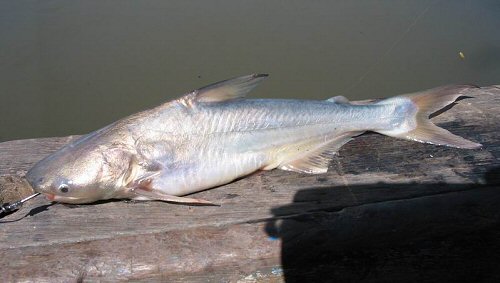


If you would like to contribute an article, please e-mail me. You will of course be credited for your work.
If you would like to donate any denomination of money to the site just click the above link button. All proceeds will go to running the site and hopefully to keep it going for a few years yet.
Print or e-mail this article below


