SCOTCAT.COM
your internet guide to all things catfish
| Breeding and fry development in Corydoras rabauti |
by Graham Ramsay |
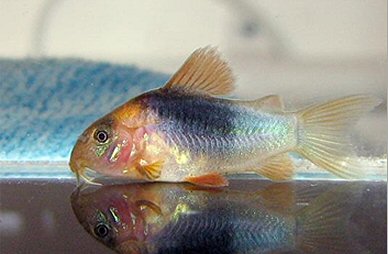
Osteogaster rabauti
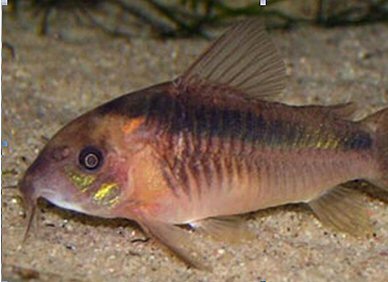
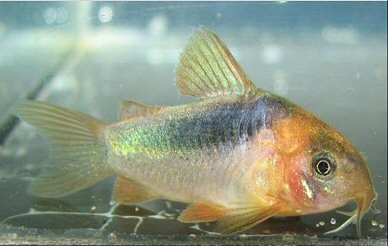
Osteogaster zygata
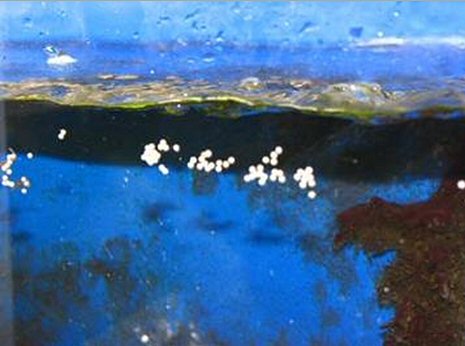
O. rabauti is a chunky fish with a rusty coloured body and fins. It has a matt green stripe running the length of its upper surface ending in a downward kink at the caudal peduncle. Fish in good condition are almost golden. O. zygata is slightly larger and more elongate. It has a pinkish-gray background colour and the green stripe has a slight metallic sheen and lacks the downward kink. Most individuals have little copper “eyebrows” which can be seen even in albino specimens. Adult O. zygata seem a little scruffy to my eyes, not something that can ever be said about O. rabauti. For breeding I used a group of large adult fish that I had been conditioning on live worms and daphnia for some time. These fish had spawned a couple of years before when about two hundred infertile eggs were laid just below the water surface and in an area of the tank that had a lot of water movement.
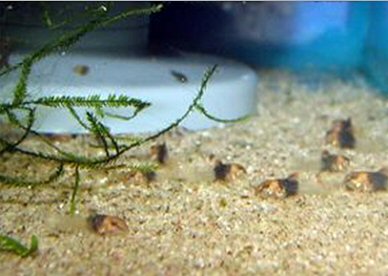
Infertile eggs laid just below surface
My group started to spawn again in the summer of 2009, usually the day after a water change, but once again the eggs were not viable. I had four females and a single male. This is not an ideal sex ratio (more males than females are recommended for corydoras breeding) and may well be the reason for such poor fertility. Eventually however from a spawn of around 200 I managed to collect around 50 eggs that showed promise. Tank parameters at this time were as follows: Tank size:
36” x 12” x 12”
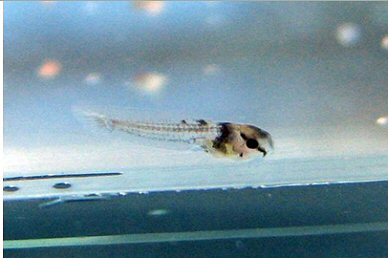
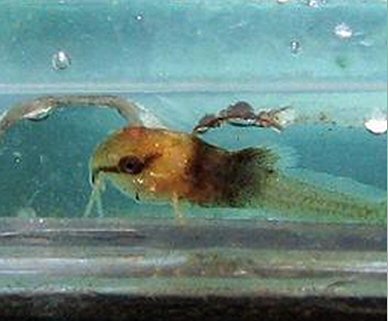
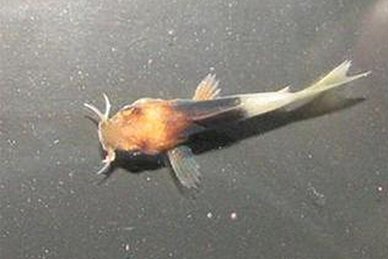
As before, eggs were laid in areas of extreme water movement. Often right on the filter outlet pipe or in the turbulent water where the current met the front glass. Another favoured area was on the air tubing entering the sponge filter. Some eggs were even placed above the water line in the splash zone caused by the air bubbles. I hatched out the eggs in a margarine tub with a little methylene blue and a vigorous air stone to prevent fungus. They took a little longer to hatch than I expected and some fry had still to emerge after a full week. When they did finally hatch they had already absorbed most of their yolk sack and a few had deformities of their spine. Some aquarists avoid the use of methylene blue and one of the reasons given is that it can harden the egg shells and prevent fry from breaking through and hatching. I don’t know if this is the case here as I’ve used it many times with no ill-effects but this was certainly unusual Although the adults of O. rabauti and O. zygata are similar, the fry could not be more different. O. zygata fry are cryptically coloured with a typical corydoras fry pattern of mottled brown spots and blotches. O. rabauti fry however have a fry pattern that has both surprised and delighted aquarists for many years and was the main reason why I wished to breed this species. The newly hatched fry showed hints of what was to come. A dark band neatly encircled the fry to the rear of their belly. Forward of this the head was beige with a neat diagonal eye stripe. To the rear of the band the body was transparent.
Newly hatched fry
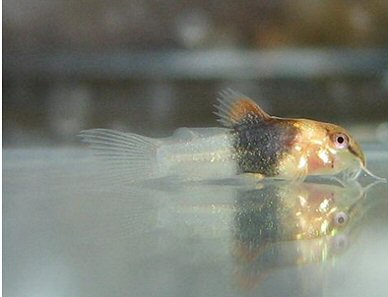
1 week old
The fry were fed the usual fare of micro worm and minute quantities of ZM100 fry food. Each day I changed half of the water with aged water of the same temperature. An apple snail was kept with the fry. This eats any uneaten food and prevents a build up of fungus on the plastic bottom which otherwise might damage or even kill the developing fry. After a week the young fish were starting to gain more colour. The middle band had widened and spilled onto the dorsal fin. The head was now golden-brown, still with an obvious diagonal eye-stripe. The rear of the fish was still largely transparent. I split the group and moved them into two tanks with other small Corydoras and shrimp. One tank was on the top shelf (warm) and the other was on the cooler bottom shelf. I went on holiday for a week and when I returned the fry in the warmer tank had not survived. Those in the cooler tank were fine and thriving. I now had a couple of dozen little gems.
Two weeks old
Two weeks old - group of fry
I started to feed newly hatched brine shrimp and pre-soaked crushed flake. Tetra Tabimin also proved to be a firm favourite as it is with all Corydoras/Osteogaster. The dorsal fin was now chocolate brown and the middle band had widened. The rear of the fish had started to turn a bluish-white. The barbels and fins were now almost fully developed with only slight webbing remaining between the caudal, adipose and dorsal fins. After about a month I noticed
a small number of fry had missing fins. I wasn’t
able to determine the cause of this but I offer
up some possibilities.
Four weeks old
Four weeks old – fins missing
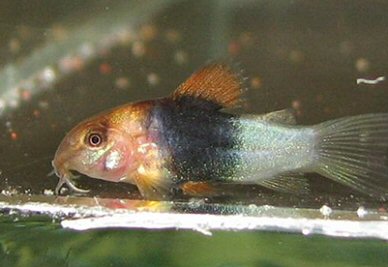
The pattern was now fully developed and can be seen in the accompanying photographs. Three distinct coloured bands from front to back – rusty brown, black and bluish white topped off with a chocolate dorsal fin. The eye stripe had faded by this time but was still just about visible. The chocolate coloured pelvic fins completed what was altogether a stunning little gem of a fish.
Six weeks old – portly little fellows
Two months old – still a handsome fish
From 6 weeks or so the fry pattern gradually faded and the familiar adult colours took their place. These little fish grow rapidly and by three months old were a sellable size. Osteogaster rabauti make a splendid breeding project for the intermediate or advanced fish breeder. Some patience and persistence is required to get the adults to spawn but the sight of a tank full of fry is payment in spades. The adults themselves are perfect community fish. All Image's by Author
Update: Placed in Lineage 7 alongside other members of the so called "aenea/us group" with the designated type species: C. eques. A revision in the future would constitute the resurrection of the genus name Osteogaster (Cope, 1871). As of the latest update Corydoras rabauti has now been placed in Lineage 7 and has the new genus name of Osteogaster (Dias et al. 2024). |
 steogaster
rabauti is a beautiful little catfish that is often
the subject of mistaken identity. Many pictures on the
internet are of another species (usually
steogaster
rabauti is a beautiful little catfish that is often
the subject of mistaken identity. Many pictures on the
internet are of another species (usually 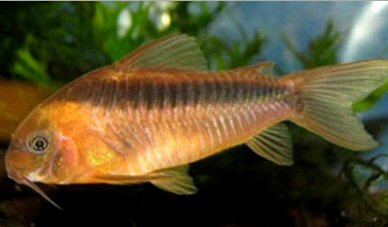

If you would like to contribute an article, please e-mail me. You will of course be credited for your work.
If you would like to donate any denomination of money to the site just click the above link button. All proceeds will go to running the site and hopefully to keep it going for a few years yet.
Print or e-mail this factsheet below


