SCOTCAT.COM
your internet guide to all things catfish
| An Internet Purchase with a Tragic Ending |
by Daphne Layley |
Being a total Dorad nutter, I was intrigued because the fish that we have all known as Platydoras costatus for decades, was renamed a couple of years ago and now goes by the name of Platydoras armatulus, and the true P. costatus is a very rare species in captivity. I looked closely at the slightly blurred image in the photograph and realised that it wasn’t either of those fish. It was, in fact, an Orinocodoras eigenmanni and at 8” to 10” it was quite a fish, probably well over maximum size.
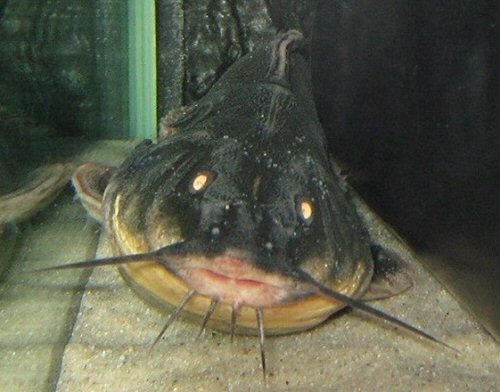
Orinocodoras eigenmanni
I contacted the seller for more information. I was in luck as he only lived 40 miles away and would be happy for me to collect it at the weekend. So I went through eBay’s “Buy It Now” process and the fish was mine. Because I wanted to have a quarantine tank ready, I phoned the seller again and asked what the water parameters were in the tank containing the fish, and he said that the pH was slightly below neutral, the water was fairly soft, and all the other readings were within acceptable tolerances. I was pleasantly surprised because I know that the tap water in his area is so hard that it can easily grow stalagmites. I assumed that he must have an RO unit, or at the very least, that he used rainwater........... I set off early round the M25 to miss the morning rush-hour and eventually arrived at a beautiful Victorian house in a tree-lined avenue in up-market commuter land. The aquarium in the living room was absolutely stunning – 5 foot x 2 foot with a solid oak stand complete with central wine rack and matching lid, obviously very expensive – the exact one that I’ll buy if I ever win the lottery! The tank was extremely brightly lit and the substrate was glaringly brilliant pure white sand, barely three-quarters of an inch deep. There was an internal filter in each back corner, an air stone and a small rock, nothing else - absolutely bare. The inhabitants were as follows: (please note – this list is a perfect example of what not to mix together in a community tank!) 1 x Motoro Stingray, 1 x Black Ghost Knife fish, 3 x hybrid Parrot Cichlids, 1 x Red-tailed Black Shark, 1 x very large (12” plus) plec, (Pterygoplichthys multiradiatus), 4 x Figure of Eight Puffer Fish (2”), 1 x small Corydoras, 6 x Black Neon Tetras, 1 x Siamese Fighter, 8 x red Discus (5” diameter), 1 x tiny L. No. (Acanthicus adonis), 1 x large Cyphotilapia frontosa cichlid, and (soon to be) my Orinocodoras. The seller (we’ll call him James to save any embarrassment) said that three of his best fish had died the previous night and he wondered what could possibly be wrong. The dead fish were: another red Discus, another Motoro Stingray and .............you won’t believe this ..........a large Arowana !!!!! The Cyphotilapia frontosa was hovering above the substrate in the centre of the tank, eyeing up the shoal of Black Neons (the numbers of which had surprisingly??? been dwindling!). The Knife fish, the RTB Shark and the tiny L. No. were trying frantically to squeeze behind one of the filters. The eight Discus were covered in mucus, (some more than others). One of the Puffers was covered in blobs of a white, jelly-like substance and was obviously dying. The Siamese Fighter’s fins were ripped to shreds and the remaining Stingray was trying desperately to bury itself in three-quarters of an inch of sand, as was my Orinocodoras, whose body was covered in mucus, to which a lot of sand was stuck, making the whole fish look completely white! I did a quick water test with some dip-strips. The pH was nearly 9, and the nitrite, nitrate, hardness and ammonia readings were so high that they were virtually off the scale! I’d never ever seen colours like them on a dip-strip before. I offered all the advice I could. I explained about RO units, over-feeding and everything else I could think of. An instant emergency water change was needed and we took James to his local fish shop and came back with all the RO water they had – good job we have a large estate car. AND THEN, and yes you’re not going to believe this either - James said that he’d ordered another EIGHT stingrays and they were coming next week.................... When Will They Ever Learn? My Orinocodoras is huge and was once probably a magnificent specimen. It is in solitary quarantine, and will be for some time! It seems grateful for a dark, quiet tank, a drainpipe to hide in and, of course, some water that’s fit to live in! Post Script: 8 days later – this catfish is now dead This gorgeous fish died 8 days after I got it, despite my best efforts to save it. It battled heroically but its fate was sealed before I even got it home and into my quarantine tank. The stress levels it was subjected to in its previous aquarium, both from the other inhabitants, the lack of shelter and, primarily, the toxic water conditions, must have been too much for its immune system to handle. The photographs were taken the day after I got it, 2 days before its skin started to erupt and it became plastered all over in the most disgusting thick, blood-streaked white matter. I did everything within my power to save it, but I failed. Its previous owner needs to learn the basics of fish keeping before he acquires any more fish. Apart from all the other uncomfortable aspects of this story, I feel very sad to think that this fish, which was obviously wild-caught, had survived all the rigors and trauma of capture, transport, plane journeys, wholesalers, etc., only to be killed by the ignorance of a novice and the lack of appropriate and timely advice from the retail trade.
Orinocodoras eigenmannii R I P Daphne Layley |
 ave
you ever bought fish on the internet? Well,
this weekend just gone, I saw an interesting item on
the eBay auction site. It read “8 to 10 inch Platydoras
costatus” and the seller even posted a photograph.
ave
you ever bought fish on the internet? Well,
this weekend just gone, I saw an interesting item on
the eBay auction site. It read “8 to 10 inch Platydoras
costatus” and the seller even posted a photograph.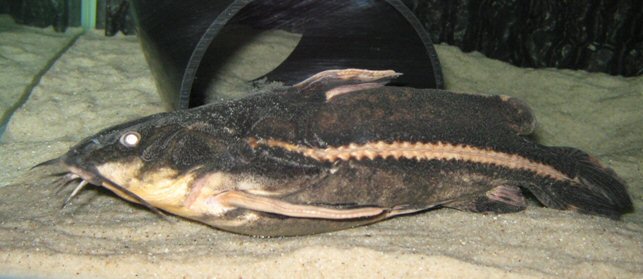

If you would like to contribute an article, please e-mail me. You will of course be credited for your work.
If you would like to donate any denomination of money to the site just click the above link button. All proceeds will go to running the site and hopefully to keep it going for a few years yet.
Print or e-mail this article below


