SCOTCAT.COM
your internet guide to all things catfish
| Breeding Corydoras xinguensis |
by Mark Bryson |
Hoplisoma xinguense - pair
Description: C. xinguensis are from the Rio Xingu Estado, Mato Grosso area of Brazil. Base colour grey, dark spots cover the body down below the level of the lateral line. Lower body and belly region plain grey. On close inspection spots can be seen on the dorsal and pectoral fin spines, caudal fin also has light spotting. Size 3.5 – 4cm. Breeding Tank & Maintenance: Tank 18"x 8"x 8" with a small glass trough 8"x 2"x 2" placed to one side of the tank. This contained silver sand and planted with Indian Fern. Filtration: Air-driven sponge plus box filter filled with ceramic rings and a small amount of coral gravel to stabilise the pH of 6.5. Feeding: I try to feed my fish at least twice daily with a good varied diet consisting of the following, Tetra Prima, frozen bloodworm/ black mosquito larvae and live grindal worms. Preparation
to Breed (Stage 1) Stage
2: Spawning: Fry: When the eggs hatch the fry are a grey ball with a tail, 2mm total length. Day 2 they were free swimming. Feeding for the first two days with diluted Liqufry, followed on day three with microworm culture. Very soon they were eating newly hatched brine shrimp, fed little and often. 50% water changes were carried out daily using water from the breeding tank. Five days old the fry were starting to develop some speckling across the face and head. Seven days old the spots were over the face and down their back, they now resembled Corydoras/Hoplisoma catfish. At this stage the fry were transferred from the 4" hatching tank to a 7" cube with a sponge filter. Also added in this tank a piece of weighted Indian Fern, this provided refuge for the fry. As they progress they will be moved to a larger tank. The original fry were removed from the parents tank, within ten days more fry, approximately two days old, were siphoned out by accident while doing a water change. Any further fry in the parents tank will be left there. These will be monitored as to their progress, comparing them with the 25 fry that were removed as either eggs or fry. Updated
January 2001 Reference:
Kristian Adolfsson “Dry and rainy season periods
in the tank” This article also written
for Paisley & District Aquarist Society, Allan
James at Scotcat www.scotcat.com &
Catfish
Study Group plus
Steve Miles at Catfish Corner
Update: Placed in Lineage 9, the "short-snouted" species with the designated type species: C. punctatus. A revision in the future would constitute the resurrection of the genus name Hoplisoma (Agassiz, 1846). As of the latest revision (Dias et al 2024) Corydoras xinguiensis has now been placed in Lineage 9 and has the new genus name of Hoplisoma and also a change to the specific name to xinguense. |
 fter
reading an article on the internet by Kristian Adolfsson
"Dry & Rainy Seasons Tank" I decided to
set up similar conditions in the hope of my wild caught
C. xinguensis (now Hoplisoma xinguense)
breeding. (3 males, 2 females).
fter
reading an article on the internet by Kristian Adolfsson
"Dry & Rainy Seasons Tank" I decided to
set up similar conditions in the hope of my wild caught
C. xinguensis (now Hoplisoma xinguense)
breeding. (3 males, 2 females).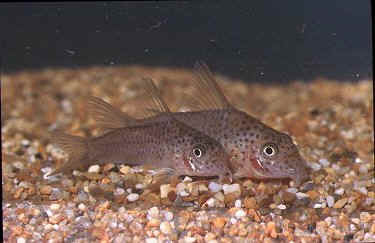


If you would like to contribute an article, please e-mail me. You will of course be credited for your work.
If you would like to donate any denomination of money to the site just click the above link button. All proceeds will go to running the site and hopefully to keep it going for a few years yet.
Print or e-mail this factsheet below


